
When we read the nativity stories in the Gospels of Matthew and Luke, the narrative is serene, miraculous, and deeply theological. But Christianity did not emerge in a quiet, spiritual vacuum. It was born into a highly literate, deeply skeptical, and fiercely competitive religious marketplace.
When early Christians began publicly circulating the claim that Jesus was born of a virgin (using the Greek word parthenos), their pagan and Jewish neighbors did not politely disagree. They launched a devastating, highly effective smear campaign. They took the central miracle of the Christian faith and weaponized it, claiming that Jesus was not the Son of God, but the illegitimate child of a Roman legionary.
The Anatomy of an Ancient Rumor
To understand how this rumor started, we have to look at the linguistics of ancient polemics. In the ancient Near East, theological debates were often fought through mockery and wordplay.
The Greek word for virgin is parthenos. Early critics, looking to humiliate the rapidly growing Christian movement, likely created a phonetic pun. They twisted parthenos into the culturally familiar Roman name Pantera (or Panthera).
The implication was brutal: Jesus wasn’t born of a parthenos; he was the bastard son of Pantera. This single linguistic twist transformed a divine miracle into a sordid, mundane scandal of a peasant woman seduced—or assaulted—by an occupying soldier.
Celsus and the Pagan Counter-Attack
We know exactly how this rumor was deployed because early Christian theologians spent decades trying to put out the fire.
The most famous written record of the Pantera claim comes from a 2nd-century pagan philosopher named Celsus. Around 175 CE, Celsus wrote a blistering attack on Christianity called The True Word. We only know what Celsus wrote because a few decades later, the Christian theologian Origen wrote a massive, multi-volume refutation called Contra Celsum (Against Celsus), quoting his opponent extensively in the process.
According to Origen, Celsus claimed he had spoken to a Jewish informant who revealed the “true” history of Jesus’s birth. Celsus wrote that Mary was a poor country woman who earned her living by spinning. When she became pregnant, her husband—a carpenter—convicted her of adultery and drove her out. Disgraced and wandering in secret, she gave birth to a son fathered by a Roman soldier named Panthera. Because the child was born in poverty and disgrace, he later went to Egypt to work as a day laborer, learned the ancient arts of Egyptian magic, and returned to Judea using these magic tricks to declare himself a god.
It is a masterpiece of ancient character assassination. It takes every pillar of the Christian story—the carpenter, the virgin birth, the flight to Egypt, the miracles—and flips them into a narrative of shame, betrayal, and charlatanism.
The Rabbinic Echoes
The rumor was not confined to pagan philosophers. The name “Pantera” became a shorthand polemic in ancient religious discourse.
In early Jewish rabbinic literature, including the Tosefta and the Talmud, there are several references to a figure named Yeshu ben Pantera (Jesus, son of Pantera) or Yeshu ben Pandera. While dating these texts and proving they refer directly to the Jesus of the New Testament is a complex and highly debated task among historians, the general consensus is that these are polemical echoes of the exact same first-century rumor. To the critics, calling him “ben Pantera” was a way to completely dismiss his messianic claims before the debate even began.
The German Tombstone: Why the Myth Survives
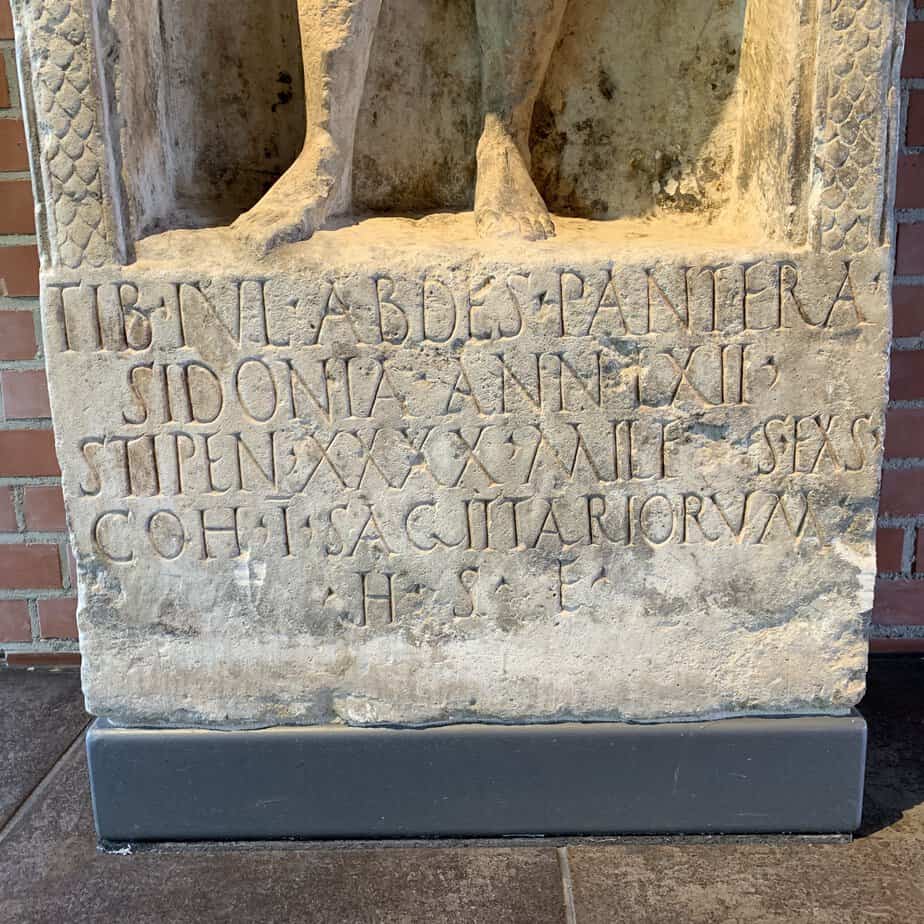
The Pantera rumor still surfaces today, often championed by modern skeptics looking for a “historical smoking gun” to debunk the nativity story. But the rumor received its greatest modern boost from a startling archaeological discovery in the 19th century.
In 1859, during railway construction in Bingerbrück, Germany, workers unearthed the gravestone of a Roman standard-bearer. The inscription read:
Tiberius Julius Abdes Pantera from Sidon, aged 62 years served 40 years, former standard bearer? lies here.
Historical records showed that Pantera’s cohort of archers had been stationed in the Levant (modern-day Syria and Judea) around the time of Jesus’s birth, before being transferred to the Rhine. Sensationalist historians seized upon the stone: Had they actually found the grave of Jesus’s biological father?
Historical consensus, however, firmly closes the door on this theory. While the timeline is a fun historical coincidence, “Pantera” (meaning panther) was a remarkably common cognomen in the Roman military. Finding a soldier named Pantera who served in the Levant is a bit like finding an American soldier named “Smith” who served in Europe during WWII. The Bingerbrück tombstone is a fascinating artifact, but it is not the father of Jesus; it simply proves that the name early critics chose for their rumor was highly plausible and culturally relevant.
Tearing Down the Domesticated History
While the Pantera rumor is almost certainly a malicious fiction—a pun created to mock the early church—it holds immense historical value. When we read the gospels devotionally, we tend to sanitize the history, imagining an early church that effortlessly spread a universally revered message. The Pantera story destroys that illusion. It grounds the early Christian movement in the gritty, hostile reality of the Roman Empire. It reminds us that the earliest followers of Jesus had to fight for their narrative in a world that was entirely willing to use brutal slander, linguistic mockery, and public shame to tear them down.
-
Beyond Abstinence: Defining the Architecture of Purity Culture
For many raised in late-20th-century evangelicalism, “abstinence” and “purity culture” are frequently treated as exact synonyms. However, while abstinence is a private historical ethical choice, purity culture is a modern, highly visible sociological construct. This article examines the architecture of the 1990s movement—from purity pledges to the courtship model—and explains why disentangling the ancient ethic from the modern subculture is the crucial first step in understanding its lasting psychological impact.
-
How Can Modern Churches Build Strong Communities Without Sacrificing Intellectual Honesty?
Can a church remain strong when its members question traditional interpretations of the Bible?Discover how shared values, meaningful relationships, and intellectual honesty can help modern Christian communities thrive without demanding agreement on every question.
-
A Voice from the Dust: How the Discovery of Ugarit Rewrote Biblical Scholarship
The accidental discovery of the ancient city of Ugarit in 1928 transformed biblical scholarship. Its texts provided crucial insights into Biblical Hebrew, uncovered the mythology of ancient Canaan, and revealed how Israelite religion developed within the wider cultural world of the ancient Near East.
-
Did Paul Believe Christians Go to Heaven? Paul’s Cosmos, Christology, and Hope of Resurrection
What did Paul think heaven was, who did he believe Jesus was, and what did he expect to happen after death? Explore Paul’s first-century Jewish apocalyptic worldview, his complex understanding of Jesus, and his expectation of bodily resurrection and the liberation of creation.
-
The Whistleblower in the Dirt: Unearthing the Socio-Economic Reality of the Talents
What’s the Parable of the Talents really about? Squadering your abilities or is there more? Let’s dig a little deeper.