
The World Behind the Text: Geopolitics, Commensality, and Textual Survival
The intense economic competition between the sibling states of the Iron Age Levant is clearly documented in both the archaeological record and the biblical text. The relationship between the Northern Kingdom of Israel and Moab during the 9th century BCE offers a perfect case study of this regional friction, uniquely corroborated by two independent sources: the biblical account in 2 Kings 3 and the extrabiblical Mesha Stele (c. 840 BCE).
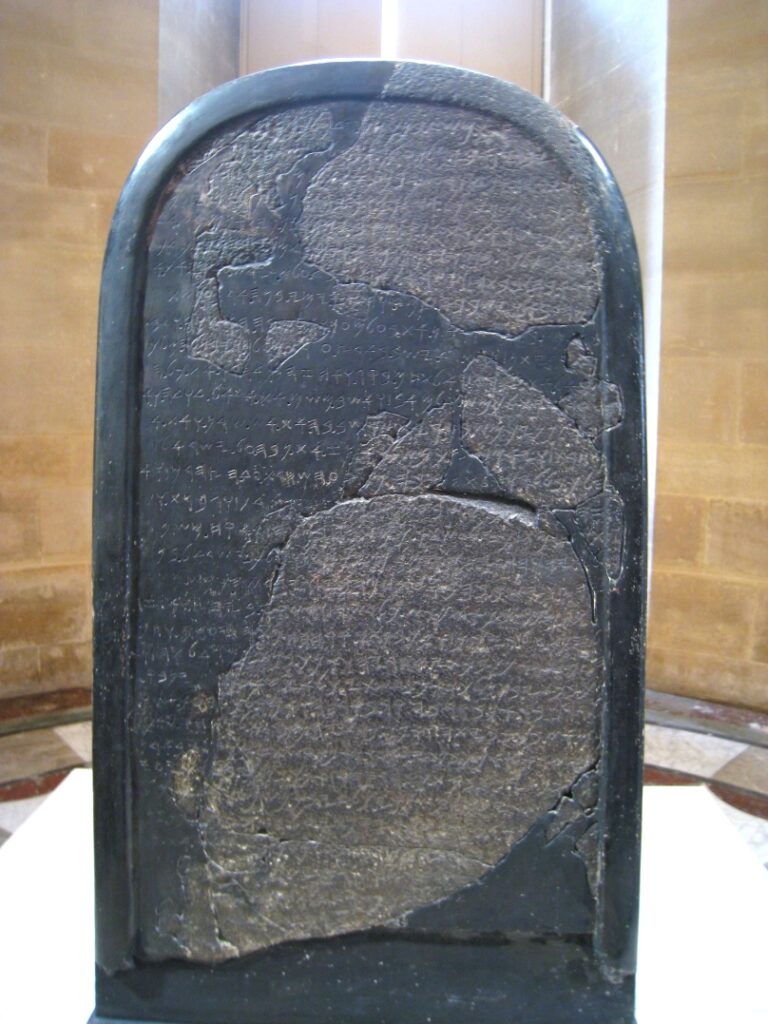
During the early 9th century BCE, Israel experienced a surge of centralization and military power under the Omride dynasty. In an effort to control the lucrative King’s Highway and siphon the pastoral wealth of the Transjordanian plateau, King Omri and his successor Ahab expanded eastward and subjugated Moab. The Israelite administration transformed Moab into a vassal state, demanding a massive annual tribute—described in 2 Kings as 100,000 lambs and the wool of 100,000 rams.
Following Ahab’s death, King Mesha of Moab capitalized on Israel’s geopolitical vulnerability and launched a successful war of liberation. The Mesha Stele records how the Moabite king defeated the occupying Israelite garrisons, recaptured territory, and freed his economy.
Crucially, the Mesha Stele demonstrates that these rival nations operated within a nearly identical theological framework. Mesha does not attribute his initial subjugation to Israel’s superior military strategy. Instead, he states that Omri oppressed Moab for “many days” because the Moabite national god, Chemosh, “was angry with his land.” When Mesha successfully liberated his territory, he attributed the victory entirely to the restored favor of Chemosh. Just as biblical writers attributed the political fortunes of Israel to the wrath or favor of Yahweh, Moabite scribes utilized the exact same theological rationale to explain their own geopolitical history.
Cultic Commensality and Redistribution
The religious practices of these states shared a common Northwest Semitic template, characterized by the veneration of a national patron deity (Yahweh in Israel, Chemosh in Moab, Milcom in Ammon, and Qos in Edom).
Historians and anthropologists increasingly view the sacrificial temple systems of these nations not exclusively through a theological lens, but as vital socioeconomic institutions. Alongside formal tributes and royal taxes, animal sacrifices functioned as a mechanism of redistribution. The administration of the cult enabled the priesthood and monarchy to centralize regional surpluses, legitimizing their authority. Furthermore, it facilitated communal meals. Because meat was a luxury rarely consumed in daily agrarian life, large state-sponsored sacrificial feasts were highly anticipated events. This ritual commensality—eating in the presence of the deity—helped bind the rural tribal populations to the centralized state apparatus.
Imperial Integration and the Judean Exception
The autonomy of these Iron Age kingdoms came to a violent end in the early 6th century BCE with the arrival of the Neo-Babylonian empire. Nebuchadnezzar II systematically dismantled the administrative and cultic centers of Judah, Moab, Ammon, and Philistia.
For most of these states, the loss of their monarchies and territorial sovereignty marked the beginning of their cultural assimilation. The distinct political identities of the Ammonites and Moabites gradually dissolved under successive waves of imperial domination, Arabization, and eventual Hellenization.
Edom experienced a more complex trajectory. Following the Babylonian deportation of the Judean elite in 586 BCE, Edomite populations migrated into the depopulated southern hill country of Judah (the Negev region), an area later known by the Greco-Roman designation Idumea. During the late 2nd century BCE, the expanding Hasmonean dynasty of Judea conquered Idumea and forcibly integrated its population into the Judean religious order. This assimilation culminated in the rise of Herod the Great, an Idumean (Edomite) who ruled as the Roman-appointed King of Judea. Following the Roman-Jewish wars of the 1st century CE, the Idumeans were fully assimilated into the broader Jewish population and ceased to exist as a separate ethnic entity.
Conversely, the Judean population that returned from the Babylonian exile experienced a highly unusual historical trajectory that ensured their survival. Contemporary historical research emphasizes how priestly scribes actively transformed older religious traditions into a comprehensive textual framework during and after the exile. By centering their identity on legal and cultic texts—rather than relying on a vulnerable physical king or a localized temple idol—the Judean priesthood successfully cultivated a portable identity. This monumental act of textualization enabled their religious and cultural framework to withstand the systemic collapses that ultimately caused all their sibling states to disappear from the historical record.
-
Beyond Abstinence: Defining the Architecture of Purity Culture
For many raised in late-20th-century evangelicalism, “abstinence” and “purity culture” are frequently treated as exact synonyms. However, while abstinence is a private historical ethical choice, purity culture is a modern, highly visible sociological construct. This article examines the architecture of the 1990s movement—from purity pledges to the courtship model—and explains why disentangling the ancient ethic from the modern subculture is the crucial first step in understanding its lasting psychological impact.
-
How Can Modern Churches Build Strong Communities Without Sacrificing Intellectual Honesty?
Can a church remain strong when its members question traditional interpretations of the Bible?Discover how shared values, meaningful relationships, and intellectual honesty can help modern Christian communities thrive without demanding agreement on every question.
-
A Voice from the Dust: How the Discovery of Ugarit Rewrote Biblical Scholarship
The accidental discovery of the ancient city of Ugarit in 1928 transformed biblical scholarship. Its texts provided crucial insights into Biblical Hebrew, uncovered the mythology of ancient Canaan, and revealed how Israelite religion developed within the wider cultural world of the ancient Near East.
-
Did Paul Believe Christians Go to Heaven? Paul’s Cosmos, Christology, and Hope of Resurrection
What did Paul think heaven was, who did he believe Jesus was, and what did he expect to happen after death? Explore Paul’s first-century Jewish apocalyptic worldview, his complex understanding of Jesus, and his expectation of bodily resurrection and the liberation of creation.
-
The Whistleblower in the Dirt: Unearthing the Socio-Economic Reality of the Talents
What’s the Parable of the Talents really about? Squadering your abilities or is there more? Let’s dig a little deeper.