
The Queen, the Storm, and the Smear Campaign: Unearthing the Historical Jezebel
The name “Jezebel” is perhaps the most universally recognized shorthand for a wicked woman in Western literature. In the biblical narrative, she is the ultimate villain: a foreign temptress, a mass murderer of prophets, and an unrepentant idolater who eventually meets a gruesome end by being thrown from a window and devoured by dogs.
However, when we apply a historical-critical lens and strip away centuries of theological domestication and misogynistic caricature, a very different figure emerges. Historically, Jezebel was not a cartoonish supervillain. She was a formidable, highly educated ancient Near Eastern queen caught in a violent cultural and theological clash.
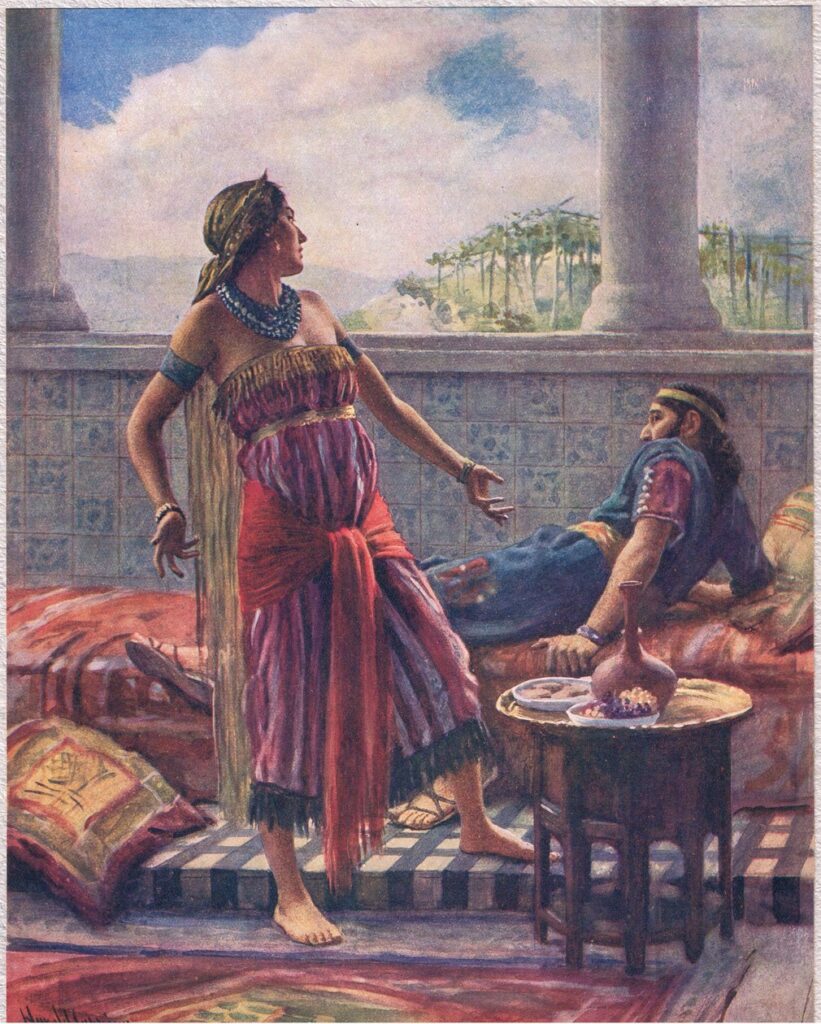
The Geopolitical Power Couple
To understand the historical Jezebel, we must look at the geopolitical landscape of the 9th century BCE.
At this time, the Northern Kingdom of Israel was significantly wealthier, larger, and more internationally connected than the smaller, more isolated Southern Kingdom of Judah (with its capital in Jerusalem). Under the Omride dynasty, King Ahab built a massive, centralized state. To secure Israel’s economic and military dominance, Ahab entered into a diplomatic marriage with Jezebel, the daughter of King Ethbaal of Tyre and Sidon (modern-day Lebanon).
This alliance was a geopolitical masterstroke. It united Israel’s lucrative overland trade routes and agricultural surplus with the massive maritime fleet and commercial empire of the Phoenicians. The alliance brought unprecedented wealth into the Israelite capital of Samaria, a prosperity evidenced today by archaeological discoveries like the famous “Samaria Ivories.”
A Clash of Political Cultures: Naboth’s Vineyard
Perhaps the most telling story about Jezebel’s historical reality is the incident of Naboth’s vineyard (1 Kings 21).
King Ahab wishes to buy a vineyard adjacent to his palace, but the owner, Naboth, refuses, citing ancient Israelite law that ancestral land cannot be permanently sold. Ahab, respecting this local tribal law, goes home sulking. Jezebel, however, is bewildered by his weakness. She allegedly demands, “Are you the king of Israel or not?” She then orchestrates a mock trial, has Naboth executed on false charges of blasphemy, and seizes the land.
While the biblical authors use this story to showcase her pure wickedness, historians see a profound clash of political paradigms. Jezebel was raised in Tyre, an absolute monarchy where the king’s word was the ultimate law. She simply could not comprehend the older Israelite tribal system, where customary peasant land rights could supersede the will of the monarch. She acted exactly as a typical ancient Near Eastern absolute ruler was trained to act—which proved fundamentally incompatible with traditional Israelite law.
The Battle for the Storm
The deepest friction, however, was religious. The biblical authors heavily condemn Jezebel for aggressively importing the worship of the Phoenician gods Baal and Asherah into Israel.
Historically, ancient Near Eastern diplomatic marriages always involved the incoming queen bringing her native cults to the new capital; it was standard practice for the king to build shrines for her deities. Jezebel promoted the worship of Baal-Melqart as a state-sponsored religion, financially supporting hundreds of his prophets.
It is crucial to note that the Israelite royal court did not abandon Yahweh. We know this because Ahab and Jezebel gave their children names that incorporated the name of Yahweh (e.g., Ahaziah and Jehoram). Rather, they practiced a form of state syncretism—worshipping Yahweh as the national god, while heavily patronizing Baal, the regional storm and fertility god, to satisfy their Phoenician allies and secure agricultural prosperity.
This royal syncretism deeply offended the rural, fiercely monolatrous prophets of Yahweh, most notably Elijah. The resulting conflict was not just a theological debate; it was a violent political rebellion by rural traditionalists against a cosmopolitan, internationally aligned royal court.
The Cosmic Takeover
The 9th-century crisis triggered by Jezebel’s court ultimately changed the nature of Yahweh forever.
In an agrarian society entirely dependent on seasonal rainfall, the god of the storm is the most important deity for daily survival. For the prophets of Yahweh to prove that Yahweh should be the only god of Israel, they had to prove he could do everything Baal could do. To defeat Baal, Yahwism systematically absorbed his cosmic resume.
We can see this active assimilation clearly preserved in the biblical text:
- The Mount Carmel Showdown: The famous contest in 1 Kings 18 is a highly specific theological attack on Baal’s core competencies. The contest is to see which god can send fire (lightning) and end a three-year drought (rain). Since Baal is the storm god, he should win this easily. When Yahweh sends the lightning and the rain instead, the text is making a radical claim: Yahweh, not Baal, controls the storm.
- Stolen Titles: Ancient Canaanite texts discovered at Ugarit reveal that one of Baal’s most famous titles was “Rider of the Clouds.” The biblical scribes deliberately co-opted this exact title for Yahweh (e.g., Psalm 68:4: “Sing praises to his name; lift up a song to him who rides upon the clouds”).
- Recycled Hymns: Many critical biblical scholars believe Psalm 29 was originally an ancient Canaanite hymn dedicated to Baal. The poem describes the “voice” (thunder) of the deity breaking the cedar trees of Lebanon and shaking the wilderness—a perfect description of a Levantine thunderstorm moving in from the Mediterranean Sea. The Israelite scribes likely took this culturally resonant hymn, crossed out the name “Baal,” and inserted “Yahweh.”
By the time the prophetic movement finished its work, the national warrior god of the southern deserts had completely absorbed Baal’s characteristics, evolving into the universal master of the storm, the rains, and the harvest.
Tearing Down the Caricature
Why is Jezebel’s biblical portrayal so uniquely vitriolic? The answer lies in who wrote her history.
The primary accounts of her life in the Books of Kings were compiled and edited centuries later by scribes in the Southern Kingdom of Judah (the “Deuteronomistic Historians”). These southern scribes had a distinct political agenda: they despised the Northern Kingdom, they demanded exclusive worship of Yahweh at the Jerusalem Temple, and they were deeply suspicious of foreign alliances.
Jezebel was the perfect target. By painting the most successful northern dynasty as the puppets of a wicked, foreign, Baal-worshipping woman, the Judean scribes effectively delegitimized the entire northern state. By the time the New Testament was written centuries later, her name had been weaponized entirely; in Revelation, the image of Jezebel is twisted to symbolize sexual immorality and heretic seduction.
When readers elevate the biblical text to the status of flawless, divine dictation—ignoring the messy, human, and deeply political history of rival scribes and regional conflicts—they create an idol out of the text itself. They replace the ancient idols of wood and stone with a Paper Calf.
When we apply a critical lens and tear down that Paper Calf, we are left not with a demonic caricature, but with a historically grounded, fiercely intelligent Phoenician princess. Jezebel played the brutal game of ancient Near Eastern politics exactly as she was taught—and her royal court inadvertently forced the ultimate theological evolution of the Hebrew Bible.
Leave a Reply
You must be logged in to post a comment.