
Unearthing the Storm God: The Historical Baal and the Ugaritic Texts
The name “Baal” is one of the most recognizable in ancient Near Eastern history, yet for millennia, it was understood almost exclusively through the polemical lens of the Hebrew Bible. To the biblical authors, Baal was the ultimate theological rival. However, historical and archaeological discoveries in the 20th century have allowed modern scholars to reconstruct the identity, worship, and mythology of this deity from the perspective of his own followers.
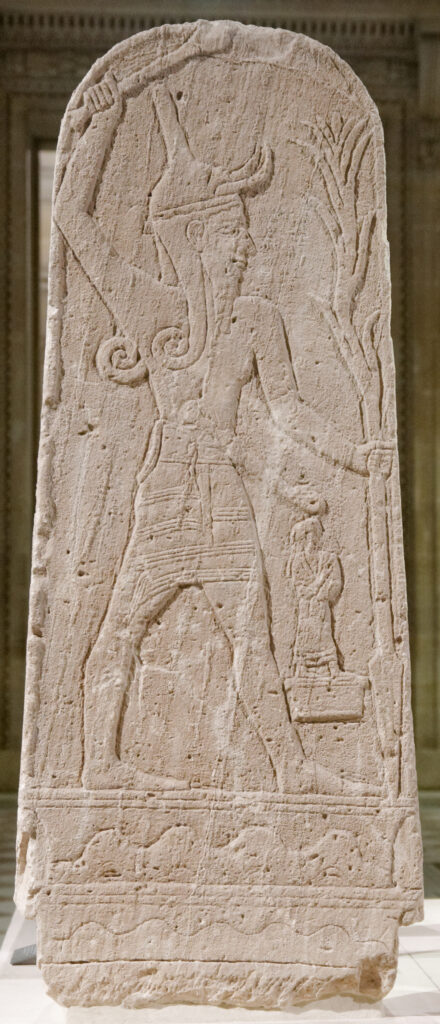
Historically and linguistically, the word ba’al is a common Northwest Semitic noun meaning “lord,” “master,” or “owner.” While it was sometimes used as an honorific for various local deities, by the second millennium BCE, it had become the primary title—and effectively the proper name—for the great Canaanite storm god, Hadad.
As a storm god, Baal was the bringer of rain, lightning, and thunder. In the agrarian societies of the ancient Levant, where survival depended entirely on unpredictable seasonal rainfall rather than river irrigation, the deity who controlled the rain controlled life itself.
The Turning Point: The Discovery at Ugarit
Our historical understanding of Baal was revolutionized in 1928 with the discovery of the ancient city of Ugarit (modern Ras Shamra in Syria). Excavations revealed a prosperous Late Bronze Age coastal kingdom that flourished until its destruction around 1200 BCE during the Bronze Age Collapse.
Among the ruins, archaeologists found archives of clay tablets written in an alphabetic cuneiform script. These texts, written in the Ugaritic language (a close linguistic relative of biblical Hebrew), provided a massive corpus of indigenous Canaanite literature, administrative records, and religious myths. The crown jewel of these discoveries is the Baal Cycle.
The Ugaritic Baal Cycle
The Baal Cycle is a collection of mythological narratives, originally inscribed on six major clay tablets dating to approximately the 14th century BCE. It details Baal’s rise to supremacy among the pantheon of gods (the divine council presided over by the aging chief god, El) and his ongoing struggles to maintain the cosmic and agricultural order.
The epic can be divided into three primary interconnected conflicts:
1. The Battle Against Yamm (Sea/Chaos)
The cycle begins with a succession crisis. The high god El favors Yamm, the god of the sea and chaotic waters, to rule over the other deities. Yamm demands heavy tribute and commands the gods to surrender Baal into his captivity. Armed with two magical maces crafted by the craftsman god Kothar-wa-Khasis, Baal engages Yamm in brutal combat. Baal defeats Yamm, establishing the fundamental ancient Near Eastern motif of the storm god subduing the chaotic, untamed ocean—a necessary step to establish order in the cosmos.
2. The Building of the Palace
Having established his dominance, Baal complains that, unlike the other gods, he lacks a royal palace. With the intercession of his fierce sister/consort Anat (a goddess of war and hunting) and the mother goddess Athirat, El grants permission for a palace to be built on Mount Zaphon (Baal’s sacred mountain). The completion of the palace solidifies Baal’s kingship and symbolizes the establishment of his earthly temple. Crucially, Baal insists that a window be installed in the palace, which serves as the conduit through which he sends his rains upon the earth.
3. The Conflict with Mot (Death/Underworld)
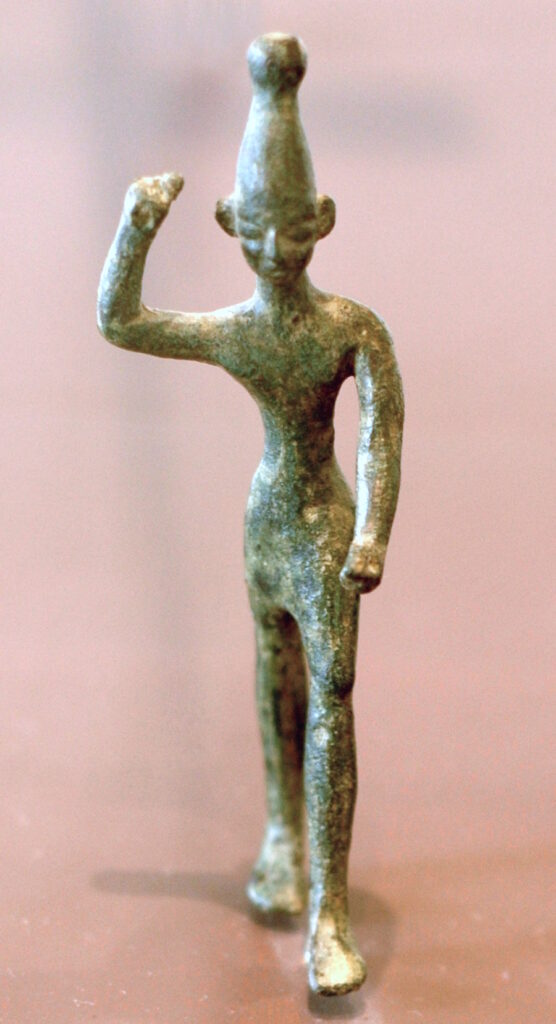
Baal’s supremacy is immediately challenged by Mot, the god of death, drought, and the underworld. Baal confidently challenges Mot, but Mot’s power is absolute, and Baal is swallowed whole, descending into the underworld.
With the storm god dead, the earth experiences severe drought and sterility. The goddess Anat mourns him violently, then tracks down Mot, defeating him in a visceral agricultural metaphor: she cleaves him with a sword, winnows him with a sieve, burns him, grinds him with millstones, and scatters his remains over the fields. Following Mot’s destruction, Baal is resurrected, and the rains return to the earth. However, the cycle acknowledges that Mot will eventually return, establishing the perpetual, cyclical nature of the seasons.
Historical and Theological Significance
The Baal Cycle is not simply an entertaining myth; it is a profound reflection of the existential anxieties of the ancient Canaanite people. It served as a theological explanation for the natural world:
- The Agricultural Cycle: The conflict between Baal and Mot perfectly mirrors the climate of the Levant, which experiences a wet, fertile winter (Baal’s reign) and a parched, dead summer (Mot’s reign).
- Order vs. Chaos: Baal’s defeat of Yamm represents the triumph of habitable, ordered creation over the destructive forces of the sea and floods.
- Cultic Function: The recitation of these myths likely tied into the ritual life of Ugarit, ensuring the return of the rains and the fertility of the crops through sympathetic magic and cultic devotion.
Historically, the Ugaritic texts prove that the worship of Baal was not a fringe, “idolatrous” cult of depravity, as framed by later rival traditions. Rather, it was a highly organized, complex, and deeply entrenched religious system designed to make sense of the harsh environmental realities of the ancient Mediterranean world.