The Ergatai: The Landless Laborers Behind the Parables
When we read the texts of the New Testament, the agricultural metaphors often feel quaint to modern ears: seeds falling on paths, masters hiring men in the marketplace, harvests waiting to be reaped. But in the first-century Roman Levant, these were not merely picturesque stories. They were sharp reflections of a severe socio-economic crisis.
At the center of this crisis was a rapidly expanding social class known in Greek as the ergatai.
Who Were the Ergatai?
In ancient Greek literature, an ergates (plural: ergatai) simply meant a worker or laborer. However, in the socio-economic context of first-century Galilee and Judea, the term took on a more specific and precarious meaning. The ergatai were landless day laborers.
In the ancient agrarian hierarchy, they occupied the absolute bottom rung of free society. In many ways, their daily existence was more vulnerable than that of a slave. While a slave was considered property and therefore represented an investment that a master had to house and feed, the day laborer had no such safety net. If an ergates did not find work in the marketplace by sunrise, his family did not eat that night.
The Making of a Landless Class
To understand how a society originally based on ancestral family farming (smallholdings) produced a massive class of landless laborers, we have to look at the mechanics of ancient debt.
The agrarian economy of the ancient Near East was highly volatile, dependent on unpredictable rainfall. When a peasant farmer experienced a bad harvest, he still had to feed his family and pay his taxes. To survive, he would take out a loan from a wealthy urban landowner or aristocrat, using his ancestral land as collateral.
With interest rates often exceedingly high, a few bad seasons would trigger a default. The wealthy creditor would foreclose on the land, adding it to his expanding estate. The peasant, now stripped of his property, was reduced to either a tenant farmer (paying rent to work the land he once owned) or evicted entirely, forced into the ranks of the wandering ergatai.
Why Did the Ergatai Multiply in the First Century?
The first century CE saw a drastic acceleration of this debt-and-foreclosure cycle, driven by several converging historical factors:
- Triple Taxation: A Galilean peasant under the Herodian dynasty faced an agonizing tax burden. They paid tribute to Rome, civil taxes to the local ruler (Herod Antipas), and religious tithes to the Temple establishment in Jerusalem. This relentless extraction stripped away any surplus the peasantry could save for famine years.
- Commercialization of Agriculture: Wealthy elites began shifting their large, consolidated estates away from subsistence crops (wheat and barley) toward cash crops destined for export (wine and olive oil). This required fewer year-round workers and more seasonal labor, perfectly utilizing the desperate ergatai during harvest time.
- Herodian Urbanization: Herod Antipas undertook massive building projects, including the construction of the capital city of Tiberias and the rebuilding of Sepphoris. These projects drew thousands of peasants away from the land for construction jobs. Once the cities were built, this massive workforce was left unemployed, swelling the numbers of day laborers looking for agricultural work.
The Social Fallout
The explosive growth of the ergatai created intense social friction. Traditional village structures, built on kinship and mutual support, broke down under the weight of systemic poverty.
The consolidation of wealth into the hands of a few urban elites while the rural population starved bred immense resentment. This environment became a fertile breeding ground for banditry (lestai). Many displaced peasants, seeing no survival in the daily marketplace, took to the hills to raid the caravans of the wealthy. This rising temperature of class conflict was a major underlying cause of the disastrous First Jewish-Roman War, which erupted a generation later in 66 CE.
The Historical Perspective of Jesus
When examining the historical Jesus through a critical lens, it becomes clear that his ministry was deeply entangled with the plight of the ergatai. His audience in the Galilean countryside consisted heavily of these displaced, economically crushed peasants.
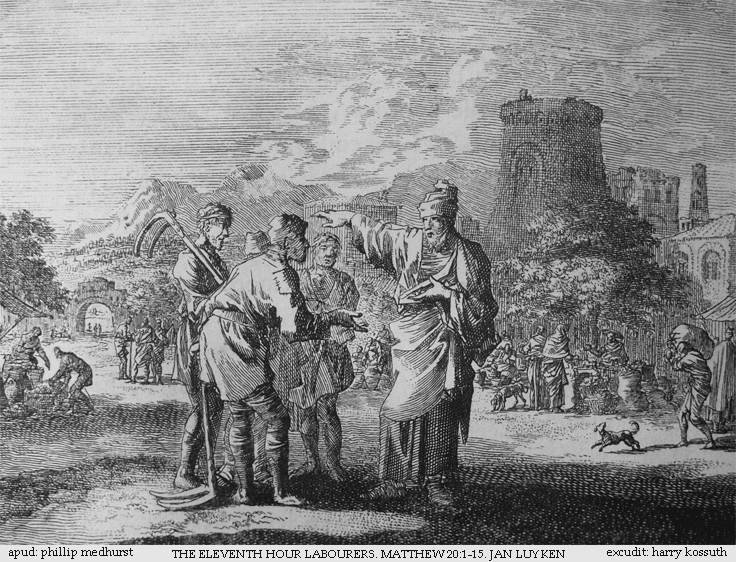
In the famous Parable of the Workers in the Vineyard (Matthew 20), the landowner hires men at dawn, but continues hiring idle men at the third, sixth, ninth, and even eleventh hours. While later theology spiritualized this as a story about the timing of salvation, the historical reality is starkly economic: the marketplace was flooded with unemployed ergatai desperate for a fraction of a day’s wage. When the landowner pays the last workers a full denarius (a standard day’s living wage), it is a striking subversion of economic norms—an assertion of radical social justice ensuring everyone has enough to survive the day.
Jesus’ pronouncements, such as “the worker (ergates) is worthy of his wages” (Luke 10:7) and his blistering critiques of those who devour widows’ houses (foreclosures), were not abstract moralizing. They were direct responses to the predatory economic engine that was systematically turning independent farmers into starving ergatai. For a class that had been structurally pushed off side, his message offered a profound reassertion of their inherent value.