
The archaeology of the biblical lands has changed dramatically over the past century and a half. In the nineteenth century, much of the work was driven by biblical geography: explorers attempted to identify places mentioned in the Bible and to connect modern landscapes with ancient narratives. By the early twentieth century, excavation had become increasingly systematic, and archaeologists began developing methods for establishing chronological sequences from the material remains themselves. By the later twentieth century, the relationship between archaeology and the Bible had become much more critical. Archaeologists increasingly treated the biblical texts as historical sources that required evaluation rather than as straightforward guides to what excavation ought to uncover.
Today, the archaeology of Israel, Palestine, Jordan, Lebanon, Syria, and the wider southern Levant is a multidisciplinary field. Excavation remains important, but archaeologists also use scientific dating methods and archaeometric techniques, including archaeobotany, zooarchaeology, geoarchaeology, archaeometallurgy, residue analysis, remote sensing, and, increasingly, ancient DNA. The central question is no longer simply whether archaeology can “prove the Bible.” Instead, researchers ask what material evidence can tell us about settlement, economy, environment, technology, warfare, political organization, religion, and everyday life in the ancient Near East—and how those findings relate to surviving textual traditions.
Antiquarian Beginnings and the Stratigraphic Revolution
The roots of modern archaeology in the Levant lie partly in nineteenth-century exploration. European and American travelers, missionaries, scholars, and surveyors increasingly attempted to identify biblical places and reconstruct the geography of ancient Palestine. Their interests were often religious, but their methods gradually became more systematic.
One of the most influential figures was the American biblical scholar Edward Robinson, who traveled through Ottoman Palestine in the 1830s. Robinson compared biblical geographical descriptions with the contemporary landscape and paid particular attention to Arabic place names that might preserve ancient toponyms. His work helped identify numerous ancient sites and established a model for combining textual evidence, historical geography, and direct observation. Robinson was not an excavator in the modern sense. His importance lies partly in helping establish the principle that the biblical landscape could be investigated empirically. Instead of treating geographical traditions simply as descriptions handed down by religious authorities, scholars could test them against roads, terrain, settlements, ruins, and local place names.
This interest in systematic exploration was institutionalized with the foundation of the Palestine Exploration Fund (PEF) in 1865. The PEF supported surveys, mapping, archaeological investigations, and other forms of research. One of the most important achievements of this period was the PEF’s Survey of Western Palestine, carried out in the 1870s by Charles William Wilson, Charles Warren, Claude Reignier Conder, Horatio Herbert Kitchener, and others. The survey produced detailed maps and recorded archaeological, geographical, and ethnographic information. Yet this was still archaeology strongly influenced by biblical geography, where researchers frequently approached the landscape with biblical questions already in mind.
From Treasure Hunting to Stratigraphy
Early excavations were often focused on spectacular architecture, inscriptions, tombs, and objects. What mattered was frequently the discovery of something that could be identified with a biblical person, place, or event. The development of stratigraphic archaeology fundamentally changed this approach.
A tell—a mound created by successive periods of human occupation—is essentially an archaeological archive created unintentionally by repeated habitation. Buildings collapse, are rebuilt, floors are raised, walls are modified, rubbish accumulates, and new structures are constructed over earlier ones. However, earlier deposits are generally beneath later deposits, but archaeological layers can be disturbed by pits, graves, rebuilding, erosion, animal activity, and later construction. Archaeologists therefore do not simply assume that everything deeper is automatically older; they reconstruct the site’s sequence from its stratigraphic relationships.
The British archaeologist Sir William Matthew Flinders Petrie played an important role in developing systematic archaeological methods to navigate this sequence. His 1890 excavation at Tell el-Hesi is particularly important in the history of archaeological chronology. Petrie recognized that pottery styles changed over time and that these changes could be used to establish relative chronological sequences. This was not yet absolute dating; Petrie could not assign a calendar year to an archaeological layer from its pottery. Instead, he could determine that one assemblage was earlier or later than another. By comparing pottery sequences between sites, archaeologists could gradually construct regional chronological frameworks. This technique, generally described as ceramic typology and seriation, became fundamental.
The Shift from Objects to Contexts
As stratigraphic methods improved, the discipline experienced a crucial conceptual shift: moving from prioritizing objects to prioritizing archaeological contexts. A single ceramic pot displayed on a museum shelf with no recorded origin holds limited historical value. However, that same pot sitting in a sealed destruction layer alongside grain silos and specific architectural features is immensely informative. The location, the stratigraphic layer, the association with other objects, and the relationship to the surrounding architecture can tell archaeologists exactly when and how the vessel was used. This emphasis on provenance and context meant that the material sequence itself could provide historical information, rather than merely serving as an illustration of a chronology derived from texts.
The Rise of the Albrightian Synthesis

During the first half of the twentieth century, archaeology in the biblical lands developed into what became known as “biblical archaeology.” The most influential figure in the American tradition was William Foxwell Albright. Albright helped establish an intellectual model in which archaeology, ancient languages, epigraphy, ceramics, and biblical texts could be integrated into a comprehensive historical reconstruction.
This “Albrightian” archaeology did not simply mean going around “trying to prove the Bible”—his approach was considerably more scholarly and sophisticated than that caricature suggests. Albright and his students possessed high confidence in the historical value of biblical traditions, integrating them deeply into their interpretations of the material record. The field was frequently organized around themes like the patriarchal period, the Exodus, the conquest of Canaan, and the emergence of the monarchy. This interdisciplinary ambition produced important archaeological discoveries and established professional standards that remain influential.
However, it also created a methodological problem: archaeological evidence could easily be interpreted according to expectations derived from the biblical narrative. A destruction layer could be interpreted as evidence for a biblical conquest if its date appeared compatible; conversely, the absence of such a layer became a problem requiring explanation.
Garstang, Kenyon, and the Methodological Lesson
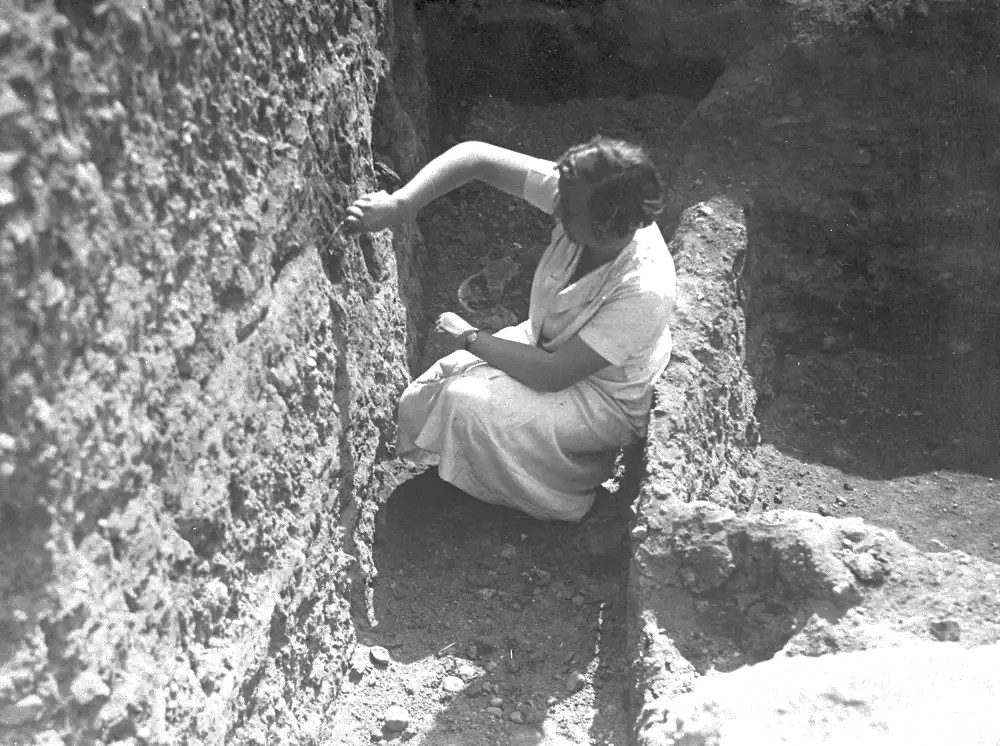
The tension between biblical expectations and archaeological context is perfectly illustrated by excavations at Jericho. Before Kathleen Kenyon, the most influential excavations at Jericho were directed by John Garstang between 1930 and 1936. Garstang identified substantial fortifications and a destruction layer, explicitly attempting to relate them to the biblical account of Joshua. His chronology became an important point of reference for scholars who regarded archaeology as capable of confirming the conquest narrative.
Following World War II, Kathleen Kenyon introduced the Wheeler-Kenyon method to Levantine archaeology. By dividing excavation areas into relatively narrow trenches separated by standing sections (balks), excavators could meticulously record the vertical sequence of deposits. Kenyon’s later excavations at Jericho demonstrated the importance of much more detailed stratigraphic control. Her work produced a substantially earlier date for the principal destruction traditionally associated with Joshua, breaking the link between the archaeological event and the biblical narrative. The disagreement between Garstang and Kenyon became an important historiographical sequence, demonstrating how different excavation methods and chronological assumptions could produce profoundly different historical conclusions.
Israeli Archaeology and the Minimalist/Maximalist Debate
The establishment of the State of Israel in 1948 gave archaeology an additional cultural and political dimension. Yigael Yadin directed major excavations at sites including Hazor and Masada, generating enormous public interest and making archaeology part of Israel’s national historical consciousness. The interpretation of Iron Age monumental architecture became particularly important. Large structures at sites such as Hazor, Megiddo, and Gezer were traditionally associated with the reigns of David and Solomon, serving as perceived physical evidence of a powerful United Monarchy.

However, from the 1970s onward, historical-critical approaches in biblical scholarship highlighted that the Bible was not a neutral archaeological field guide. This realization fueled a fierce intellectual controversy often described as the minimalist-maximalist debate. Scholars such as Thomas L. Thompson, Niels Peter Lemche, and Philip R. Davies questioned how much historical information could safely be extracted from the biblical narratives, especially concerning the patriarchs and the United Monarchy. On the other side, scholars such as William G. Dever criticized what he regarded as overly skeptical reconstructions. The actual methodological disagreement did not simply center on whether one “believed” the Bible, but rather concerned how much historical weight should be given to biblical texts and how that weight should interact with archaeological evidence. Dever became a prominent advocate for moving away from the term “biblical archaeology” entirely, arguing for an independent historical discipline concerned with the societies of the ancient Levant.
Rethinking Israel’s Origins and Epigraphic Anchors
The biblical book of Joshua presents a relatively coherent account in which the Israelites enter Canaan, conquer major cities, and establish themselves in the land. Archaeological research has complicated this picture. Excavations have not produced a simple archaeological signature corresponding to a single, rapid conquest of Canaan. Some sites show destruction; others do not.
The Material Evidence of the Highlands
Beginning particularly in the late twentieth century, archaeologists increasingly documented a massive demographic shift in the early Iron Age: hundreds of small settlements appeared or changed substantially in the central hill country. These were not monumental urban centers, but relatively small villages with distinctive architectural styles (like the four-room house) and subsistence patterns. There is notable continuity with aspects of Late Bronze Age Canaanite culture. Even dietary choices—such as specific pig consumption patterns—are frequently discussed, though they are increasingly viewed as nuanced socio-economic indicators rather than simple ethnic markers. The archaeological pattern does not map neatly onto Joshua’s conquest narrative. Consequently, one highly influential interpretation sees early Israel as emerging substantially from within the indigenous population of Canaan through a long and complex process of social transformation, rather than arriving as an entirely external population.
Epigraphy as a Historical Anchor
The integration of archaeology and epigraphy provides vital historical anchors in this complex picture. The Merneptah Stele, an Egyptian monument dated to the late 13th century BCE, is arguably the most critical early anchor. It contains the earliest widely accepted extrabiblical reference to a group called “Israel” in the southern Levant. This demonstrates what archaeology and epigraphy can do: establish that a group bearing a particular name existed at a particular time, without necessarily explaining everything about its origins.
Similarly, the Tel Dan Stele—discovered in northern Israel—contains an extrabiblical ninth-century BCE reference to the “House of David.” It provides an important example of how archaeology can illuminate biblical history without simply “proving the Bible.” The stele offers independent evidence for a Davidic dynasty, but it does not establish the biblical description of David’s kingdom in all its literary details.
The Mesha Stele provides a third excellent case study. Also dating to the ninth century BCE, it details the perspective of a Moabite king and references the Kingdom of Israel, its king Omri, and their regional political conflicts. Together, these inscriptions show readers what epigraphy actually contributes, demonstrating that archaeology can provide independent evidence for people, dynasties, or events mentioned in texts without validating the entire surrounding narrative.
The Debate over the United Monarchy and Radiocarbon Dating
The biblical texts portray David and Solomon as rulers of a substantial tenth-century BCE kingdom centered in Jerusalem. The debate over whether the material record demonstrates a centralized state of significant administrative complexity during this time became prominent through the work of Israel Finkelstein and Amihai Mazar.

Finkelstein’s “Low Chronology” proposed lowering the dates assigned to several Iron Age architectural assemblages. Structures previously attributed to the tenth-century BCE United Monarchy could, in his reconstruction, belong partly to the ninth century BCE, under the Omride dynasty. Mazar developed a “Modified Conventional Chronology,” arguing that while radiocarbon research requires some revisions, the evidence still permits significant state development in the tenth century BCE. Both scholars accept the existence of Iron Age Israelite and Judahite political entities; the disagreement concerns the dating, scale, and interpretation of particular archaeological assemblages.
Radiocarbon dating has become especially important in this debate. It is crucial to understand that radiocarbon does not date a building directly; it dates organic material (like seeds or olive pits) associated with an archaeological context. Furthermore, calibration is required to convert radiocarbon measurements into calendar-date ranges because atmospheric radiocarbon concentrations have varied over time. Radiocarbon dating has not simply “solved” Iron Age chronology. There have been substantial, ongoing debates over samples, Bayesian modeling, and the relationship between samples and archaeological strata, as seen in Mazar’s published collaborative work with radiocarbon expert Christopher Bronk Ramsey.
What Archaeology Can and Cannot Tell Us
Archaeology is powerful precisely because it can answer questions that texts cannot, but it also has clear limits. Excavation can establish that a settlement existed, that a building was constructed, that a city experienced a violent destruction, that crops were cultivated, or that particular goods were traded. It can sometimes establish dates and patterns of population change.
It is much harder to determine the identity, intentions, or beliefs of the people responsible for those remains. A destruction layer, for example, does not come with a label identifying its attackers. An archaeological city cannot normally be assigned to a biblical king simply because a biblical text says that king built there. Such conclusions require complex arguments based on chronology, inscriptions, material culture, historical context, and other converging lines of evidence. This distinction is fundamental to modern archaeology. The question is not simply whether archaeology confirms or contradicts a biblical story, but what the material evidence itself demonstrates, what it makes possible, and what remains uncertain.
The Multidisciplinary Present
Modern archaeology differs fundamentally from nineteenth-century exploration: an excavation involves specialists in geology, botany, zoology, chemistry, genetics, geography, climate science, and conservation. Independent chronological evidence, where applicable, is provided by techniques like radiocarbon dating, archaeomagnetic dating, luminescence methods, and isotope analysis. Archaeological interpretation increasingly seeks convergence among different forms of evidence.
This transformation does not mean biblical texts are irrelevant. Instead, it requires distinguishing between three distinct categories of evidence and analysis:
- Textual evidence: What ancient authors and communities wrote and transmitted.
- Material evidence: What physically survives from past human activity.
- Interpretation: The historical reconstruction created by carefully combining those sources.
Material and textual evidence operate differently. A text tells us what an author said; archaeology tells us what survives materially. Sometimes they illuminate one another, sometimes they disagree, and sometimes archaeology provides information for which the textual record has no equivalent. The ancient Levant was inhabited by farmers, merchants, soldiers, administrators, craftsmen, and slaves whose lives were considerably more complicated than surviving literary traditions suggest. Archaeology allows those societies to be studied not only through the stories later generations told about them, but through the physical traces they themselves left behind.
-
Beyond Abstinence: Defining the Architecture of Purity Culture
For many raised in late-20th-century evangelicalism, “abstinence” and “purity culture” are frequently treated as exact synonyms. However, while abstinence is a private historical ethical choice, purity culture is a modern, highly visible sociological construct. This article examines the architecture of the 1990s movement—from purity pledges to the courtship model—and explains why disentangling the ancient ethic from the modern subculture is the crucial first step in understanding its lasting psychological impact.
-
How Can Modern Churches Build Strong Communities Without Sacrificing Intellectual Honesty?
Can a church remain strong when its members question traditional interpretations of the Bible?Discover how shared values, meaningful relationships, and intellectual honesty can help modern Christian communities thrive without demanding agreement on every question.
-
A Voice from the Dust: How the Discovery of Ugarit Rewrote Biblical Scholarship
The accidental discovery of the ancient city of Ugarit in 1928 transformed biblical scholarship. Its texts provided crucial insights into Biblical Hebrew, uncovered the mythology of ancient Canaan, and revealed how Israelite religion developed within the wider cultural world of the ancient Near East.
-
Did Paul Believe Christians Go to Heaven? Paul’s Cosmos, Christology, and Hope of Resurrection
What did Paul think heaven was, who did he believe Jesus was, and what did he expect to happen after death? Explore Paul’s first-century Jewish apocalyptic worldview, his complex understanding of Jesus, and his expectation of bodily resurrection and the liberation of creation.
-
The Whistleblower in the Dirt: Unearthing the Socio-Economic Reality of the Talents
What’s the Parable of the Talents really about? Squadering your abilities or is there more? Let’s dig a little deeper.