
When reading the historical books of the Hebrew Bible, it is easy to default to the perspective of the biblical authors. In this framework, the Israelites’ victories are divine miracles, and their defeats are divine punishments. But what happens to our understanding of ancient history when we step across the Jordan River and read the exact same events recorded by their bitter enemies?
In 1868, an Alsatian medical missionary named Frederick Augustus Klein was exploring the ruins of ancient Dibon in modern-day Jordan when local Bedouin guides led him to a massive, three-foot-tall block of black basalt.
Known today as the Mesha Stele (or the Moabite Stone), this 9th-century BCE monument remains one of the most spectacular archaeological discoveries in Near Eastern history. It reads like a lost chapter of the Book of Kings—except the Israelites are framed as the oppressive villains, and the Moabites are the divinely appointed heroes.
The Near Destruction of an Archive
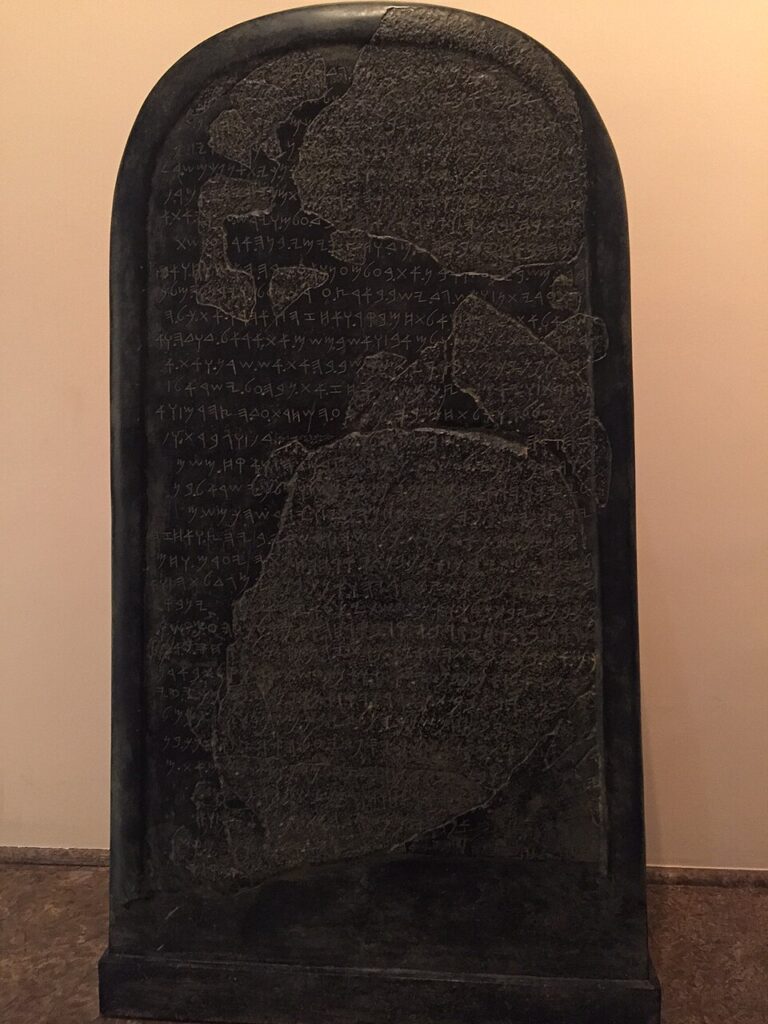
Before analyzing the text, it is worth acknowledging the chaotic reality of biblical archaeology. The Mesha Stele we have today is a reconstructed puzzle.
Shortly after Klein discovered it, intense bidding wars broke out between the Ottoman authorities and European diplomats from France, Britain, and Germany. Fearing that colonial powers would simply confiscate the stone without payment, the local Bedouin tribes decided to destroy it. They heated the massive basalt slab over a roaring fire and threw cold water over it, shattering the priceless artifact into dozens of pieces.
Fortunately, the French archaeologist Charles Clermont-Ganneau had anticipated trouble. He had previously dispatched an associate to the site to create a papier-mâché “squeeze”—a physical paper impression of the intact inscription. Using that fragile piece of paper, epigraphers were later able to track down the scattered fragments, reassemble them, and accurately translate the text. Today, the reconstructed stone sits in the Louvre Museum in Paris.
The Theology of the Enemy
The stele was carved around 840 BCE by King Mesha of Moab, a nation located directly east of the Dead Sea. It operates as a victory monument erected to commemorate Moab’s successful rebellion against the Kingdom of Israel.
What makes the stele fundamentally important to historians is not just the military timeline, but the theological framework Mesha uses to explain his victory. He employs the exact same theological logic as the biblical writers, merely swapping out the names of the deities.
In the biblical worldview, when Israel is defeated by foreign armies, the prophets declare it is because Yahweh was angry with his people. On the stele, King Mesha writes that Israel oppressed Moab for forty years because Chemosh (the national god of Moab) was angry with his land. When the geopolitical tide finally turns, Mesha writes that Chemosh spoke to him directly, commanding him to go to war, slaughter the Israelites, and drag the sacred vessels of their god before his altar. Mesha boasts: “I took the vessels of Yahweh, and I dragged them before Chemosh.” To historians, this line is a monumental anchor. It is the absolute earliest extra-biblical mention of the Israelite God, Yahweh, ever discovered in the archaeological record. Furthermore, it demonstrates that the Moabites and the Israelites viewed the cosmos in identical terms: wars were not just fought between mortal armies, but were physical manifestations of conflicts between rival gods.
Corroborating the Bible (And Spotting the Lie)
The scientific consensus recognizes the Mesha Stele as providing incredible independent corroboration for the geopolitical landscape described in the biblical text. In 2 Kings 3, the Bible acknowledges that Moab was a vassal state that paid a heavy tribute of sheep and wool to Israel, and that King Mesha rebelled following the death of the powerful Israelite King Ahab (son of Omri).
The stele confirms this reality perfectly. Mesha explicitly names the “King of Israel, Omri,” confirming the existence of the Omride dynasty and the immense, oppressive power of the Northern Kingdom.
However, King Mesha was not an objective historian; he was a politician erecting a monument. And like all ancient kings, he utilized propaganda.
Toward the end of the inscription, Mesha boasts about the utter devastation he brought upon the Israelite territories. He confidently declares to the world: “And Israel perished, it perished forever!”
This is a piece of blatant, glorious royal fiction. We know for an absolute historical fact that Israel had not perished forever. The Northern Kingdom of Israel would continue to exist, build massive cities, and fight wars for more than a century before finally being wiped out by the Assyrian Empire in 722 BCE.
Tearing Down the Monolith
When we read the Mesha Stele alongside the Hebrew Bible, we are forced to discard a sanitized, one-sided history. The Moabite Stone grounds the biblical text in the gritty, violent, and highly political reality of the ancient Near East.
It proves that the Israelites were not a mythological people; they were a heavily militarized kingdom capable of brutally oppressing their neighbors. It shows us that Israel’s enemies utilized the exact same theological language of divine wrath and holy war. And most importantly, it reminds us that whether a text is written on a sacred scroll or carved into black basalt, ancient history was always shaped by the political agendas of the victors.
-
Beyond Abstinence: Defining the Architecture of Purity Culture
For many raised in late-20th-century evangelicalism, “abstinence” and “purity culture” are frequently treated as exact synonyms. However, while abstinence is a private historical ethical choice, purity culture is a modern, highly visible sociological construct. This article examines the architecture of the 1990s movement—from purity pledges to the courtship model—and explains why disentangling the ancient ethic from the modern subculture is the crucial first step in understanding its lasting psychological impact.
-
How Can Modern Churches Build Strong Communities Without Sacrificing Intellectual Honesty?
Can a church remain strong when its members question traditional interpretations of the Bible?Discover how shared values, meaningful relationships, and intellectual honesty can help modern Christian communities thrive without demanding agreement on every question.
-
A Voice from the Dust: How the Discovery of Ugarit Rewrote Biblical Scholarship
The accidental discovery of the ancient city of Ugarit in 1928 transformed biblical scholarship. Its texts provided crucial insights into Biblical Hebrew, uncovered the mythology of ancient Canaan, and revealed how Israelite religion developed within the wider cultural world of the ancient Near East.
-
Did Paul Believe Christians Go to Heaven? Paul’s Cosmos, Christology, and Hope of Resurrection
What did Paul think heaven was, who did he believe Jesus was, and what did he expect to happen after death? Explore Paul’s first-century Jewish apocalyptic worldview, his complex understanding of Jesus, and his expectation of bodily resurrection and the liberation of creation.
-
The Whistleblower in the Dirt: Unearthing the Socio-Economic Reality of the Talents
What’s the Parable of the Talents really about? Squadering your abilities or is there more? Let’s dig a little deeper.