
If you play fantasy role-playing games, read medieval demonology, or watch modern supernatural thrillers, you have likely encountered Mammon. In pop culture and medieval folklore, Mammon is a terrifying figure: the literal Prince of Hell who rules over the sin of greed, a golden, grotesque arch-demon who tempts humans with earthly riches.
But if you search the ancient historical record for a pagan god or an ancient Babylonian demon named “Mammon,” you will not find one.
Unlike Satan, who evolved from a heavenly prosecutor, or the Messiah, who evolved from a political job title, the evolution of Mammon is the story of a massive, centuries-long linguistic misunderstanding. Mammon did not start out as a spiritual entity at all. He started out as a bank account.
Here is the historical evolution of how a perfectly mundane ancient word was accidentally transformed into a Prince of Hell.
Phase 1: The Mundane Bank Account (Ancient Aramaic)
In the ancient Near East, during the centuries leading up to the first century CE, the lingua franca of the region was Aramaic. In the Aramaic language, the word מָמוֹנָא (mamon or mamona) was incredibly common.
It was not a mystical or religious word. It was a financial one.
Mamon simply translated to “wealth,” “property,” “profit,” or “that in which one places their trust.” If you bought a piece of land, sold a flock of sheep, or counted the coins in your leather purse, you were dealing with mamon.
We see this exact usage in the ancient Jewish texts of the Second Temple period. In the Dead Sea Scrolls and the early Rabbinic writings (like the Mishnah), mamon is used strictly as a common noun. Rabbis would debate the legal rules regarding mamon (property damage or financial compensation). There was no dark, demonic connotation to it. It was just money.
Phase 2: The Rival Master (The First Century CE)
The catalyst for Mammon’s transformation from a noun into a monster occurs in the New Testament, specifically in the teachings of Jesus of Nazareth.
In the Gospel of Matthew (6:24) and the Gospel of Luke (16:13), Jesus delivers a famous, piercing proverb about the psychological weight of wealth:
“No one can serve two masters. Either you will hate the one and love the other, or you will be devoted to the one and despise the other. You cannot serve both God and Mammon.“
In the original Greek text of the New Testament, the author simply transliterated the Aramaic word into Greek letters (mamonas).
Modern historical-critical scholars note that Jesus was not revealing the existence of a new, rival god. He was using a brilliant rhetorical device called personification. By capitalizing wealth and framing it as an active “master” (kurios in Greek), Jesus was making a devastating psychological critique: Money is not neutral. If you are not careful, your property will eventually own you.
For the audiences of the first century, the meaning was crystal clear. Jesus was warning them against the idolatry of greed. But for later readers who did not speak Aramaic, that brilliant metaphor was about to be taken entirely literally.
Phase 3: The Birth of a Demon (The Middle Ages)
As the Christian church expanded into the Roman and European worlds in the centuries following the New Testament, knowledge of Aramaic completely faded.
When medieval European theologians read the Latin translation of the Gospels, they hit a linguistic wall. They saw Jesus comparing God to something called “Mammon.” Because early Christians were fiercely conditioned to view pagan gods and foreign idols as literal, geographical demons, they assumed that “Mammon” must be the proper name of a specific, rival deity.
The metaphor died, and the monster was born.
- Gregory of Nyssa (4th century) was one of the first major theologians to explicitly claim that Mammon was another name for Beelzebub or the Devil.
- Peter Lombard (12th century), a massive figure in medieval scholasticism, codified the idea that Mammon was the specific name of the demon who presided over the sin of avarice.
- Thomas Aquinas (13th century) cemented the concept by organizing the Seven Deadly Sins and assigning a specific ruling demon to each. Mammon officially became the patron demon of greed.
By the late Middle Ages, the translation error was absolute. The Church’s demonologists had drawn up complex hierarchies of Hell, and Mammon was firmly seated on a golden throne as one of the Seven Princes.
Phase 4: The Literary Monster (The Renaissance)
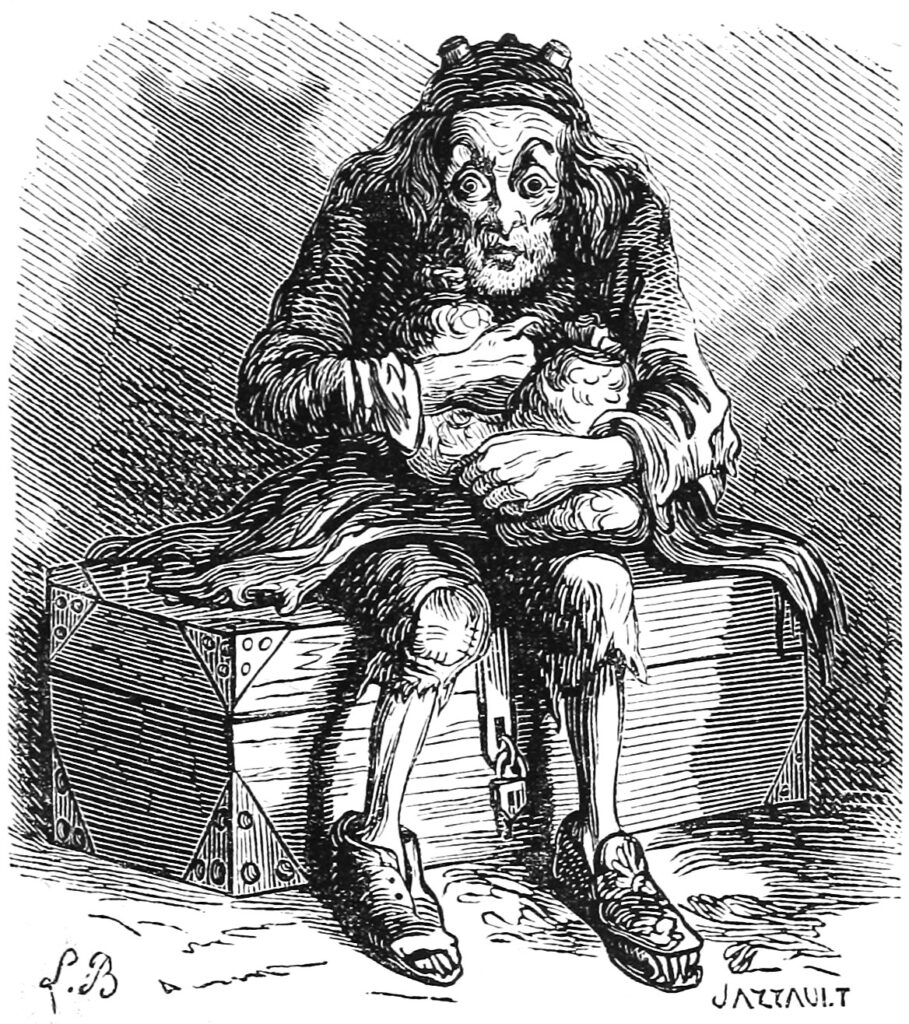
Once Mammon was officially recognized as a demon, literature and art fleshed out his terrifying biography.
The ultimate culmination of Mammon’s evolution occurred in 1667, when the English poet John Milton published his epic masterpiece, Paradise Lost. Milton gave Mammon a tragic, highly developed backstory.
In Milton’s telling, even before the angels rebelled and fell from Heaven, Mammon was uniquely flawed. While the other angels gazed upward at the glory of God, Mammon was obsessed with the floor: he constantly stared downward, admiring the golden pavement of Heaven’s streets. When Satan launched his cosmic rebellion, Mammon eagerly joined, arguing that it was better to build a wealthy empire in Hell than to serve a master in Heaven. Milton describes him as the architect of Pandemonium, the capital city of Hell, built out of gold mined from the underworld’s soil.
From a common Aramaic noun for “stuff,” Mammon had officially become an immortal fallen angel.
The Ultimate Irony
When historians and linguists trace the biography of Mammon, they uncover a fascinating and slightly tragic irony about human nature.
Jesus used the word mamon to force humans to take personal responsibility for their own greed. The metaphor was designed to highlight the dark, internal human inclination to hoard wealth at the expense of others.
But over the centuries, human beings did what we always do: we externalized the blame. By turning a common noun into a literal, supernatural demon, medieval society successfully shifted the guilt. It is much easier to say, “The demon Mammon tempted me,” than to admit, “I love my money more than my neighbor.”
-
Beyond Abstinence: Defining the Architecture of Purity Culture
For many raised in late-20th-century evangelicalism, “abstinence” and “purity culture” are frequently treated as exact synonyms. However, while abstinence is a private historical ethical choice, purity culture is a modern, highly visible sociological construct. This article examines the architecture of the 1990s movement—from purity pledges to the courtship model—and explains why disentangling the ancient ethic from the modern subculture is the crucial first step in understanding its lasting psychological impact.
-
How Can Modern Churches Build Strong Communities Without Sacrificing Intellectual Honesty?
Can a church remain strong when its members question traditional interpretations of the Bible?Discover how shared values, meaningful relationships, and intellectual honesty can help modern Christian communities thrive without demanding agreement on every question.
-
A Voice from the Dust: How the Discovery of Ugarit Rewrote Biblical Scholarship
The accidental discovery of the ancient city of Ugarit in 1928 transformed biblical scholarship. Its texts provided crucial insights into Biblical Hebrew, uncovered the mythology of ancient Canaan, and revealed how Israelite religion developed within the wider cultural world of the ancient Near East.
-
Did Paul Believe Christians Go to Heaven? Paul’s Cosmos, Christology, and Hope of Resurrection
What did Paul think heaven was, who did he believe Jesus was, and what did he expect to happen after death? Explore Paul’s first-century Jewish apocalyptic worldview, his complex understanding of Jesus, and his expectation of bodily resurrection and the liberation of creation.
-
The Whistleblower in the Dirt: Unearthing the Socio-Economic Reality of the Talents
What’s the Parable of the Talents really about? Squadering your abilities or is there more? Let’s dig a little deeper.