
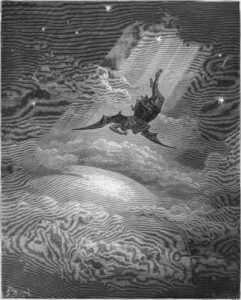
Of all the names associated with the Devil, Lucifer is arguably the most romanticized, tragic, and famous. In Western theology and pop culture, Lucifer is the ultimate anti-hero: the most beautiful, brilliant, and powerful archangel in Heaven who let his own radiant pride convince him he could overthrow God, resulting in his fiery banishment to Hell.
It is an incredibly compelling origin story. But for modern historical-critical scholars, there is a massive plot hole: Lucifer is not a person, an angel, or a demon in the Hebrew Bible. In fact, the word “Lucifer” isn’t even Hebrew. Much like Mammon and Beelzebub, the story of Lucifer is the story of a brilliant political metaphor that was stripped of its historical context, mistranslated into a different language, and ultimately weaponized as a cosmic myth.
Here is the historical evolution of how a dead Babylonian king was accidentally transformed into the Devil’s first name.
Phase 1: The Babylonian Taunt (The Hebrew Text)
To find the origin of the story, we have to look at Isaiah 14, written during the era of the Babylonian Exile. The prophet Isaiah is not writing a theological treatise about the spiritual realm; he is writing a vicious, highly political “taunt song” (a dirge) mocking a recently deceased human tyrant—specifically, the King of Babylon (likely Nebuchadnezzar or Nabonidus).
In Isaiah 14:12, the prophet uses a brilliant astronomical metaphor to mock the king’s massive ego and subsequent downfall. The original Hebrew text reads:
“How you have fallen from heaven, Helel ben Shahar!”
Helel ben Shahar translates literally to the “Shining One, Son of the Dawn.” In ancient Near Eastern astronomy, this was the standard title for the planet Venus (the Morning Star).
The metaphor is scientifically and poetically perfect. Venus is the brightest object in the morning sky. As the dawn approaches, Venus rises higher and higher, boldly appearing as though it is going to challenge the Sun for dominance of the sky. But the moment the Sun actually rises, Venus is instantly obliterated by the superior light and disappears.
Isaiah is looking at the King of Babylon and saying: You thought you were the morning star. You arrogantly tried to rise above the heavens, but the moment the true God showed up, you vanished into the dirt. It was a brilliant, grounded political insult.
Phase 2: The Translation Accident (The Latin Vulgate)
The transformation of this political insult began nearly a thousand years later, in the late 4th century CE. The Catholic scholar Jerome was tasked with translating the original Hebrew and Greek biblical texts into Latin to create the official Bible of the Roman Empire (the Vulgate).
When Jerome reached Isaiah 14:12, he had to translate the Hebrew phrase Helel ben Shahar (“morning star”) into Latin. The standard Latin word for the planet Venus at dawn was lucifer.
The word lucifer is a simple compound noun: lux (light) + ferre (to bring or bear). It literally means “light-bringer.”
So, Jerome translated the verse perfectly: “Quomodo cecidisti de caelo, lucifer, qui mane oriebaris?” (How you have fallen from heaven, morning star…).
To Jerome and the early Roman readers, lucifer was not capitalized. It was not a proper name. It was just the Latin word for a planet, used in a poem about a Babylonian king.
Phase 3: The Apocalyptic Copy-Paste (The Church Fathers)
If the text was just about a king, how did it become the backstory for Satan? The blame falls on early Christian theologians like Origen and Tertullian, who pioneered a highly allegorical method of reading the Bible.
In the New Testament, Jesus famously states in Luke 10:18, “I saw Satan fall like lightning from heaven.” Furthermore, the Book of Revelation (chapter 12) describes a cosmic war where a great dragon is hurled down to the earth.
When the early Church Fathers read the Latin translation of Isaiah 14—“How you have fallen from heaven, lucifer”—they experienced a theological lightbulb moment. They completely ignored the surrounding verses (which explicitly state the passage is about a human man who dies, gets eaten by maggots, and is buried in a grave) and isolated verse 12.
They concluded that Isaiah was not talking about Babylon at all; he was receiving a mystical vision of the exact same event Jesus mentioned in Luke. They merged the texts together. “Lucifer” was instantly stripped of its planetary meaning and retroactively crowned as the proper, angelic name of Satan before his catastrophic fall.
Phase 4: The Tragic Anti-Hero (Dante and Milton)
Once theology established Lucifer as a fallen archangel, literature took over and cemented his physical and psychological profile.
In the 14th century, Dante Alighieri placed Lucifer at the absolute bottom of Hell in his Inferno. But it was the English poet John Milton in 1667 who truly perfected the character in his epic masterpiece, Paradise Lost.
Milton gave Lucifer a voice, an ethos, and a deeply relatable psychological motivation. Milton’s Lucifer is not a grotesque monster; he is a breathtakingly beautiful, highly intelligent general fighting against what he perceives to be an absolute, tyrannical monarchy. It is Milton’s Lucifer who famously declares, “Better to reign in Hell, than serve in Heaven.” Milton’s brilliant, sympathetic portrayal permanently locked the modern image of Lucifer into place. He became the ultimate Romantic rebel—a symbol of enlightenment, tragic pride, and anti-authoritarianism.
The Bottom Line
When we trace the history of Lucifer, we uncover one of the most fascinating linguistic journeys in human history. The “Devil’s first name” did not originate in Hell, nor was it ever spoken in the Garden of Eden.
He began as a poetic Hebrew metaphor about a dead Babylonian king. That metaphor was accurately translated into a Latin word for a planet. That Latin word was subsequently stripped of its context by early theologians looking to solve a cosmic puzzle, and finally handed to poets who turned a linguistic accident into the greatest anti-hero in Western literature.
-
Beyond Abstinence: Defining the Architecture of Purity Culture
For many raised in late-20th-century evangelicalism, “abstinence” and “purity culture” are frequently treated as exact synonyms. However, while abstinence is a private historical ethical choice, purity culture is a modern, highly visible sociological construct. This article examines the architecture of the 1990s movement—from purity pledges to the courtship model—and explains why disentangling the ancient ethic from the modern subculture is the crucial first step in understanding its lasting psychological impact.
-
How Can Modern Churches Build Strong Communities Without Sacrificing Intellectual Honesty?
Can a church remain strong when its members question traditional interpretations of the Bible?Discover how shared values, meaningful relationships, and intellectual honesty can help modern Christian communities thrive without demanding agreement on every question.
-
A Voice from the Dust: How the Discovery of Ugarit Rewrote Biblical Scholarship
The accidental discovery of the ancient city of Ugarit in 1928 transformed biblical scholarship. Its texts provided crucial insights into Biblical Hebrew, uncovered the mythology of ancient Canaan, and revealed how Israelite religion developed within the wider cultural world of the ancient Near East.
-
Did Paul Believe Christians Go to Heaven? Paul’s Cosmos, Christology, and Hope of Resurrection
What did Paul think heaven was, who did he believe Jesus was, and what did he expect to happen after death? Explore Paul’s first-century Jewish apocalyptic worldview, his complex understanding of Jesus, and his expectation of bodily resurrection and the liberation of creation.
-
The Whistleblower in the Dirt: Unearthing the Socio-Economic Reality of the Talents
What’s the Parable of the Talents really about? Squadering your abilities or is there more? Let’s dig a little deeper.