
If you ask a modern person to describe Satan, they will paint a vivid, terrifying picture: a red, horned beast with a pitchfork, a fallen angel ruling over a fiery underworld, and the ultimate cosmic arch-nemesis of God.
But if you flip back to the earliest pages of the Hebrew Bible, this character is completely missing.
In modern historical-critical scholarship, Satan is not a static figure of eternal evil. Instead, “Satan” is a character who evolved over the course of a millennium. His transformation from a loyal heavenly civil servant into the ultimate cosmic rebel leader was driven by geopolitical shifts, foreign cultural influences, and a desperate theological need to solve a classic problem: If God is entirely good, where does evil come from?
Here is the evolutionary biography of the Devil, traced through the history of the ancient world.
Phase 1: The Heavenly Prosecutor (The Pre-Exilic Period)
In the oldest layers of the Hebrew Bible, “satan” is not a proper name. It is a common noun. The Hebrew root שָׂטָן (satan) simply means “adversary,” “accuser,” or “prosecutor.” In a military context, a satan was an earthly political enemy.
When the word was used in a spiritual context, it almost always appeared with the definite article: הַשָּׂטָן (ha-satan)—meaning “The Accuser.”
In books like Job (chapters 1–2) and Zechariah (chapter 3), ha-satan is a loyal member of God’s heavenly council (the bene elohim). He isn’t an evil rebel ruling Hell; he is a heavenly bureaucrat with a specific job description. He functions as the prosecuting attorney or the quality-control inspector for Yahweh.
In the Book of Job, ha-satan strolls into heaven after patrolling the earth. He doesn’t fight God; he strikes up a conversation with Him. When God brags about Job’s righteousness, The Accuser essentially says, “Of course he’s good, you’ve blessed him. Let me test him, and we’ll see if his faith holds up.” God grants him permission. Throughout the entire narrative, ha-satan cannot take a single action without Yahweh’s direct authorization. He is not God’s enemy—he is God’s instrument.
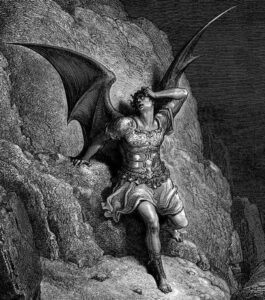
Phase 2: The Editorial Shift and the Problem of Evil
As Israelite theology moved away from an early form of polytheism toward a strict, radical monotheism, the scribes ran into a massive philosophical problem. If Yahweh is the only god in existence, then Yahweh must be the source of absolutely everything—both blessings and horrific tragedies.
The early texts were shockingly comfortable with this. In Isaiah 45:7, God explicitly states: “I form the light and create darkness, I bring prosperity and create disaster; I, the Lord, do all these things.” But as the centuries rolled on, attributing evil, cruelty, or moral lapses directly to God became deeply uncomfortable for the scribes. To protect the moral purity of Yahweh, the writers began to use the satan figure to deflect blame.
We can actually watch this editorial evolution happen on the page by comparing two biblical books that tell the exact same story centuries apart:
- The Old Version (2 Samuel 24:1 – Written pre-exile): “Again the anger of the Lord burned against Israel, and he incited David against them, saying, ‘Go and take a census of Israel and Judah.'” (In this ancient text, God gets angry and tricks David into sinning).
- The New Version (1 Chronicles 21:1 – Written post-exile): “Satan rose up against Israel and incited David to take a census of Israel.”
By the time the Chronicler rewrote the history in the 4th century BCE, the word satan had dropped its definite article. It was transforming from a job title (the accuser) into a proper noun (Satan), acting as a convenient theological buffer to protect God’s reputation.
Phase 3: The Persian Influence and Cosmic Dualism
The ultimate catalyst for Satan’s evolution occurred during the Babylonian Exile and the subsequent Persian period (6th–4th centuries BCE). During this era, the Jewish people lived under the cultural umbrella of the Persian Empire, whose dominant religion was Zoroastrianism.
Zoroastrianism was built on a fierce, absolute cosmic dualism. It taught that the universe was a giant battlefield between two massive, equal forces: Ahura Mazda (the god of absolute light and goodness) and Angra Mainyu (the independent spirit of absolute darkness and evil).
This cosmic battleground model deeply infected Jewish thought, especially during the chaotic Second Temple period. Writers of extra-biblical apocalyptic literature—such as the Book of Enoch, the Book of Jubilees, and the Dead Sea Scrolls—began to merge the old Hebrew concept of the heavenly satan with the Persian concept of an independent cosmic warlord.
During this era, Satan absorbed various names and mythological backgrounds:
- He became Mastema (the prince of animosity).
- He became Belial (the spirit of lawlessness).
- He was fused with Azazel (the wilderness demon) and Semyaza (the leader of the fallen angels who rebelled before the Great Flood).
By the 1st century BCE, Satan was no longer an employee in God’s court. He had been rewritten as a fallen, mutinous archangel who had launched a cosmic rebellion and successfully established an independent kingdom of darkness on earth.
Phase 4: The New Testament Fusion
When Christianity emerged in the first century CE, it fully inherited this highly evolved, apocalyptic version of Satan. The New Testament writers fused all of these disparate traditions into one definitive, ultimate villain.
In the Gospels, Satan is elevated to the “prince of this world.” He is powerful enough to offer Jesus all the kingdoms of the earth during the temptation in the wilderness.
It was also during this late period that Christian writers made a retrospective editorial move that forever changed how the world reads western literature: they fused Satan with the serpent of Genesis 3. In the original Old Testament text of Genesis, the serpent is never identified as Satan; it is simply described as the cleverest of the wild animals. But by the time the Book of Revelation was written at the end of the first century, the transformation was complete, explicitly condemning “that ancient serpent called the devil, or Satan, who leads the whole world astray” (Revelation 12:9).
Phase 5: The Rabbinic Cool-Down
While Christianity leaned heavily into cosmic dualism—framing human history as a battle between Jesus and the Devil—Rabbinic Judaism took a completely different path.
Fearing that giving Satan too much power would compromise the absolute unity and sovereignty of God (falling into the trap of Persian dualism), the ancient rabbis systematically cooled down the apocalyptic mythology.
In Rabbinic Judaism, Satan was stripped of his independent cosmic kingdom and returned to his original, subordinate status. In the Talmud, Satan is viewed not as an external monster ruling Hell, but as a psychological metaphor. The rabbis taught that Satan, the Angel of Death, and the yetzer hara (the internal human inclination toward evil) are all the exact same entity. Satan became the internal voice of human temptation, operating strictly under God’s ultimate control.
Summary: A Character Created by Crisis
When we trace the historical evolution of Satan, we realize that the Devil was not born in a vacuum. He was constructed over centuries to solve a vital psychological need. By transforming ha-satan from a loyal heavenly prosecutor into an independent agent of darkness, ancient communities successfully moved the origin of suffering, tragedy, and sin away from God. The Devil did not fall from heaven in an ancient cosmic war—he grew up slowly, brick by brick, alongside the history of the ancient world.
-
Beyond Abstinence: Defining the Architecture of Purity Culture
For many raised in late-20th-century evangelicalism, “abstinence” and “purity culture” are frequently treated as exact synonyms. However, while abstinence is a private historical ethical choice, purity culture is a modern, highly visible sociological construct. This article examines the architecture of the 1990s movement—from purity pledges to the courtship model—and explains why disentangling the ancient ethic from the modern subculture is the crucial first step in understanding its lasting psychological impact.
-
How Can Modern Churches Build Strong Communities Without Sacrificing Intellectual Honesty?
Can a church remain strong when its members question traditional interpretations of the Bible?Discover how shared values, meaningful relationships, and intellectual honesty can help modern Christian communities thrive without demanding agreement on every question.
-
A Voice from the Dust: How the Discovery of Ugarit Rewrote Biblical Scholarship
The accidental discovery of the ancient city of Ugarit in 1928 transformed biblical scholarship. Its texts provided crucial insights into Biblical Hebrew, uncovered the mythology of ancient Canaan, and revealed how Israelite religion developed within the wider cultural world of the ancient Near East.
-
Did Paul Believe Christians Go to Heaven? Paul’s Cosmos, Christology, and Hope of Resurrection
What did Paul think heaven was, who did he believe Jesus was, and what did he expect to happen after death? Explore Paul’s first-century Jewish apocalyptic worldview, his complex understanding of Jesus, and his expectation of bodily resurrection and the liberation of creation.
-
The Whistleblower in the Dirt: Unearthing the Socio-Economic Reality of the Talents
What’s the Parable of the Talents really about? Squadering your abilities or is there more? Let’s dig a little deeper.