
For most of modern history, the biblical King David presented a massive problem for archaeologists. According to the Hebrew Bible, David was the glorious warrior-poet who united the tribes of Israel, conquered Jerusalem, and established a sprawling, golden-age empire stretching across the Levant.
But outside the pages of the Bible, there was absolute silence. Up until the late 20th century, archaeologists had not found a single inscription, monument, or contemporary document mentioning a king named David. By the 1980s and early 1990s, a fierce academic movement known as “biblical minimalism” gained significant traction. These scholars argued that because there was zero extra-biblical evidence, David and his son Solomon were likely purely mythical figures—the ancient Judean equivalent of King Arthur, invented centuries later to give a fractured people a heroic origin story.
And then, in the summer of 1993, a shattered piece of basalt rock was pulled from the rubble in northern Israel, and the entire academic debate was turned upside down.
The Discovery at the Border
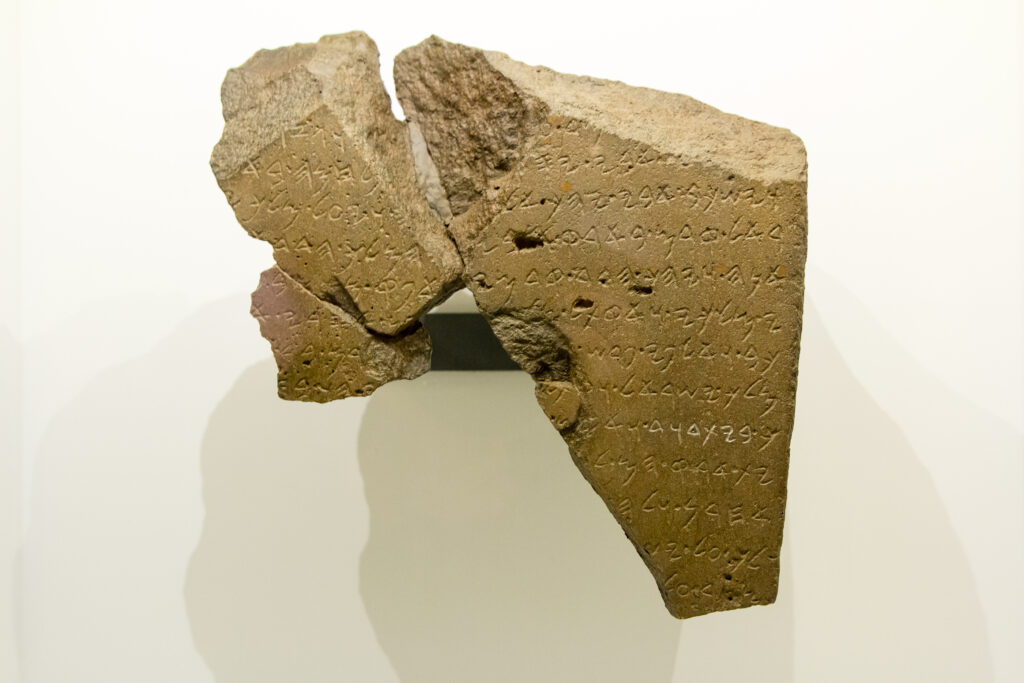
The discovery was made at Tel Dan, a massive archaeological mound located at the northernmost border of ancient Israel. Excavators, led by Israeli archaeologist Avraham Biran, were uncovering the ruins of an ancient plaza when a surveyor noticed something unusual on a stone that had been broken and reused as building material in a later wall.
Etched into the dark basalt were the clear, unmistakable letters of an ancient alphabet. Over the next year, more fragments were discovered, allowing epigraphers to piece together a sensational message.
The Tel Dan Stele, dating to the late 9th century BCE, was a victory monument written in Aramaic. It was not written by an Israelite, but by their bitter regional enemy: an Aramean king, almost certainly King Hazael of Damascus. In the inscription, the Aramean king boasts of a brutal military campaign, claiming to have killed thousands of charioteers and horsemen.
But the true earthquake was found in lines 7 and 8. The Aramean king boasts that he personally killed Jehoram, the “King of Israel,” and Ahaziah, the king of the “House of David” (Beit David).
The Death of Extreme Minimalism
The appearance of the phrase “House of David” sent shockwaves through the historical community. It was the very first time the name David had ever been found in an extra-biblical, ancient Near Eastern text.
The stele effectively killed the extreme minimalist argument. You cannot have a dynasty named the “House of David” unless there was a historical founder named David. Just as the Assyrians referred to the northern kingdom as the “House of Omri” (named after its powerful founder), the Arameans referred to the southern kingdom of Judah by the name of its dynastic patriarch. The Tel Dan Stele proved, definitively, that King David was not a mythical King Arthur. He was a flesh-and-blood historical monarch who established a ruling dynasty in Jerusalem.
Where to See the Stele Today
Because of its immense historical value, the Tel Dan Stele is carefully preserved and displayed for the public. It is permanently housed in the Archaeology Wing of the Israel Museum in Jerusalem. The fragments have been mounted together, allowing visitors to stand just inches away from the 3,000-year-old basalt stone and clearly see the white-highlighted Aramaic letters spelling out “House of David.” While it occasionally travels internationally on loan to other major institutions, Jerusalem remains its permanent home.
A Reality Check: Tearing Down the Paper Calf
However, while the Tel Dan Stele proves David existed, it is crucial to understand what it does not prove.
When sensational archaeological discoveries are made, biblical literalists often use them to prop up a “Paper Calf”—claiming that if David’s name is on a rock, then every single miraculous and imperial claim made about him in the Bible must be historically flawless.
But the stele does not prove that David slew Goliath, wrote the Psalms, or ruled a massive, wealthy, unified empire from the Euphrates to Egypt. In fact, modern archaeology in Jerusalem suggests that during David’s actual lifetime (the 10th century BCE), Judah was a relatively small, rural, and economically marginal highland chiefdom—nothing like the spectacular imperial capital described by the later biblical scribes.
Furthermore, the Tel Dan Stele directly contradicts the biblical narrative. In the Book of 2 Kings (Chapter 9), the Bible claims that the Israelite general Jehu was the one who assassinated King Jehoram and King Ahaziah in a violent, divinely ordained coup. But on the stele, the Aramean King Hazael claims he is the one who killed them. Once again, we see the messy reality of ancient history, where opposing kings and rival scribes spun the same bloody events to serve their own political and theological agendas.
The True Value of the Stone
The Tel Dan Stele is arguably one of the most important archaeological artifacts ever discovered in the Levant. It grounds the biblical text in the gritty, violent reality of the ancient Near East.
It teaches us that we do not have to choose between a completely mythical Bible and a flawlessly literal one. The truth is far more fascinating. Behind the inflated, golden-age theology of the later scribes lies a very real, historical warlord named David, whose legacy was so enduring that a century and a half later, the enemies of Judah still knew exactly whose house they were fighting.
-
Beyond Abstinence: Defining the Architecture of Purity Culture
For many raised in late-20th-century evangelicalism, “abstinence” and “purity culture” are frequently treated as exact synonyms. However, while abstinence is a private historical ethical choice, purity culture is a modern, highly visible sociological construct. This article examines the architecture of the 1990s movement—from purity pledges to the courtship model—and explains why disentangling the ancient ethic from the modern subculture is the crucial first step in understanding its lasting psychological impact.
-
How Can Modern Churches Build Strong Communities Without Sacrificing Intellectual Honesty?
Can a church remain strong when its members question traditional interpretations of the Bible?Discover how shared values, meaningful relationships, and intellectual honesty can help modern Christian communities thrive without demanding agreement on every question.
-
A Voice from the Dust: How the Discovery of Ugarit Rewrote Biblical Scholarship
The accidental discovery of the ancient city of Ugarit in 1928 transformed biblical scholarship. Its texts provided crucial insights into Biblical Hebrew, uncovered the mythology of ancient Canaan, and revealed how Israelite religion developed within the wider cultural world of the ancient Near East.
-
Did Paul Believe Christians Go to Heaven? Paul’s Cosmos, Christology, and Hope of Resurrection
What did Paul think heaven was, who did he believe Jesus was, and what did he expect to happen after death? Explore Paul’s first-century Jewish apocalyptic worldview, his complex understanding of Jesus, and his expectation of bodily resurrection and the liberation of creation.
-
The Whistleblower in the Dirt: Unearthing the Socio-Economic Reality of the Talents
What’s the Parable of the Talents really about? Squadering your abilities or is there more? Let’s dig a little deeper.