
The destruction of the First Temple in 586 BCE and the subsequent Babylonian exile represent the most significant theological bottleneck in biblical history. When Jewish exiles returned to rebuild the Temple in the late 6th century BCE, they did not simply reconstruct a building; they reinvented how Yahweh was worshipped.
To understand the sheer scale of this transformation, we must look at how the daily operations, the rituals, and the factions running the Temple evolved. The shift from the pre-exilic era (the First Temple period) to the post-exilic era (the Second Temple period) was a transition from a highly sensory, pluralistic royal cult to a centralized, text-driven theocracy.
The Sensory Reality of Pre-Exilic Worship
In the modern popular imagination, the First Temple was strictly dedicated to Yahweh, resembling a massive, quiet synagogue. Historical and archaeological evidence increasingly suggests a vastly different picture. If you walked into the temple precinct in the 8th century BCE, you would experience a noisy, smoky, open-air slaughterhouse mixed with a vibrant pantheon of visual symbols.
The later, post-exilic editors of the Hebrew Bible viewed this pluralism as idolatry, but their texts inadvertently preserve a detailed inventory of what early Israelite and Judahite worship actually entailed. Several distinct objects of veneration shared the sacred space alongside the altar of Yahweh:
- The Ark of the Covenant: Positioned in the innermost sanctum (the Holy of Holies), the Ark functioned conceptually as the footstool or the mobile throne of the invisible Yahweh, housing the covenant tablets.
- The Asherah: The biblical text explicitly states that for much of the First Temple period, an asherah stood right in the temple courtyard or sanctuary. This was a stylized wooden pole or a living sacred tree representing the goddess Asherah, widely viewed by many scholars as associated with Yahweh as a divine consort in early Israelite religion.
- Nehushtan (The Bronze Serpent): According to 2 Kings 18:4, Israelites burned incense to a bronze snake inside the temple. Attributed to Moses, this ancient object was likely the center of a healing cult, as serpents were strongly associated with magic and medicine in the ancient Near East.
- Solar Worship: 2 Kings 23 reveals that kings of Judah had dedicated horses and chariots to the sun god at the very entrance to the Temple, indicating that solar deities were incorporated into the state cult before King Josiah’s reforms.
A Diverse Workforce: Women, Weavers, and the “Consecrated Ones”
Operating this complex sanctuary required a highly diverse workforce. One of the most provocative verses detailing this reality is 2 Kings 23:7, which describes King Josiah tearing down the quarters of the “male shrine prostitutes” and the women who wove for Asherah within the temple precinct.
For decades, this verse fueled sensationalized ideas of temple orgies and fertility cults. However, modern historical-critical scholarship paints a very different picture:
- The Myth of Sacred Prostitution: The translation of “shrine prostitutes” is widely rejected by contemporary scholars. The Hebrew word used is qedeshim, which literally means “consecrated ones” or “holy ones.” Modern historians have thoroughly debunked the 19th-century myth of ancient Near Eastern “sacred prostitution.” Instead, scholars suggest the qedeshim were a specialized class of temple personnel—perhaps minor priests, musicians, or ecstatic diviners who performed rituals deemed illegitimate by later orthodox factions. The strict post-exilic editors of the biblical text likely used sexualized language as a smear tactic to delegitimize these rival religious groups.
- Women in the Temple Economy: The mention of women weaving for Asherah, conversely, provides a highly accurate glimpse into ancient temple economics. In the ancient Near East, deities were believed to inhabit their cult objects and required care, including clothing. The Jerusalem Temple housed a massive textile workshop where women wove elaborate ceremonial garments or tent-like pavilions for the Asherah pole. Historically, this proves that women held official, highly skilled, and respected institutional roles within the First Temple—a stark contrast to the post-exilic period, where the priesthood became far more exclusively male and women were structurally pushed to the margins of the complex.
The Prophets in the Temple Courts
While the personnel managed the altars and artifacts, another crucial group operated within the First Temple precinct: the prophets. In the pre-exilic period, prophets were not just solitary writers; they were highly active public figures.
There were essentially two types of prophets interacting with the Temple. Cultic prophets were officially employed by the state, delivering ecstatic oracles and divine affirmations during festivals alongside temple musicians. In contrast, independent prophets (like Isaiah and Jeremiah) frequently used the crowded temple courtyards as their stage. They stood at the temple gates during major festivals to deliver scathing critiques of the royal and priestly establishment, warning that Yahweh despised their rivers of sacrificial blood if it was not accompanied by social justice and care for the vulnerable.
The Priests: Blood, Smoke, and Bureaucracy
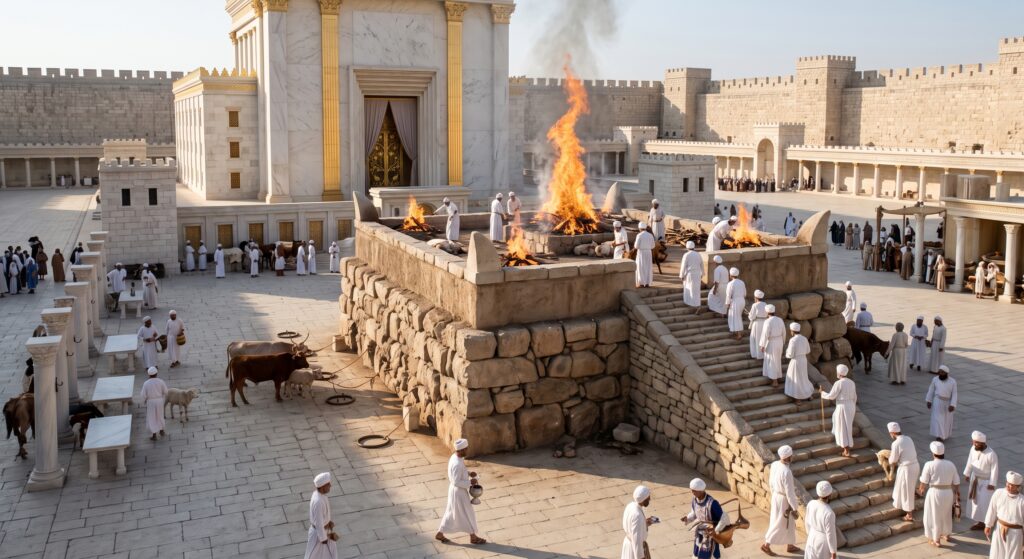
Animal sacrifice was the absolute core of ancient Near Eastern worship. The foundational ritual of the Temple was the Tamid (the “continual” offering). Every single day, without fail, the priests sacrificed an unblemished lamb at dawn and another at twilight. These were entirely burned on the great altar, accompanied by grain offerings and libations of wine.
Between these daily anchors, the courtyards were filled with Israelites bringing personal sacrifices, such as peace offerings (shelamim), where the fat was burned, but the meat was roasted and eaten by the worshipper’s family in a ritual feast. During major agricultural festivals like Passover, historians estimate that thousands of animals were processed. The logistics of blood drainage, butchery, and fire management were staggering.
For the vast majority of ordinary priests, temple service was not a full-time occupation. According to biblical tradition, the priesthood was divided into rotational courses. An average priest lived in his hometown, working as a farmer or artisan, traveling to Jerusalem to serve in the Temple for only two separate weeks out of the year, plus the pilgrimage festivals. Only the High Priest and senior administrators held permanent positions.
Beyond slaughtering animals, priestly duties were highly bureaucratic and medical. They managed the immense economic wealth of the temple treasury, which functioned as the national bank. They acted as public health inspectors, diagnosing skin diseases and structural rot in houses. They also utilized sacred divination objects (the Urim and Thummim) to seek yes-or-no answers from Yahweh on matters of state.
One of the most intimate priestly duties was the Priestly Blessing (the Aaronic Blessing: “May the Lord bless you and keep you…”). In 1979, archaeologists discovered the Ketef Hinnom silver scrolls—two tiny amulets dating to the 7th century BCE containing this exact formula. This proves that pre-exilic priests actively pronounced this blessing, likely raising their hands over the worshippers after the morning Tamid sacrifice to impart divine protection.
The Post-Exilic Shift: The Rise of the Theocracy
When the Second Temple was completed around 515 BCE, the monarchy was gone. Judah was now just a province of the Persian Empire. Without a Davidic king, the High Priest stepped into the power vacuum, transforming Judea into a theocracy centered entirely around the Temple.
Worship in the post-exilic Temple became highly standardized and strictly regulated by the newly compiled Torah. The diverse visual elements of the First Temple (the Asherah, the solar chariots, the bronze serpent) were entirely purged. Classical prophetic authority gradually declined, replaced by the study of texts.
The Temple was now dominated by the Zadokite Priesthood—an elite lineage that claimed exclusive rights to the altar, demoting other Levites to gatekeepers and musicians. While these aristocratic priests managed the sacrificial economy, rival groups of scribes and sages gathered in the outer courtyards to debate the law and compile wisdom literature. The Temple had evolved from a king’s pluralistic private chapel—managed by a diverse workforce of weavers, prophets, and priests—into the absolute, text-driven monopoly of Jewish religious and political life.
-
Beyond Abstinence: Defining the Architecture of Purity Culture
For many raised in late-20th-century evangelicalism, “abstinence” and “purity culture” are frequently treated as exact synonyms. However, while abstinence is a private historical ethical choice, purity culture is a modern, highly visible sociological construct. This article examines the architecture of the 1990s movement—from purity pledges to the courtship model—and explains why disentangling the ancient ethic from the modern subculture is the crucial first step in understanding its lasting psychological impact.
-
How Can Modern Churches Build Strong Communities Without Sacrificing Intellectual Honesty?
Can a church remain strong when its members question traditional interpretations of the Bible?Discover how shared values, meaningful relationships, and intellectual honesty can help modern Christian communities thrive without demanding agreement on every question.
-
A Voice from the Dust: How the Discovery of Ugarit Rewrote Biblical Scholarship
The accidental discovery of the ancient city of Ugarit in 1928 transformed biblical scholarship. Its texts provided crucial insights into Biblical Hebrew, uncovered the mythology of ancient Canaan, and revealed how Israelite religion developed within the wider cultural world of the ancient Near East.
-
Did Paul Believe Christians Go to Heaven? Paul’s Cosmos, Christology, and Hope of Resurrection
What did Paul think heaven was, who did he believe Jesus was, and what did he expect to happen after death? Explore Paul’s first-century Jewish apocalyptic worldview, his complex understanding of Jesus, and his expectation of bodily resurrection and the liberation of creation.
-
The Whistleblower in the Dirt: Unearthing the Socio-Economic Reality of the Talents
What’s the Parable of the Talents really about? Squadering your abilities or is there more? Let’s dig a little deeper.