
Amulets in the Dark: What the Silver Scrolls Actually Tell Us
When discussing the historical-critical dating of the Bible, a fascinating piece of archaeological evidence inevitably enters the conversation: the Ketef Hinnom scrolls. Discovered in 1979 in a burial cave southwest of the Old City of Jerusalem, these artifacts are frequently heralded as the ultimate proof of the Bible’s antiquity.
They are, in fact, the oldest surviving physical artifacts containing text found in the Hebrew Bible, predating the Dead Sea Scrolls by roughly four hundred years. But when we look at these artifacts through a historical and anthropological lens, rather than a dogmatic one, they reveal a story that is far more complex—and far more magical—than a simple confirmation of biblical inerrancy.
The Discovery in the Tomb
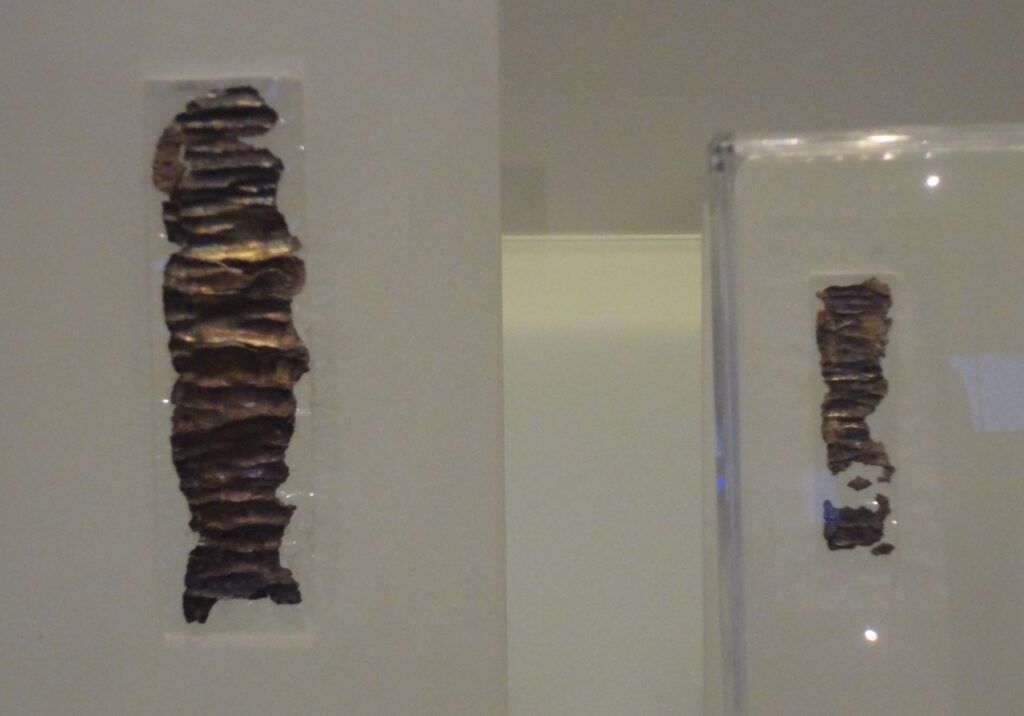
The discovery was made by archaeologist Gabriel Barkay during the excavation of a series of rock-hewn tombs dating back to the First Temple period. In one of the burial chambers, beneath the collapsed roof, archaeologists found a repository of bones and grave goods. Among the pottery and jewelry were two tiny, tightly rolled cylinders of pure silver.
Because the silver was incredibly brittle, it took experts at the Israel Museum three years to develop a method to unroll them without turning the ancient metal to dust. Once unrolled, the scrolls revealed faint inscriptions in Paleo-Hebrew script.
When translated, the text sent a shockwave through the academic world. The scrolls contained a variation of the Priestly Blessing, a liturgical formula found almost verbatim in the Book of Numbers (6:24-26):
“May Yahweh bless you and keep you; May Yahweh cause his face to shine upon you and grant you peace.”
Dating to the late 7th or early 6th century BCE—just prior to the Babylonian destruction of Jerusalem in 586 BCE—these tiny scrolls proved that at least this specific liturgical fragment existed and was actively used by the Judahite population before the Exile.
The Apologetic Leap
Within traditional, fundamentalist circles, the Ketef Hinnom scrolls are often weaponized against critical scholarship. The apologetic argument usually follows this logic: Because this fragment of the Book of Numbers existed in the 7th century BCE, it proves that the entire Pentateuch (the first five books of the Bible) was already written, compiled, and recognized as canonical scripture at that time.
From a historical-critical perspective, this is a massive and intellectually dishonest leap.
Finding a standardized liturgical prayer or a poetic blessing does not prove the existence of the surrounding narrative framework. Liturgy, poetry, and oral blessings are often the oldest strata of any religious tradition. They circulate independently in the culture long before editors and redactors weave them into a larger, comprehensive narrative (like the Book of Numbers). The silver scrolls prove that the Priestly Blessing is ancient; they do not prove that the Book of Numbers existed in the 7th century BCE.
The Theology of the Amulet
Perhaps the most fascinating aspect of the silver scrolls is not what was written on them, but how they were used.
These were not scrolls meant for reading in a synagogue or studying in a library. They were tiny—the larger of the two is only about an inch wide when unrolled. They were deliberately rolled up tightly, leaving a hollow center so a string could be passed through them.
They were amulets.
In the ancient Near East, the primary function of such an object was apotropaic—meaning it was designed to ward off evil, sickness, and demonic forces. The Judahite who wore this silver cylinder around their neck (and eventually took it to the grave) was not engaging in abstract theological reflection. They were engaging in a form of culturally accepted folk magic. By physically binding the divine name of Yahweh to their body, they believed they were invoking a protective force field against the chaotic elements of the ancient world.
A Living Religion, Not a Static Book
The Ketef Hinnom scrolls beautifully dismantle the “Paper Calf” by reminding us how the ancients actually interacted with their religion.
They did not worship a bound, inerrant book. Their religion was deeply tactile, protective, and embedded in the physical realities of survival. The use of Yahweh’s name on a silver amulet fits perfectly into the ancient Mediterranean landscape, existing comfortably alongside the syncretic practices of the time.
The silver scrolls do not prove that ancient Israelites were orthodox readers of a completed Bible. Instead, they provide a brilliant, intimate glimpse into the authentic, lived religion of 7th-century Judah: a world where divine blessings were inscribed on metal and worn in the dark to keep the terror of the world at bay.
Leave a Reply
You must be logged in to post a comment.