
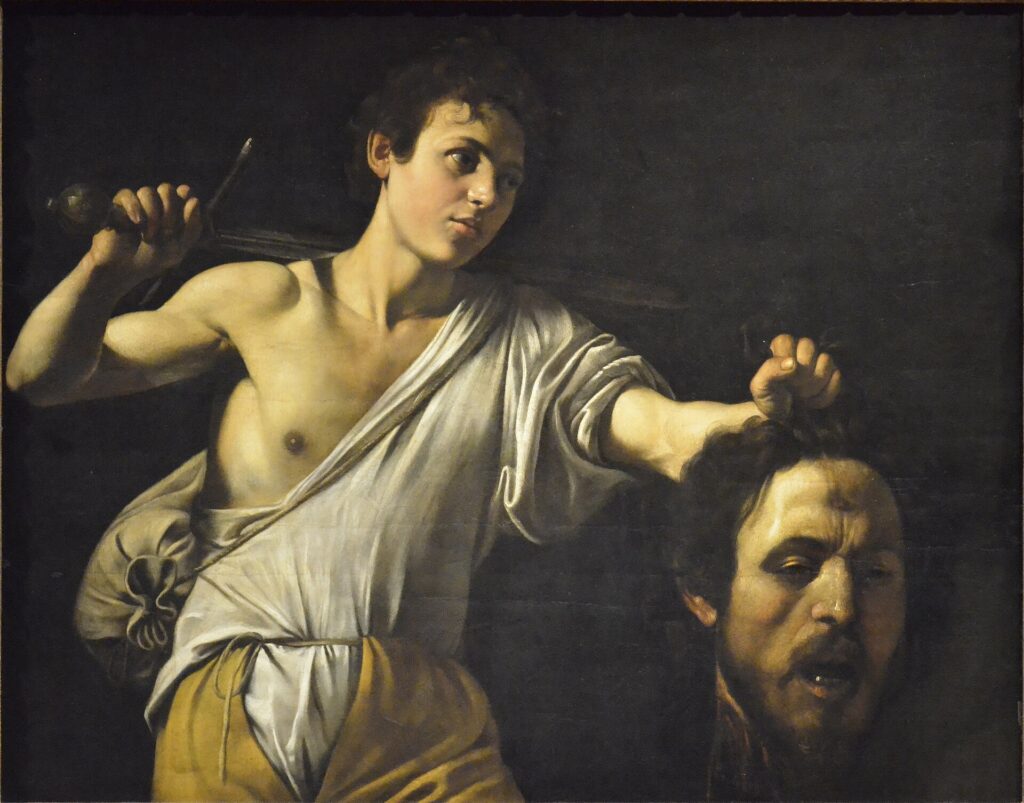
The story of David and Goliath is perhaps the most famous underdog narrative in human history. The image of the young, faithful shepherd boy stepping onto the battlefield with nothing but a sling and five smooth stones to fell the towering Philistine champion is deeply embedded in Western culture. According to 1 Samuel 17, this spectacular victory launched David’s career, transforming him from an obscure youth into a national hero and, eventually, the King of Israel.
But for biblical scholars and historians, the story presents a massive, glaring problem. If you turn a few pages deeper into the historical books of the Hebrew Bible, the text accidentally reveals a closely guarded secret: someone else killed Goliath.
By comparing the contradicting accounts within the Bible itself, we can uncover a fascinating story of ancient royal propaganda and see how the legendary feats of obscure soldiers were absorbed to build the mythos of a king.
The Second Assassin (2 Samuel 21)
To find the contradiction, we have to look near the very end of David’s reign, in the book of 2 Samuel. Chapter 21 contains a rather dry, historical list of various battles fought between David’s elite mercenaries and the Philistines.
Tucked into this list of military summaries is a shocking verse (2 Samuel 21:19):
“In another battle with the Philistines at Gob, Elhanan son of Jair the Bethlehemite killed Goliath the Gittite, who had a spear with a shaft like a weaver’s rod.”
The text is unambiguous. It does not say Elhanan helped David, nor does it say he killed another giant. It explicitly states that a relatively obscure soldier named Elhanan killed Goliath of Gath—the exact same giant, carrying the exact same oversized spear (“like a weaver’s rod”) described in the famous David story.
The Scribal Fix: The Brother of Goliath
When later ancient scribes were copying and compiling the texts, this blatant contradiction presented a severe theological and historical embarrassment. How could they reconcile the legendary foundation of David’s reign with this obscure historical footnote?
We can actually catch the ancient scribes in the act of trying to fix this error. Centuries after the Books of Samuel were written, a different group of scribes wrote the Book of Chronicles, which is essentially a sanitized, idealized retelling of Israel’s history. When the Chronicler reached the story of Elhanan, they made a brilliant, slight editorial adjustment.
In 1 Chronicles 20:5, the text reads:
“In another battle with the Philistines, Elhanan son of Jair killed Lahmi the brother of Goliath the Gittite, who had a spear with a shaft like a weaver’s rod.”
By simply adding the word “brother” (and inventing the name Lahmi, which is likely a corruption of the Hebrew word for “Bethlehemite”), the later scribes neatly resolved the contradiction. In their revised history, David killed Goliath, and later, Elhanan killed Goliath’s brother.
Modern English translators of the Bible often feel the same embarrassment as the ancient Chronicler. If you read 2 Samuel 21:19 in the King James Version (and some other traditional translations), you will notice they insert the words “the brother of” in italics, deliberately altering the original Hebrew of Samuel to make it match the sanitized version in Chronicles.
The Historical-Critical Consensus
So, who actually killed the giant? For historical-critical scholars, the answer relies on a fundamental rule of textual analysis: lectio difficilior potior (the more difficult reading is the stronger one).
When faced with two contradicting texts, historians ask which direction the alteration most likely flowed. It is virtually impossible to imagine a scenario where a later scribe would take the absolute greatest, most famous victory of Israel’s most legendary king, and accidentally attribute it to an obscure, unknown soldier named Elhanan.
However, the reverse scenario is incredibly common in the ancient world. Kings routinely appropriated the achievements of their subordinates.
The historical consensus is that Elhanan was a real, historical warrior in David’s elite mercenary band. During a border skirmish with the Philistines, Elhanan accomplished a highly celebrated feat: he engaged and killed a massive, heavily armed Philistine champion from Gath.
Decades later, as David’s dynasty was establishing itself in Jerusalem, royal propagandists needed an origin story to legitimize the king’s divine right to rule. They took the historical feat of Elhanan, magnified it into a valley-wide standoff, and retroactively attributed it to the young David. The giant became taller, the stakes became national, and the gritty military reality of an obscure mercenary was transformed into a theological masterpiece.
A Composite History
When we read the Bible critically, the presence of both stories is not a reason to discard the text; it is a reason to appreciate its complexity. The ancient editors who compiled the final version of the Hebrew Bible were remarkably conservative with their sources. Even as they promoted the grand, theological epic of David and Goliath in 1 Samuel, they refused to completely erase the older, messy historical records in 2 Samuel.
By leaving Elhanan in the text, the biblical editors accidentally left behind a monument to a forgotten soldier, allowing modern readers to peel back the layers of royal propaganda and glimpse the authentic, gritty history of the ancient Near East.
-
Beyond Abstinence: Defining the Architecture of Purity Culture
For many raised in late-20th-century evangelicalism, “abstinence” and “purity culture” are frequently treated as exact synonyms. However, while abstinence is a private historical ethical choice, purity culture is a modern, highly visible sociological construct. This article examines the architecture of the 1990s movement—from purity pledges to the courtship model—and explains why disentangling the ancient ethic from the modern subculture is the crucial first step in understanding its lasting psychological impact.
-
How Can Modern Churches Build Strong Communities Without Sacrificing Intellectual Honesty?
Can a church remain strong when its members question traditional interpretations of the Bible?Discover how shared values, meaningful relationships, and intellectual honesty can help modern Christian communities thrive without demanding agreement on every question.
-
A Voice from the Dust: How the Discovery of Ugarit Rewrote Biblical Scholarship
The accidental discovery of the ancient city of Ugarit in 1928 transformed biblical scholarship. Its texts provided crucial insights into Biblical Hebrew, uncovered the mythology of ancient Canaan, and revealed how Israelite religion developed within the wider cultural world of the ancient Near East.
-
Did Paul Believe Christians Go to Heaven? Paul’s Cosmos, Christology, and Hope of Resurrection
What did Paul think heaven was, who did he believe Jesus was, and what did he expect to happen after death? Explore Paul’s first-century Jewish apocalyptic worldview, his complex understanding of Jesus, and his expectation of bodily resurrection and the liberation of creation.
-
The Whistleblower in the Dirt: Unearthing the Socio-Economic Reality of the Talents
What’s the Parable of the Talents really about? Squadering your abilities or is there more? Let’s dig a little deeper.