
When we picture the Ten Commandments, we almost inevitably picture the classic Hollywood cinematic moment: Moses standing on Mount Sinai, holding two massive stone tablets inscribed with a definitive, unchanging list of moral absolutes. It is the bedrock of Western ethics: do not murder, do not steal, do not commit adultery.
But when we actually open the Hebrew Bible and read the text closely, the monolithic certainty of those stone tablets shatters. The Bible does not contain one definitive list of the Ten Commandments. It contains three. And when you compare them side-by-side, they do not match.
To the historical-critical reader, these multiple lists are not embarrassing errors. They are brilliant, flashing signposts pointing directly to the way ancient Israelite religion evolved, argued with itself, and eventually wove its competing traditions together.
List 1 and 2: The Shifting Sabbath
The first set of commandments appears in Exodus 20. This is the classic “Ethical Decalogue” that most people learn in Sunday school. Decades later in the biblical narrative, as the Israelites are preparing to enter the Promised Land, Moses gives a massive farewell speech in Deuteronomy 5, where he repeats the Ten Commandments to the next generation.
For the most part, these two lists are identical. But there is a glaring, highly theological difference in the fourth commandment: the rationale for keeping the Sabbath day holy.
- In Exodus 20, the reasoning is cosmic: “For in six days the Lord made the heavens and the earth, the sea, and all that is in them, but he rested on the seventh day.”
- In Deuteronomy 5, the creation story is completely absent. The reasoning is sociopolitical: “Remember that you were slaves in Egypt and that the Lord your God brought you out of there… Therefore the Lord your God has commanded you to observe the Sabbath day.”
Why the change? Scholars point to the different editorial hands behind the texts. The Exodus version bears the fingerprints of the Priestly source, a group of scribes deeply concerned with cosmic order, ritual purity, and the creation narrative. The Deuteronomy version was written by the Deuteronomistic scribes, whose primary theological obsession was the memory of the Exodus, social justice, and protecting the vulnerable (including giving servants a day of rest). Different scribes used the exact same commandment to push completely different theological priorities.
List 3: The Bizarre “Ritual” Decalogue
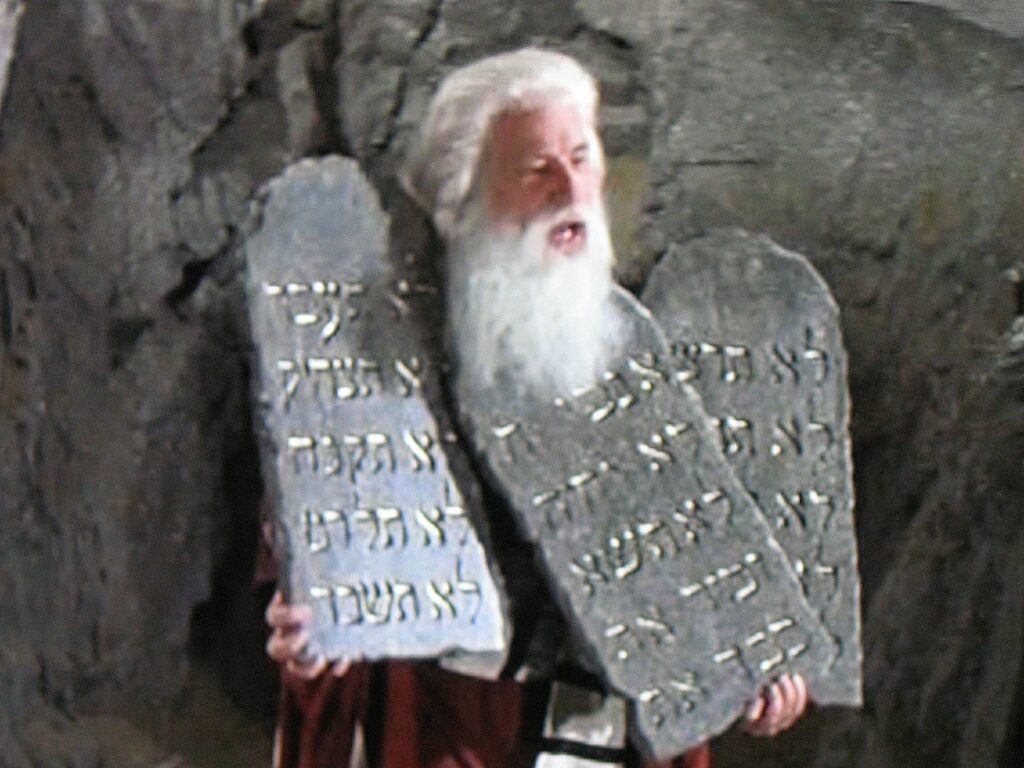
The most shocking discrepancy, however, happens in Exodus 34.
According to the narrative, Moses shatters the original stone tablets in a rage after discovering the Israelites worshipping the Golden Calf. God tells Moses to carve two new blank stone tablets and bring them up the mountain, promising: “I will write on them the words that were on the first tablets, which you broke.”
Moses goes up the mountain, and God dictates a new list. But this new list looks absolutely nothing like the first one. There is no mention of murder, stealing, adultery, or honoring your parents. Instead, this list (known by scholars as the “Ritual Decalogue”) is entirely focused on agricultural and cultic laws. God commands them to:
- Celebrate the Festival of Unleavened Bread.
- Redeem the firstborn of donkeys with a lamb.
- Not offer the blood of a sacrifice with anything containing yeast.
- Not boil a young goat in its mother’s milk.
The ultimate irony? At the end of this bizarre, agricultural list of rules, the text says: “And he wrote on the tablets the words of the covenant—the Ten Commandments.” (Exodus 34:28). This entirely different list is the only place in the entire Hebrew Bible where the exact phrase “Ten Commandments” is explicitly used.
The Editorial Quilt
How did we end up with such conflicting lists? As we have seen in the stories of Joseph, the Flood, and the formation of the Torah, the Bible is a patchwork of independent ancient traditions.
Early Israel was not a theological monolith. An ancient agrarian community living in the rural northern highlands (the Yahwist tradition found in Exodus 34) cared deeply about agricultural festivals, cultic purity, and how to properly sacrifice livestock. Decades or centuries later, urban scribes living in Jerusalem cared much more about ethical behavior, property rights, and civic order (the Ethical Decalogues).
When the post-exilic redactors sat down to compile the Torah, they had all these different versions of the Sinai revelation sitting on their desks. If they were modern editors, they would have picked the best one and deleted the rest to avoid confusing the reader. But ancient editors operated differently. They revered the texts. The rural Ritual Decalogue and the urban Ethical Decalogue were both sacred traditions, so the scribes kept them all, weaving them into the narrative narrative despite the glaring contradictions.
Embracing the Debate
When we idolize the Bible as a Paper Calf—treating it as a single, flawless fax from heaven—the existence of three different Ten Commandments is a terrifying problem. It forces readers to invent convoluted excuses for why God seemingly changed his mind between Exodus 20 and Exodus 34.
But when we read the text critically, the multiple decalogues become a profound testament to the humanity of the Bible. The text preserves a vibrant, centuries-long debate among ancient Israelites about what God actually values most: Is it cosmic order? Is it social justice and liberation? Or is it proper ritual worship? By leaving all three lists in the text, the ancient editors invite us to participate in that exact same debate today.
-
Beyond Abstinence: Defining the Architecture of Purity Culture
For many raised in late-20th-century evangelicalism, “abstinence” and “purity culture” are frequently treated as exact synonyms. However, while abstinence is a private historical ethical choice, purity culture is a modern, highly visible sociological construct. This article examines the architecture of the 1990s movement—from purity pledges to the courtship model—and explains why disentangling the ancient ethic from the modern subculture is the crucial first step in understanding its lasting psychological impact.
-
How Can Modern Churches Build Strong Communities Without Sacrificing Intellectual Honesty?
Can a church remain strong when its members question traditional interpretations of the Bible?Discover how shared values, meaningful relationships, and intellectual honesty can help modern Christian communities thrive without demanding agreement on every question.
-
A Voice from the Dust: How the Discovery of Ugarit Rewrote Biblical Scholarship
The accidental discovery of the ancient city of Ugarit in 1928 transformed biblical scholarship. Its texts provided crucial insights into Biblical Hebrew, uncovered the mythology of ancient Canaan, and revealed how Israelite religion developed within the wider cultural world of the ancient Near East.
-
Did Paul Believe Christians Go to Heaven? Paul’s Cosmos, Christology, and Hope of Resurrection
What did Paul think heaven was, who did he believe Jesus was, and what did he expect to happen after death? Explore Paul’s first-century Jewish apocalyptic worldview, his complex understanding of Jesus, and his expectation of bodily resurrection and the liberation of creation.
-
The Whistleblower in the Dirt: Unearthing the Socio-Economic Reality of the Talents
What’s the Parable of the Talents really about? Squadering your abilities or is there more? Let’s dig a little deeper.