From a historical-critical perspective, 2 Corinthians is the most intensely personal, emotional, and autobiographical letter Paul ever wrote. It was likely composed around 55–56 CE, written from the Roman province of Macedonia (northern Greece) after Paul had left Ephesus.
The historical backdrop is a massive deterioration in Paul’s relationship with the Corinthian church. After sending 1 Corinthians, the situation in the church worsened. Rival, highly charismatic Jewish-Christian teachers arrived in Corinth with letters of recommendation, flashy rhetorical skills, and claims of spectacular spiritual visions. These rivals successfully turned the congregation against Paul, mocking his physical appearance, his lack of speaking ability, and his refusal to accept financial patronage (which they viewed as a sign that he was a second-rate apostle).
Paul made a quick “painful visit” to Corinth to handle the situation but was publicly humiliated by a member of the church while the congregation watched in silence. Humiliated and furious, Paul retreated to Ephesus and sent the harsh “Tearful Letter” via his associate Titus, demanding they discipline the offender and reaffirm their loyalty to him. While in Macedonia, Titus finally returned with good news: the Tearful Letter had worked. The church had repented, disciplined the offender, and longed to see Paul again.
The Compositional Puzzle: Because of violent, jarring shifts in tone, a widespread consensus in modern biblical scholarship views 2 Corinthians not as a single, continuous document, but as a composite text—a patchwork of two or more separate letters written at different times, stitched together later by an editor. The most obvious fracture occurs between Chapter 9 and Chapter 10. Chapters 1–9 are filled with overwhelming joy, relief, and reconciliation. But in Chapter 10, the tone suddenly snaps into a bitter, sarcastic, and ferocious defense of his apostleship. Many scholars believe Chapters 10–13 actually represent a surviving fragment of the harsh “Tearful Letter” placed at the end of the collection.
Synopsis
Because of its emotional and likely composite nature, 2 Corinthians lacks the tight, systematic, theological structure of Romans or the checklist-style organization of 1 Corinthians. Instead, it revolves around the paradox of Christian leadership: true spiritual power is demonstrated exclusively through weakness and suffering.
Part I: Reconciliation and the Glory of the New Covenant (Chapters 1–7)
The letter opens with a profound sigh of relief. Paul praises the “God of all comfort, who comforts us in all our affliction.” He addresses the fallout of his “painful visit,” urging the church to now forgive and restore the individual who had publicly insulted him, proving that his goal was reconciliation, not permanent punishment.
Paul then launches into a majestic defense of his apostolic ministry, contrasting the “Old Covenant” of Moses with the “New Covenant” of the Spirit. Drawing on the story of Exodus, Paul notes that Moses had to wear a veil because the glory of the old covenant (written on stone) was fading. In contrast, the new covenant (written on human hearts by the Spirit) has a permanent, ever-increasing glory.
However, Paul immediately addresses a glaring paradox: if his ministry is so glorious, why is his life so miserable? Why is he constantly beaten, starved, imprisoned, and on the run? Paul answers with one of his most famous metaphors: “But we have this treasure in clay jars.” God deliberately places the glorious message of the gospel inside frail, breakable, and suffering human vessels (Paul’s battered body) so that it is absolutely clear that the transcendent power belongs to God and not to the human messenger.
Part II: The Collection for Jerusalem (Chapters 8–9)
Having restored his relationship with the community, Paul pivots to administrative business. He is still organizing a massive financial collection from his Gentile churches to bring back to the impoverished Jewish Christians in Jerusalem. The Corinthians had eagerly promised to contribute a year earlier but had stopped collecting money during their conflict with Paul.
Using a highly diplomatic and persuasive tone, Paul urges them to finish what they started. He uses the Macedonian churches as a psychological lever, pointing out that the Macedonians—despite extreme poverty—begged for the privilege of giving. Paul does not issue a command, but appeals to the ultimate example of Jesus, “who though he was rich, yet for your sakes he became poor.” He outlines a theology of Christian giving that is not based on taxation or guilt, but on mutual equality and joy, famously stating, “God loves a cheerful giver.”
Part III: The “Fool’s Speech” and the Super-Apostles (Chapters 10–13)
At Chapter 10, the tone radically shifts. Paul directly attacks the rival teachers who have infiltrated the Corinthian church, sarcastically referring to them as “super-apostles” (hyperlian apostoloi). These rivals were boasting about their pure Jewish lineage, their striking rhetoric, their ecstatic visions, and their letters of recommendation.
In response, Paul engages in a masterpiece of Greco-Roman satire known as the “Fool’s Speech.” He tells the Corinthians that if they want him to boast like a fool, he will. But instead of boasting about his successes, Paul boasts about his absolute humiliation. He lists his “credentials”: being flogged with 39 lashes five times, beaten with rods, stoned, shipwrecked, and constantly in danger from bandits and rivers. His ultimate “boast” is the deeply shameful memory of having to escape the city of Damascus by being lowered out of a window in a wicker basket like a coward.
He then addresses the issue of visionary experiences. He admits he was once “caught up to the third heaven” and heard unutterable things. But to keep him from becoming arrogant, God gave him a “thorn in the flesh” (likely a chronic physical illness or recurring persecution). Three times Paul begged God to remove it. God’s response forms the theological climax of the entire letter and encapsulates Paul’s entire understanding of ministry:
“My grace is sufficient for you, for power is made perfect in weakness.”
Paul concludes that he will gladly boast in his insults, hardships, and weaknesses, because “whenever I am weak, then I am strong.” He closes the letter with a final warning to examine themselves before his upcoming third visit, ensuring they are truly living in the faith.
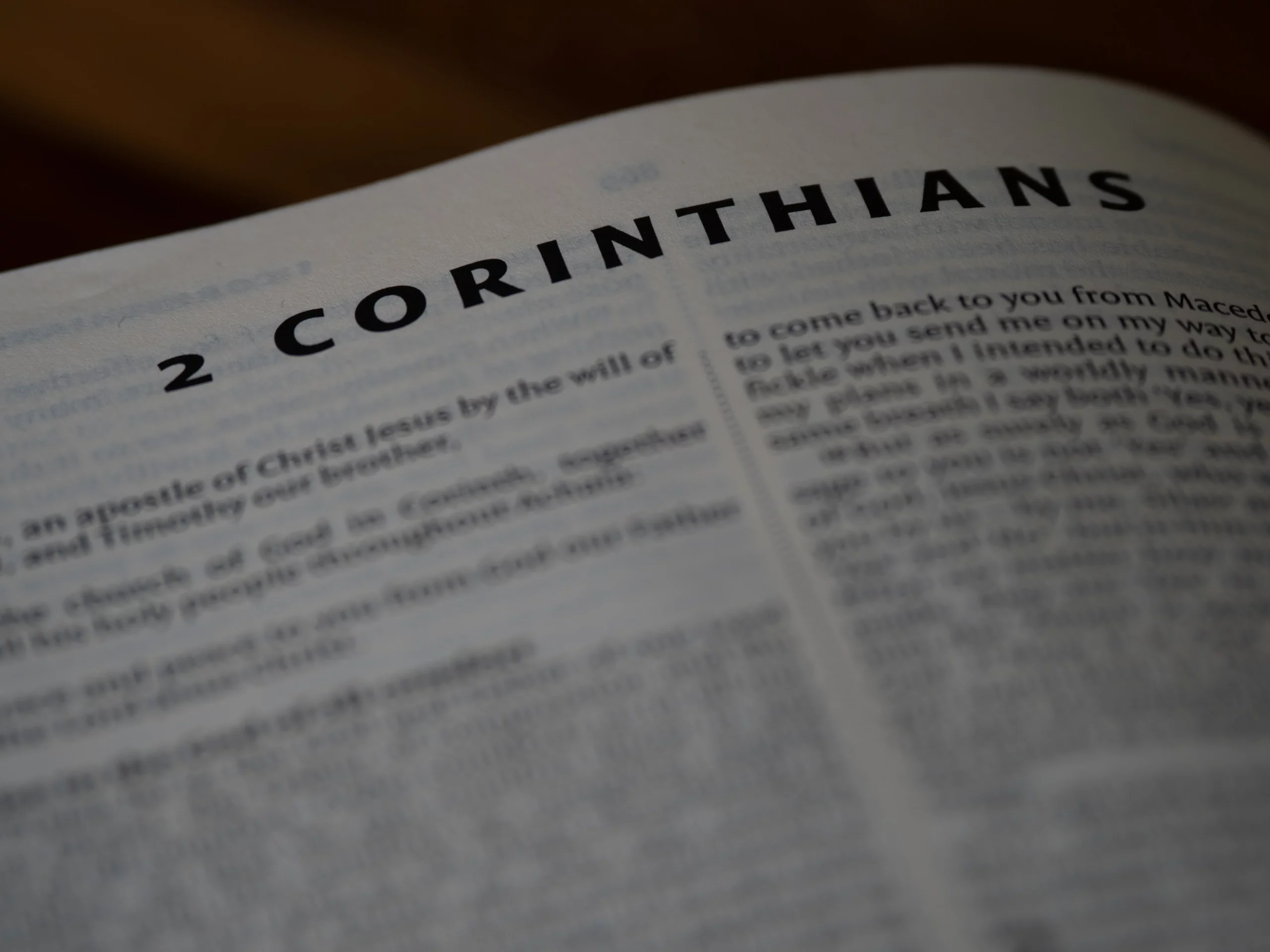
The Greek title for the Second Epistle to the Corinthians is Pros Korinthious Bēta (Πρὸς Κορινθίους Β΄), which translates to “Second to the Corinthians.”
As with 1 Corinthians, the canonical title simplifies a much more complicated historical reality. Based on internal clues within Paul’s writings, scholars reconstruct that Paul actually wrote at least four letters to this church. The sequence looks roughly like this:
-
The “Lost Letter” (mentioned in 1 Cor 5:9).
-
Our canonical 1 Corinthians.
-
The “Tearful Letter” of severe rebuke (mentioned in 2 Cor 2:4), written after a disastrous visit.
-
Our canonical 2 Corinthians (or at least, the primary joyful portion of it).