
Before Johannes Gutenberg revolutionized the world with the printing press in the 15th century, the multiplication of texts was a labor-intensive, manual process. For modern readers, the image of a solitary scribe hunched over a desk, meticulously copying a text by candlelight, is the standard visualization of book production. However, in classical antiquity, there was another, far more rapid method: mass dictation.
By placing one reader at the front of a room and a dozen scribes at their desks, a publisher could create a small “edition” of a book in a single afternoon. But this ancient equivalent of the printing press came with a distinct set of challenges, leaving behind a unique trail of linguistic blunders.
The Mechanics of Scriptorium Dictation
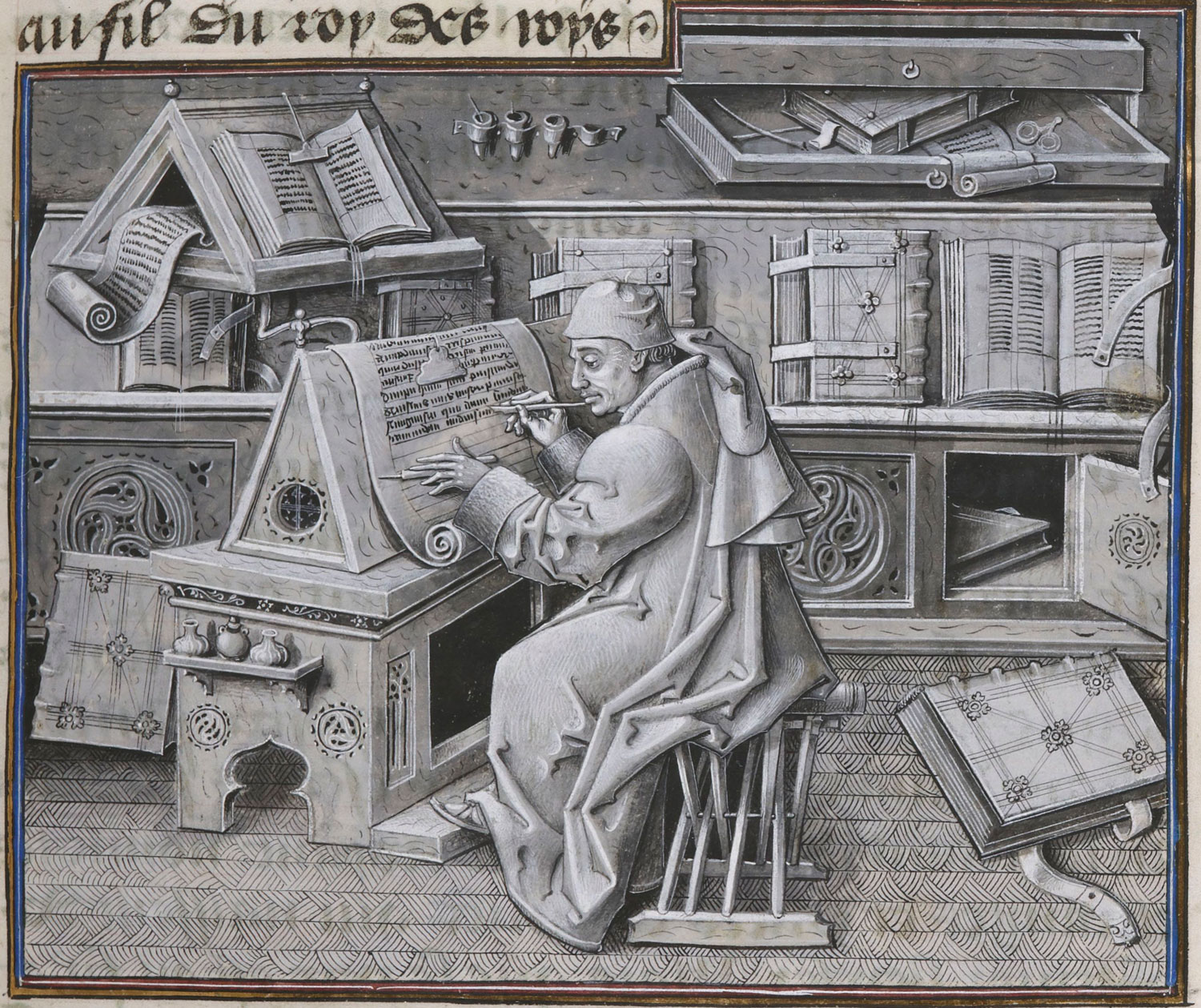
The process of dictation in a scriptorium (a room set apart for writing) involved a single person, often called the lector or pronuntiator, reading aloud from a master text (the exemplar). Meanwhile, multiple scribes would write down the spoken words simultaneously.
The primary advantage of this method was speed and volume. Visual copying requires one physical exemplar for every scribe. Dictation requires only one master copy to supply an entire room. For commercial publishing houses in ancient Rome, this was the most efficient way to bring a highly anticipated text to the commercial market.
The Cons: “Errors of the Ear”
While mass dictation allowed for rapid multiplication, it was highly problematic for textual integrity. When textual critics analyze ancient documents, they categorize scribal mistakes into two main camps: errors of the eye and errors of the ear.
Visual copying produced “errors of the eye,” such as skipping a line or accidentally repeating a word. Dictation, however, introduced auditory hurdles. In his work on manuscript transmission, scholar James D. Price states that errors of the ear happened when a scribe copied a text while another read the exemplar text orally (Price, n.d.). Price explains that in these cases, the scribe would often accidentally write the homonym of the word being articulated (Price, n.d.).
These phonetic confusions were exacerbated by two historical practices:
- Scriptio Continua: In antiquity, texts were written in scriptio continua, meaning they were written entirely without spaces or punctuation. A dictated string of syllables could easily be misunderstood. For example, a dictated sequence like “theredisnowhere” forced a scribe to decide whether to write “the red is nowhere” or “there is now here.”
- Itacism: This was a phenomenon in the evolution of the Greek language where several distinct vowels and diphthongs all gradually merged to sound identically to one another. Because they sounded exactly the same when read aloud, scribes constantly swapped them out in dictated manuscripts, leading to rampant spelling substitutions.
Acoustic interference also played a major role. A cough, an echo, or a reader’s poor enunciation could cause a scribe to miss a crucial word. Furthermore, the physical setup of ancient scribes compounded these difficulties. Summarizing the observations of renowned textual scholar Bruce M. Metzger, academic literature notes that scribes often worked under challenging physical constraints, sometimes having to sit on the ground or a stool while balancing their writing materials and scrolls directly on their thighs and knees (Botha, n.d.). Such balancing acts only added to the difficulty of keeping pace with a spoken dictation.
The Shift to Visual Copying
Because of the sheer volume of errors introduced by dictation, the practice largely fell out of favor by the Middle Ages. The monastic scriptoria that preserved texts through the medieval period prioritized extreme accuracy over mass distribution. The monastic rule of silence generally precluded the noise of mass dictation, leading to a system where monks copied texts visually, one-to-one.
When the rise of European universities in the 12th and 13th centuries created a sudden demand for multiple copies of textbooks, publishers did not revert to mass dictation. Instead, they developed the pecia system. A stationer would divide a master copy of a book into small sections (the peciae) and rent them out individually to students or scribes to copy visually, deliberately avoiding the phonetic pitfalls of the ancient world.
Ultimately, mass dictation represents a fascinating era in the history of the book—a time when publishers traded textual perfection for the ability to spread ideas as quickly as the human voice could speak them.
-
Beyond Abstinence: Defining the Architecture of Purity Culture
For many raised in late-20th-century evangelicalism, “abstinence” and “purity culture” are frequently treated as exact synonyms. However, while abstinence is a private historical ethical choice, purity culture is a modern, highly visible sociological construct. This article examines the architecture of the 1990s movement—from purity pledges to the courtship model—and explains why disentangling the ancient ethic from the modern subculture is the crucial first step in understanding its lasting psychological impact.
-
How Can Modern Churches Build Strong Communities Without Sacrificing Intellectual Honesty?
Can a church remain strong when its members question traditional interpretations of the Bible?Discover how shared values, meaningful relationships, and intellectual honesty can help modern Christian communities thrive without demanding agreement on every question.
-
A Voice from the Dust: How the Discovery of Ugarit Rewrote Biblical Scholarship
The accidental discovery of the ancient city of Ugarit in 1928 transformed biblical scholarship. Its texts provided crucial insights into Biblical Hebrew, uncovered the mythology of ancient Canaan, and revealed how Israelite religion developed within the wider cultural world of the ancient Near East.
-
Did Paul Believe Christians Go to Heaven? Paul’s Cosmos, Christology, and Hope of Resurrection
What did Paul think heaven was, who did he believe Jesus was, and what did he expect to happen after death? Explore Paul’s first-century Jewish apocalyptic worldview, his complex understanding of Jesus, and his expectation of bodily resurrection and the liberation of creation.
-
The Whistleblower in the Dirt: Unearthing the Socio-Economic Reality of the Talents
What’s the Parable of the Talents really about? Squadering your abilities or is there more? Let’s dig a little deeper.