
When modern readers picture the Tower of Babel, they usually imagine the famous Renaissance paintings by Pieter Bruegel: a massive, spiraling Romanesque colosseum reaching into the clouds, teeming with arrogant humanity. For centuries, the story in Genesis 11 has been read as a straightforward moral fable about the sin of human pride and a historical account of how different languages were created.
However, when we place this text back into its ancient Near Eastern context, the Renaissance paintings fade away, replaced by the baked mud of Mesopotamia. The story of Babel is an etiology—a mythic origin story designed to explain a current reality (in this case, the multiplicity of human languages). But more importantly, it is a razor-sharp, anti-imperial satire directed at the greatest superpower of the ancient world, modeled on a very specific piece of historical architecture: the Babylonian ziggurat.
The Architectural Clues: Bricks and Bitumen
The biblical authors embedded glaring architectural clues in the text that immediately signal the story’s geographical setting. Genesis 11:3 reads: “They said to each other, ‘Come, let’s make bricks and bake them thoroughly.’ They used brick instead of stone, and tar for mortar.”
To an ancient Judean audience, this detail was a massive neon sign. In the highlands of Israel and Judah, architecture was based on locally quarried limestone. But in the alluvial plains of Mesopotamia—where the city of Babylon was located—there was virtually no usable stone. The Babylonians built their massive monuments using mud bricks fired in kilns, bound together with bitumen (naturally occurring tar). The biblical scribes are explicitly pointing their audience toward the architectural pride of Mesopotamia.
The Historical Template: The Etemenanki
The “tower” in the Genesis narrative is not a medieval spire; it is a ziggurat. Ziggurats were massive, terraced step-pyramids that dominated the skylines of Mesopotamian cities. They functioned as artificial mountains, topped with a shrine, designed to serve as a physical staircase connecting the earthly realm with the divine realm of the gods.
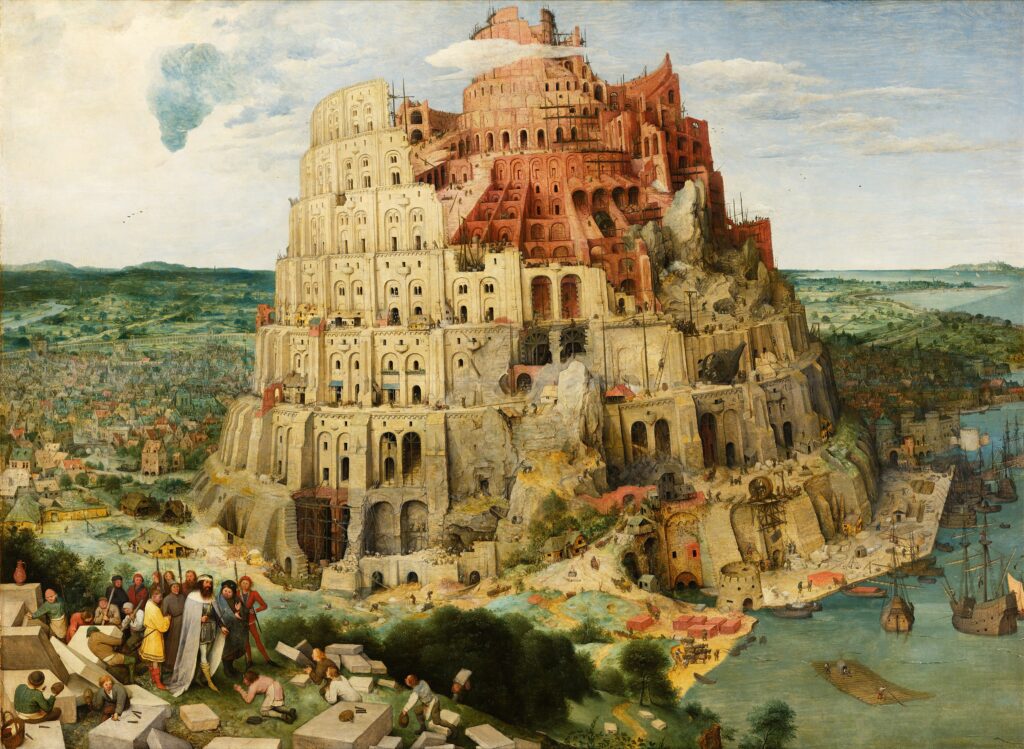
The most famous of these structures was located in the heart of Babylon itself. It was a colossal, seven-tiered ziggurat dedicated to the patron god Marduk, named the Etemenanki, which translates from Sumerian as “The Temple of the Foundation of Heaven and Earth.” When the Judean elite were deported to Babylon during the Exile in the 6th century BCE, they would have stood in the shadow of this staggering monument. However, ziggurats were notoriously difficult to maintain. Because they were made of mud-brick, they were highly susceptible to water damage, erosion, and structural collapse. Throughout its history, the Etemenanki was repeatedly damaged, destroyed by rival empires (such as the Assyrians), left in ruins, and subsequently rebuilt by later kings.
To the captive Judean scribes, the sight of a colossal, ruined, or perpetually unfinished ziggurat—a massive pile of baked brick reaching for the heavens but crumbling under its own weight—provided the perfect visual template for a theological mockery.
The Linguistic Punchline
The biblical scribes weaponized this architectural failure to create a brilliant etiology for the world’s diverse languages, wrapped in a linguistic pun.
In the Akkadian language spoken by the Babylonians, the name of their great city was Bāb-ili, which proudly translates to “Gate of the God.” The Babylonians believed their city and its ziggurat were the literal cosmic center of the universe.
The Hebrew scribes completely inverted this imperial propaganda. They tied the name of the city not to divine gates, but to the Hebrew root verb balal, which means “to confuse” or “to mix.” The biblical text essentially says: They call their city the Gate of the Gods, but it is actually the City of Babbling. It is a deliberate, mocking subversion of Babylonian imperial ideology.
The Cosmic Squint
The satire culminates in the spatial irony of the narrative. The Babylonians arrogantly declare, “Let us build… a tower that reaches to the heavens, so that we may make a name for ourselves” (Genesis 11:4). They believe their monumental Etemenanki is breaching the divine realm.
But what is the response of Yahweh? Genesis 11:5 delivers one of the most brilliant comedic lines in the Hebrew Bible: “But the Lord came down to see the city and the tower the people were building.”
The Babylonians believe they have built a skyscraper that threatens the heavens. But from the perspective of the cosmos, their greatest architectural achievement is so infinitesimally small that God has to actively descend from heaven just to get a good look at it.
When we read the Tower of Babel purely as a literal historical event, we miss the biting intellect of the authors. The “Paper Calf” of literalism obscures a masterful piece of resistance literature. By using the unfinished, crumbling ziggurats of their captors as a template, the Judean scribes crafted an etiology that explained the diversity of languages while simultaneously cutting the pride of the Babylonian empire down to size.
-
Beyond Abstinence: Defining the Architecture of Purity Culture
For many raised in late-20th-century evangelicalism, “abstinence” and “purity culture” are frequently treated as exact synonyms. However, while abstinence is a private historical ethical choice, purity culture is a modern, highly visible sociological construct. This article examines the architecture of the 1990s movement—from purity pledges to the courtship model—and explains why disentangling the ancient ethic from the modern subculture is the crucial first step in understanding its lasting psychological impact.
-
How Can Modern Churches Build Strong Communities Without Sacrificing Intellectual Honesty?
Can a church remain strong when its members question traditional interpretations of the Bible?Discover how shared values, meaningful relationships, and intellectual honesty can help modern Christian communities thrive without demanding agreement on every question.
-
A Voice from the Dust: How the Discovery of Ugarit Rewrote Biblical Scholarship
The accidental discovery of the ancient city of Ugarit in 1928 transformed biblical scholarship. Its texts provided crucial insights into Biblical Hebrew, uncovered the mythology of ancient Canaan, and revealed how Israelite religion developed within the wider cultural world of the ancient Near East.
-
Did Paul Believe Christians Go to Heaven? Paul’s Cosmos, Christology, and Hope of Resurrection
What did Paul think heaven was, who did he believe Jesus was, and what did he expect to happen after death? Explore Paul’s first-century Jewish apocalyptic worldview, his complex understanding of Jesus, and his expectation of bodily resurrection and the liberation of creation.
-
The Whistleblower in the Dirt: Unearthing the Socio-Economic Reality of the Talents
What’s the Parable of the Talents really about? Squadering your abilities or is there more? Let’s dig a little deeper.