
For most of Western history, the stories of Genesis 2–4—the Garden of Eden, the forbidden fruit, and the murder of Abel—have been read as a literal, historical account of human origins. In theological circles, it is the foundational text for the doctrine of “original sin.”
However, when we read these chapters through a historical-critical lens, taking into account the broader literature of the ancient Near East and the specific geopolitical trauma of ancient Judah, a profoundly different text emerges. Genesis 2–4 is not a historical logbook of the first hominids. It is a highly sophisticated theological allegory, written and compiled by Judean scribes to explain the greatest catastrophe in their history: the Babylonian Exile of 586 BCE.
The Geography of Trauma: Driven to the East
To see the allegory, we have to look at the structural parallels between the story of Adam and Eve and the history of the Israelite people.
The narrative follows a specific trajectory:
- Divine Placement: God places humanity in a lush, carefully bordered land (the Garden), just as Yahweh placed Israel in the Promised Land.
- The Covenant: Humanity is given a specific commandment to obey in order to remain in the land, mirroring the Mosaic covenant.
- The Breach: Humanity violates the commandment, grasping for autonomy.
- The Expulsion: As punishment, God evicts them from the fertile land.
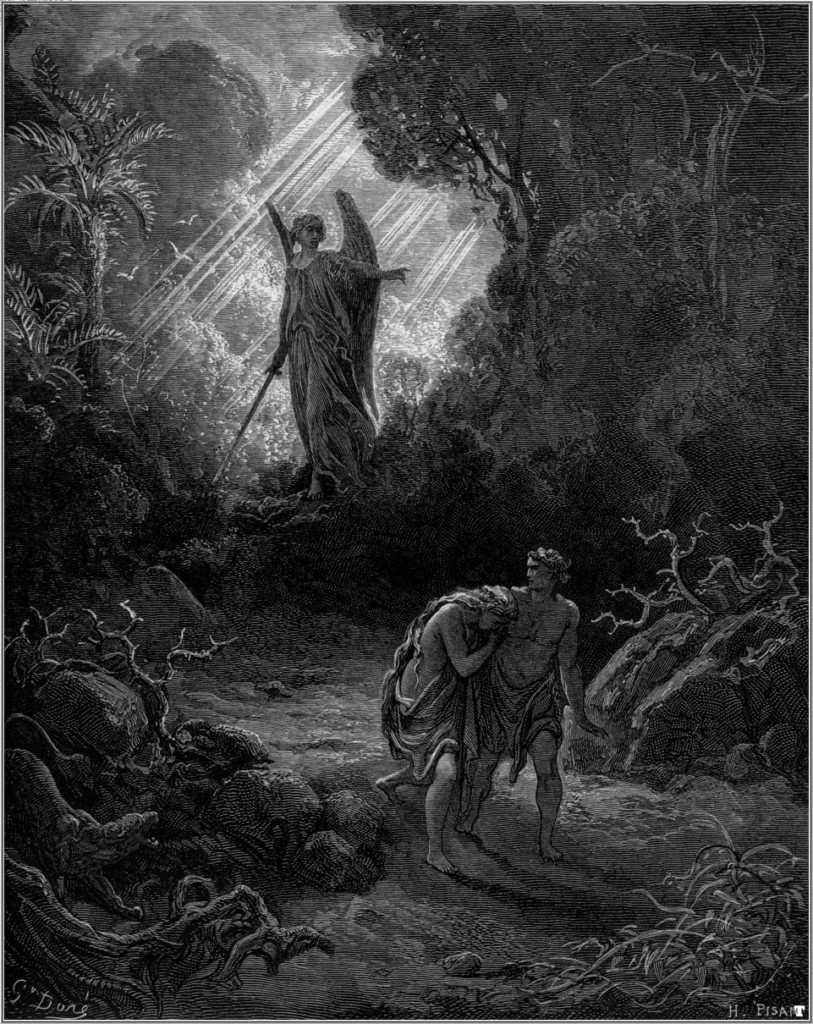
The most telling detail, however, is the direction of the expulsion. When God drives Adam and Eve out of Eden, Genesis 3:24 specifically notes that they are banished to the east. In the following chapter, when Cain murders his brother and is driven entirely out of the presence of the Lord, he too is exiled to the east, settling in the land of Nod (which literally translates to “wandering”). Cain then builds the world’s first city.
For the Judean scribes compiling this text during or shortly after the 6th century BCE, “the east” was not an abstract geographical direction. It was Babylon.
When the Babylonian Empire destroyed Jerusalem, they deported the Judean elite eastward across the desert to the massive, urbanized cities of Mesopotamia. The Eden narrative functions as a national theodicy—a way of explaining their suffering. The exiled Judeans were asking, “Why did we lose the Promised Land? Why are we wandering in the east?” The scribes answered by projecting their national trauma backward onto the canvas of cosmic origins: “We are in the east because, like our ancestors, we broke the covenant and were exiled from the presence of God.”
Borrowing from Babylon: The Ancient Near Eastern Matrix
If Genesis 2–4 is a theological reflection written by scribes exposed to Babylonian culture, it should come as no surprise that the story is saturated with the imagery of the wider ancient Near East. The biblical authors did not invent these symbols in a vacuum; they repurposed the dominant cultural motifs of their Mesopotamian captors to tell a uniquely Judean story.
The Garden of the Gods
The concept of a divine, well-watered garden is a staple of ancient Near Eastern mythology. In Sumerian myth, the land of Dilmun is described as a pure, bright paradise where predators do not hunt and sickness does not exist. Similarly, royal Assyrian and Babylonian kings maintained massive, walled botanical gardens (the linguistic root of the Persian word paridaiza, from which we get “paradise”) to symbolize their god-like mastery over the natural world.
The Sacred Trees
The imagery of the “Tree of Life” was ubiquitous in the ancient world. If you look at the stone reliefs of the Neo-Assyrian palaces, you will constantly see the motif of a sacred, stylized tree flanked by divine kings or winged genies.
The motif of a human striving for—and ultimately failing to achieve—immortality and divine wisdom is also a classic Mesopotamian trope. In the Myth of Adapa, a mortal man is granted immense wisdom by the gods but is tricked into refusing the food and water of eternal life. The Genesis narrative adapts this widespread cultural conversation about the strict boundaries between mortal humanity and the divine realm.
The Cherubim at the Gate
When Adam and Eve are exiled, God places “cherubim” and a flaming sword at the eastern gate to guard the way back to the Tree of Life. Modern readers often picture Renaissance-era babies with small wings, but an ancient Judean in Babylon would have pictured something terrifying. In the ancient Near East, karibu (or lamassu) were massive, imposing composite creatures—usually winged bulls or lions with human heads. They were placed at the threshold gates of Mesopotamian temples and royal palaces to fiercely guard the sacred space from defilement.
The Thieving Serpent
Even the serpent has a famous Mesopotamian predecessor. In the Epic of Gilgamesh, the heroic king undertakes an agonizing quest to find the secret of immortality. He eventually retrieves a magical, rejuvenating plant from the bottom of the sea. But while he is resting, a snake slithers up, eats the plant, sheds its skin, and slithers away, robbing humanity of eternal youth. The biblical scribes tapped into this deeply ingrained regional motif of the serpent as the creature that severs humanity from eternal life.
Tearing Down the Blueprint
When we insist on reading Genesis 2–4 strictly as a modern biology textbook or a historical newspaper account, we miss the profound literary and psychological depth of the text.
The story of Eden was not written to answer modern scientific questions about the origins of Homo sapiens. It was written by a traumatized, displaced people trying to make sense of their exile. By utilizing the mythological imagery of the very empire that conquered them—sacred trees, guardian sphinxes, and thieving serpents—the Judean scribes crafted a brilliant, subversive narrative. They created a theological blueprint that explained their tragic present, while laying the groundwork for a future hope of returning from the east.
-
Beyond Abstinence: Defining the Architecture of Purity Culture
For many raised in late-20th-century evangelicalism, “abstinence” and “purity culture” are frequently treated as exact synonyms. However, while abstinence is a private historical ethical choice, purity culture is a modern, highly visible sociological construct. This article examines the architecture of the 1990s movement—from purity pledges to the courtship model—and explains why disentangling the ancient ethic from the modern subculture is the crucial first step in understanding its lasting psychological impact.
-
How Can Modern Churches Build Strong Communities Without Sacrificing Intellectual Honesty?
Can a church remain strong when its members question traditional interpretations of the Bible?Discover how shared values, meaningful relationships, and intellectual honesty can help modern Christian communities thrive without demanding agreement on every question.
-
A Voice from the Dust: How the Discovery of Ugarit Rewrote Biblical Scholarship
The accidental discovery of the ancient city of Ugarit in 1928 transformed biblical scholarship. Its texts provided crucial insights into Biblical Hebrew, uncovered the mythology of ancient Canaan, and revealed how Israelite religion developed within the wider cultural world of the ancient Near East.
-
Did Paul Believe Christians Go to Heaven? Paul’s Cosmos, Christology, and Hope of Resurrection
What did Paul think heaven was, who did he believe Jesus was, and what did he expect to happen after death? Explore Paul’s first-century Jewish apocalyptic worldview, his complex understanding of Jesus, and his expectation of bodily resurrection and the liberation of creation.
-
The Whistleblower in the Dirt: Unearthing the Socio-Economic Reality of the Talents
What’s the Parable of the Talents really about? Squadering your abilities or is there more? Let’s dig a little deeper.