
Above the main entrance to the Church of the Holy Sepulchre in Jerusalem—traditionally revered as the site of the crucifixion and resurrection of Jesus of Nazareth—rests a short, unremarkable ladder made of Lebanon cedar. It sits on a stone ledge beneath a second-story window. It serves no practical purpose today, and its original function has long since faded into history.
Yet, this simple wooden object, known as the “Immovable Ladder,” is one of the most famous symbols in the ancient city. While tourists often view it as a quirky historical anomaly, for many secular critics and religious observers alike, the ladder serves as a profound, physical monument to institutional paralysis. It stands as a stark visual argument that human institutions—even those explicitly founded upon ideals of love, humility, and unity—often calcify into systems of bitter territoriality and inherited conflict.
To understand how a ladder became a symbol of sectarian gridlock, one must examine the bizarre legal framework that keeps it locked in place, and the deep theological paradox it represents.
The Irony of the Status Quo
The reason the ladder sits on the ledge is rooted in an Ottoman decree known as the Status Quo, originating in 1757 and formalized in 1852. The decree was designed to stop the six Christian denominations that share the church (Greek Orthodox, Roman Catholic, Armenian Apostolic, Coptic, Syriac, and Ethiopian Orthodox) from constantly fighting over control of the sacred space.
The Status Quo dictated that the ownership and usage rights of the church would freeze exactly as they were at the time of the decree. Under this framework, virtually nothing in the common areas can be altered, repaired, or rearranged without the unanimous consent of all six factions. While major, negotiated restorations do occasionally happen—such as the recent, massive project to repair the tomb itself—they require agonizingly complex, years-long diplomacy. For everyday matters, the default is absolute paralysis.
Historical tradition and speculation suggest the ladder was originally left on the ledge by an Armenian monk. In the 18th century, Ottoman authorities heavily taxed clergy for entering and exiting the main doors, so monks would reportedly use the ledge and window to haul up food and supplies. Because the ladder was physically present on the ledge when the Status Quo agreements were mapped out, it became a legally protected baseline. Moving it requires a diplomatic consensus that the rival factions have historically refused to reach. Save for a few illicit pranks or brief construction windows, its permanent position has remained locked for the better part of three centuries.
The Optics of Intolerance
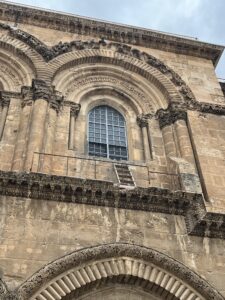
For critics, the true scandal of the Immovable Ladder is not the arcane Ottoman decree, but the modern behavior it exposes. The inability to agree on moving a piece of wood is a symptom of a much deeper, more volatile sectarian territoriality.
The strict enforcement of the Status Quo frequently boils over into physical violence. In 2002, a Coptic monk moved his chair slightly out of the summer sun and into Ethiopian territory on the roof of the church, sparking a brawl that left nearly a dozen monks hospitalized. In 2008, a fistfight broke out between Greek Orthodox and Armenian monks near the site of the tomb, requiring Israeli riot police to intervene and separate the warring clerics.
To the outside observer, these events are bewildering. The sight of ordained clergy engaging in physical combat over a chair, a swept step, or a wooden ladder paints a picture of religious institutions so obsessed with protecting their own historical borders that they have completely lost sight of the spiritual movement they claim to represent.
A Theological Contradiction
The paradox of the ladder is magnified by its location. The Church of the Holy Sepulchre is built to commemorate the ultimate act of Christian theology: a messiah who allegedly surrendered his own earthly power, taught his followers to “turn the other cheek,” and explicitly prayed that his disciples would “all be one.”
When observers point to the Immovable Ladder, they highlight this glaring contradiction. The foundational texts of the New Testament demand radical humility and the relinquishing of prestige. Yet, at the very geographic center of this faith, the institutional stewards cannot easily agree to clean a shared courtyard or move a decaying piece of cedar.
In this light, the ladder becomes a compelling piece of evidence that when a spiritual philosophy is entrusted to human bureaucracies, the preservation of turf quickly supersedes the practice of tolerance.
A Microcosm of Human Nature
Ultimately, the Immovable Ladder is not merely a religious relic; it is a monument to human nature. For historical-critical scholars and sociologists, the Church of the Holy Sepulchre acts as a microcosm of global geopolitics, demonstrating how deeply ingrained tribal identity and territorial anxiety are within human groups.
Whether viewed as a tragic theological failure or a fascinating sociological case study, the ladder remains on its ledge. It serves as a silent, enduring reminder that proclaiming ideals of unity is simple, but overcoming the inertia of a divided human institution is an entirely different endeavor.
-
Beyond Abstinence: Defining the Architecture of Purity Culture
For many raised in late-20th-century evangelicalism, “abstinence” and “purity culture” are frequently treated as exact synonyms. However, while abstinence is a private historical ethical choice, purity culture is a modern, highly visible sociological construct. This article examines the architecture of the 1990s movement—from purity pledges to the courtship model—and explains why disentangling the ancient ethic from the modern subculture is the crucial first step in understanding its lasting psychological impact.
-
How Can Modern Churches Build Strong Communities Without Sacrificing Intellectual Honesty?
Can a church remain strong when its members question traditional interpretations of the Bible?Discover how shared values, meaningful relationships, and intellectual honesty can help modern Christian communities thrive without demanding agreement on every question.
-
A Voice from the Dust: How the Discovery of Ugarit Rewrote Biblical Scholarship
The accidental discovery of the ancient city of Ugarit in 1928 transformed biblical scholarship. Its texts provided crucial insights into Biblical Hebrew, uncovered the mythology of ancient Canaan, and revealed how Israelite religion developed within the wider cultural world of the ancient Near East.
-
Did Paul Believe Christians Go to Heaven? Paul’s Cosmos, Christology, and Hope of Resurrection
What did Paul think heaven was, who did he believe Jesus was, and what did he expect to happen after death? Explore Paul’s first-century Jewish apocalyptic worldview, his complex understanding of Jesus, and his expectation of bodily resurrection and the liberation of creation.
-
The Whistleblower in the Dirt: Unearthing the Socio-Economic Reality of the Talents
What’s the Parable of the Talents really about? Squadering your abilities or is there more? Let’s dig a little deeper.