
For centuries, scholars studying the Hebrew Bible faced a major historical limitation. They were forced to analyze the texts, theology, and linguistic peculiarities of ancient Israel largely in isolation. The biblical authors frequently condemned their neighbors—the “Canaanites”—for their religious practices, but scholars possessed almost no primary sources from the Canaanites themselves.
That changed dramatically in the spring of 1928, when a Syrian peasant’s plow struck a stone slab near the Mediterranean coast at a site called Ras Shamra. The accidental discovery uncovered a tomb, which soon led French archaeologists to excavate an entire lost Bronze Age city: the ancient city of Ugarit.
Destroyed around 1200 BCE during the Late Bronze Age collapse, Ugarit had once been a wealthy and cosmopolitan trade center linking Egypt, Anatolia, Mesopotamia, and the Levant. Yet its greatest treasure was not gold or ivory, but its libraries. Archaeologists uncovered thousands of clay tablets written in a previously unknown cuneiform script. When deciphered, the language proved to be Ugaritic, a closely related Northwest Semitic language sharing deep linguistic and cultural connections with Biblical Hebrew.
The discovery transformed biblical scholarship. For the first time, scholars could compare the Hebrew Bible with the literature, poetry, and theology of one of Israel’s closest cultural neighbors. Here is how the discovery of Ugarit fundamentally reshaped historical-critical biblical studies.
1. A New Linguistic Window into Biblical Hebrew
Before the discovery of Ugarit, translators of the Hebrew Bible often encountered difficult words whose meanings remained uncertain. The biblical text contains many hapax legomena—words appearing only once in the entire Hebrew corpus. Although scholars could compare Hebrew with related Semitic languages such as Aramaic, Akkadian, and Arabic, many obscure poetic expressions remained highly debated.
Ugaritic became one of the most important comparative tools for understanding ancient Hebrew vocabulary and grammar. Because both languages belong to the Northwest Semitic family and share similar root systems, scholars could compare difficult Hebrew words with clearer parallels preserved in Ugaritic texts.
The discovery also illuminated the structure of ancient Near Eastern poetry. Biblical poetry—particularly in Psalms, Job, and the prophets—frequently relies on parallelism, where a thought is repeated, contrasted, or expanded across multiple lines. Ugaritic literary texts, especially the mythological epics, employ remarkably similar poetic techniques, formulaic expressions, and rhythmic structures.
This demonstrated that the biblical authors were participating in a much older and wider literary tradition shared across the ancient Levant. The poetic style of the Hebrew Bible did not emerge in isolation; it developed within the broader cultural world of the ancient Near East.
2. Recovering the Religion of Ancient Canaan
For centuries, the religion of the Canaanites was known almost entirely through the hostile polemics of the Hebrew Bible. The prophets and biblical historians portrayed Canaanite worship as corrupt idolatry centered around foreign gods and fertility cults. Ugarit provided scholars with the first substantial primary sources from the Canaanites themselves.
Among the most important discoveries was the Baal Cycle, a series of mythological texts describing the storm god Baal and his struggle for kingship against Yamm, the god of the chaotic sea, and Mot, the god of death.
The texts revealed a sophisticated and highly organized pantheon that included:
- El: The aged creator god and patriarch of the divine assembly, often called the “Father of Years.”
- Asherah: The mother goddess and consort of El.
- Baal: The warrior and storm god associated with rain, fertility, kingship, and agricultural prosperity.
These texts fundamentally changed how scholars understood the biblical world. The biblical authors were not reacting against vague “paganism,” but against specific religious traditions deeply embedded in the culture of the ancient Levant.
Ugarit also revealed how interconnected the religious landscape of the region truly was. Many symbols, titles, and mythological themes found in the Hebrew Bible existed within a broader shared cultural vocabulary stretching across the eastern Mediterranean.
3. The Cultural Matrix of Early Israelite Religion
Perhaps the most significant impact of Ugarit was its contribution to understanding the development of early Israelite religion. The discoveries demonstrated that ancient Israel emerged within the broader cultural and religious world of Canaan rather than in complete isolation from it.
When scholars compared the Ugaritic texts with the Hebrew Bible, they noticed striking similarities in imagery, divine titles, poetic language, and cosmological themes. Biblical authors frequently adapted older Northwest Semitic religious language and reapplied it to Yahweh, the God of Israel.
The Legacy of El
In the Hebrew Bible, Yahweh is at times identified with titles associated with El, such as El Elyon (“God Most High”). Like the Ugaritic El, Yahweh is sometimes depicted as a wise patriarch presiding over a heavenly council of divine beings, as seen in passages such as Job 1 and Psalm 82.
Many scholars believe that traditions associated with El and Yahweh gradually merged over time within Israelite religion, though the precise historical process remains debated.
The Storm-God Imagery of Baal
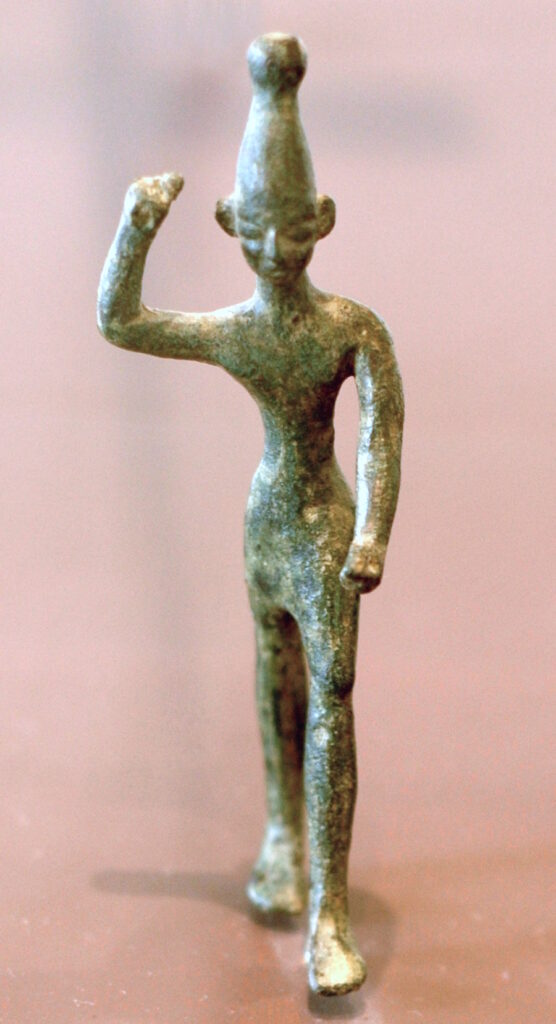
Biblical writers also adopted imagery traditionally associated with Baal. In Ugaritic literature, Baal is famously called the “Rider of the Clouds,” a title emphasizing his power as a storm deity who controls rain and fertility.
In Psalm 68:4, the biblical poet applies remarkably similar imagery to Yahweh:
“Extol him who rides on the clouds.”
Such parallels suggest that biblical authors were intentionally reusing familiar religious language from their cultural environment while redirecting it toward Yahweh worship.
One of the most discussed examples is Psalm 29. In Hebrew, the psalm presents Yahweh as a mighty storm deity whose voice shakes the wilderness and splinters the cedars of Lebanon. Many scholars argue that the psalm preserves elements of an older Canaanite storm-hymn tradition that was later adapted for Israelite worship.
While the exact origins of the psalm remain debated, the similarities with Northwest Semitic storm-god imagery are difficult to ignore.
The Legacy of Ras Shamra
The discovery of Ugarit permanently changed biblical scholarship by ending the practice of reading the Hebrew Bible in near isolation from its historical environment.
The texts from Ras Shamra revealed that ancient Israel shared language, literary conventions, religious imagery, and cultural assumptions with its neighbors. At the same time, the biblical authors reshaped those inherited traditions in distinctive ways as Israelite religion evolved over centuries.
Rather than diminishing the Hebrew Bible, the discovery of Ugarit situated it more firmly within the real historical world of the ancient Near East. By recovering the lost voices of the Canaanites, archaeologists provided the broader cultural backdrop against which the literature and theology of ancient Israel developed.
-
Beyond Abstinence: Defining the Architecture of Purity Culture
For many raised in late-20th-century evangelicalism, “abstinence” and “purity culture” are frequently treated as exact synonyms. However, while abstinence is a private historical ethical choice, purity culture is a modern, highly visible sociological construct. This article examines the architecture of the 1990s movement—from purity pledges to the courtship model—and explains why disentangling the ancient ethic from the modern subculture is the crucial first step in understanding its lasting psychological impact.
-
How Can Modern Churches Build Strong Communities Without Sacrificing Intellectual Honesty?
Can a church remain strong when its members question traditional interpretations of the Bible?Discover how shared values, meaningful relationships, and intellectual honesty can help modern Christian communities thrive without demanding agreement on every question.
-
A Voice from the Dust: How the Discovery of Ugarit Rewrote Biblical Scholarship
The accidental discovery of the ancient city of Ugarit in 1928 transformed biblical scholarship. Its texts provided crucial insights into Biblical Hebrew, uncovered the mythology of ancient Canaan, and revealed how Israelite religion developed within the wider cultural world of the ancient Near East.
-
Did Paul Believe Christians Go to Heaven? Paul’s Cosmos, Christology, and Hope of Resurrection
What did Paul think heaven was, who did he believe Jesus was, and what did he expect to happen after death? Explore Paul’s first-century Jewish apocalyptic worldview, his complex understanding of Jesus, and his expectation of bodily resurrection and the liberation of creation.
-
The Whistleblower in the Dirt: Unearthing the Socio-Economic Reality of the Talents
What’s the Parable of the Talents really about? Squadering your abilities or is there more? Let’s dig a little deeper.
Leave a Reply
You must be logged in to post a comment.