
The word “hallelujah” is arguably one of the most universally recognized expressions in the global religious vocabulary. It echoes through modern worship songs, classical masterpieces like Handel’s Messiah, and secular popular culture alike, almost always functioning as a spontaneous exclamation of joy, relief, or victory. However, when historical-critical scholars examine the origins of this famous phrase within the Hebrew Bible, a very different picture emerges.
In its original ancient Near Eastern context, the word was not a spontaneous, personal expression of emotion. It was a strict, technical liturgical command deeply embedded in the temple worship of ancient Israel. Understanding the etymology and historical usage of the phrase provides a fascinating window into the evolution of ancient Israelite liturgy and the preservation of the divine name.
The Etymological Roots
To understand the phrase, one must break it down into its original Hebrew components. The word is actually a compound of two distinct Hebrew terms: hallelu and Yah.
The first half of the phrase derives from the Hebrew root halal, which means to praise, to boast, or to shine. Crucially, in the word hallelu, this verb is conjugated as a second-person plural imperative. It is not a statement of fact, nor is it a singular exclamation. It is a direct, authoritative command issued to a group of people: “Praise ye” or “All of you, praise.”
The second half of the compound is Yah, which is the poetic, shortened form of the Tetragrammaton, YHWH (Yahweh), the personal name of the national God of ancient Israel.
Therefore, the literal translation of the phrase is a direct order to a congregation: “Praise Yahweh.” In the context of ancient Israelite religion, this was a specific cue given by a priest or a Levite choir leader, instructing the gathered assembly to begin their liturgical worship.
The Cultic Context of the Psalms
The phrase is overwhelmingly concentrated in one specific book of the Hebrew Bible: the Book of Psalms. It appears exactly twenty-four times within the Psalter, and almost exclusively in the later, post-exilic compositions.
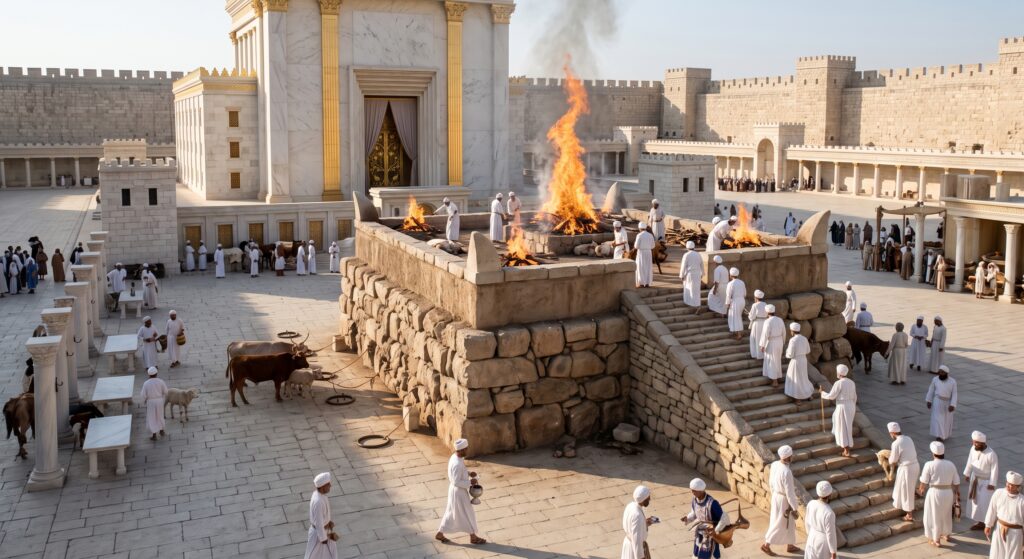
Historically, the phrase is most closely associated with a specific grouping of texts known as the “Egyptian Hallel” (Psalms 113 through 118). These particular psalms formed the core of the festival liturgy in the Second Temple period. During major pilgrimage festivals, such as Passover, the Feast of Weeks (Pentecost), and the Feast of Tabernacles (Sukkot), the temple choirs would sing these psalms as the Passover lambs were being sacrificed.
In this highly structured cultic environment, the word served as a rhythmic, antiphonal anchor. A Levitical leader would shout the command, and the massive crowds of pilgrims gathered in the temple courtyards would respond in unison. Furthermore, the Book of Psalms famously concludes with a crescendo of five consecutive texts (Psalms 146 through 150) that both begin and end with this exact liturgical command, functioning as the grand finale of the entire collection.
The Preservation of the Divine Name
The phrase also plays a critical role in the historical development of Jewish theology regarding the divine name. During the Second Temple period, the name Yahweh became increasingly viewed as too sacred and powerful to be spoken aloud by ordinary people. A strict theological boundary was established, and readers of the Hebrew text began substituting the title Adonai (Lord) whenever they encountered the Tetragrammaton.
However, the shortened form Yah embedded within this specific phrase was somehow exempt from this prohibition. Because the word had become so thoroughly ingrained in the communal muscle memory and temple liturgy, the congregation was permitted to continue singing it. As a result, the phrase inadvertently functioned as a linguistic time capsule, preserving the vocalization of the ancient divine name long after the full name of God had been silenced in public worship.
From the Temple to the World
The transition of the word from a localized temple command to a universal expression of praise began with the translation of the Hebrew Bible into Greek. When Jewish scholars produced the Septuagint in the third century BCE, they did not translate the phrase into Greek words. Instead, they simply transliterated the Hebrew sounds into the Greek alphabet, producing the word Alleluia.
This transliteration carried the word into the early Christian movement. In the New Testament, the word appears only in the Book of Revelation (chapter 19), where the author envisions a massive heavenly chorus shouting the phrase to celebrate the fall of the corrupt empire of Babylon. Through the Latin Vulgate and subsequent translations, this Greek spelling was cemented into Western Christian liturgy.
Ultimately, the history of the phrase represents a profound linguistic evolution. What began as a highly specific, plural command shouted by priests in the courtyards of Iron Age Jerusalem slowly transformed into a universal, multi-lingual declaration, completely untethered from its ancient cultic origins.
-
Beyond Abstinence: Defining the Architecture of Purity Culture
For many raised in late-20th-century evangelicalism, “abstinence” and “purity culture” are frequently treated as exact synonyms. However, while abstinence is a private historical ethical choice, purity culture is a modern, highly visible sociological construct. This article examines the architecture of the 1990s movement—from purity pledges to the courtship model—and explains why disentangling the ancient ethic from the modern subculture is the crucial first step in understanding its lasting psychological impact.
-
How Can Modern Churches Build Strong Communities Without Sacrificing Intellectual Honesty?
Can a church remain strong when its members question traditional interpretations of the Bible?Discover how shared values, meaningful relationships, and intellectual honesty can help modern Christian communities thrive without demanding agreement on every question.
-
A Voice from the Dust: How the Discovery of Ugarit Rewrote Biblical Scholarship
The accidental discovery of the ancient city of Ugarit in 1928 transformed biblical scholarship. Its texts provided crucial insights into Biblical Hebrew, uncovered the mythology of ancient Canaan, and revealed how Israelite religion developed within the wider cultural world of the ancient Near East.
-
Did Paul Believe Christians Go to Heaven? Paul’s Cosmos, Christology, and Hope of Resurrection
What did Paul think heaven was, who did he believe Jesus was, and what did he expect to happen after death? Explore Paul’s first-century Jewish apocalyptic worldview, his complex understanding of Jesus, and his expectation of bodily resurrection and the liberation of creation.
-
The Whistleblower in the Dirt: Unearthing the Socio-Economic Reality of the Talents
What’s the Parable of the Talents really about? Squadering your abilities or is there more? Let’s dig a little deeper.