
Pontius Pilate stands as one of the most famous figures in Western literature, cemented in the Christian imagination as the reluctant Roman governor who washed his hands of the execution of Jesus of Nazareth. Because his legacy was so thoroughly dominated by theological texts, a narrative eventually emerged suggesting that there was no secular, historical proof of his existence. While ancient historians firmly accepted his existence based on early Roman and Jewish texts, it is true that archaeological proof of Pontius Pilate was missing for nearly two millennia. This lack of physical evidence occasionally fueled skepticism, but a monumental discovery in the mid-twentieth century permanently shifted the historical consensus and opened a new window into the brutal reality of Roman Judea.
The Turning Point: The Pilate Stone
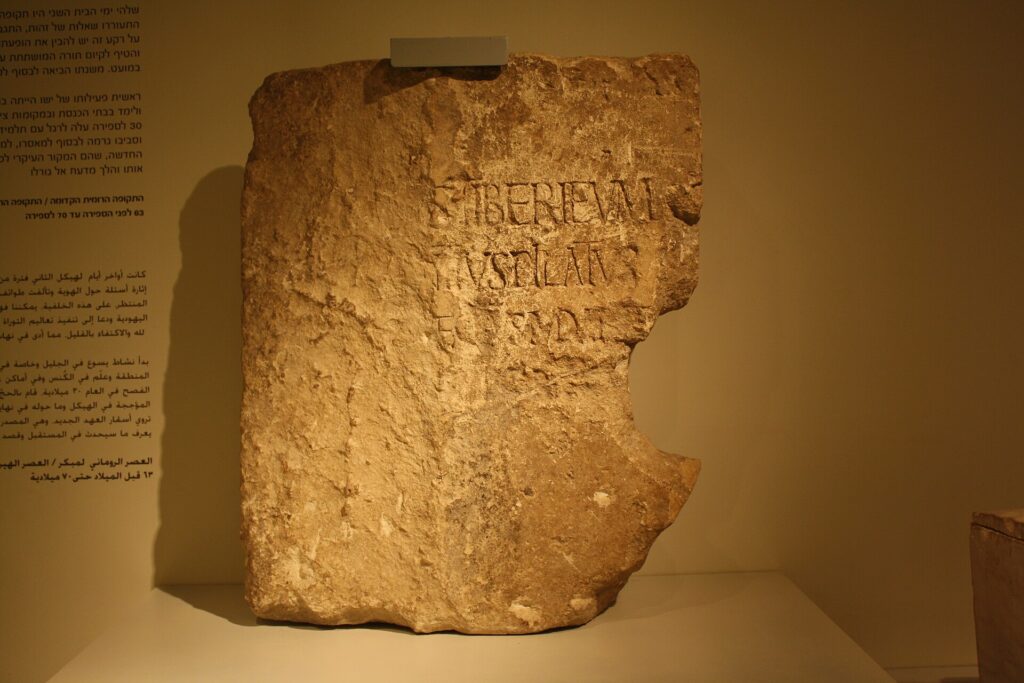
Until 1961, historians relied entirely on ancient manuscripts to document Pilate’s administration. That summer, a team of Italian archaeologists led by Dr. Antonio Frova was excavating the ruins of Caesarea Maritima, the ancient coastal capital of Roman Judea. While clearing a Roman theater, the team uncovered a limestone block that had been repurposed as a step in a staircase.
Upon examining the reverse side of the stone, the archaeologists discovered a damaged but highly legible Latin inscription. It was a dedication stone for a temple honoring the Emperor Tiberius, known as a Tiberieum. The inscription explicitly reads: “…Tiberieum… [Po]ntius Pilatus… [Praef]ectus Iuda[ea]e…” This artifact, now universally known as the Pilate Stone, provided the first undisputed physical evidence of the governor. Furthermore, it corrected a long-standing historical error regarding his official rank. Later Roman historians like Tacitus, alongside the Gospel writers, referred to Pilate using the anachronistic title of Procurator. The stone proved that during the reign of Tiberius, the actual title for the Roman administrator of Judea was Prefect—a strictly military role emphasizing that his primary administrative duty was keeping a volatile frontier province subjugated through armed force.
A Portrait of Brutality
While the Pilate Stone provided the physical anchor, the historical understanding of Pilate’s personality and administrative style derives from secular texts outside the biblical canon. Two major first-century Jewish historians—Flavius Josephus and Philo of Alexandria—wrote extensively about his tenure, which lasted from 26 to 36 CE.
The historical Pilate detailed in these accounts contrasts sharply with the hesitant, philosophically conflicted judge portrayed in the Gospels. The secular record describes a ruler who was ruthless, stubborn, and deeply insensitive to the religious convictions of his subjects. Philo of Alexandria, writing shortly after Pilate’s rule, characterized the administration as one defined by bribery, outrages, wanton injuries, repeated executions without trial, and ceaseless cruelty.
Flavius Josephus documented several specific historical incidents that highlight Pilate’s heavy-handed tactics. Early in his tenure, Pilate ordered his troops to march into Jerusalem carrying military standards bearing the image of the Emperor. Because Jewish law strictly forbade graven images, this sparked a massive, non-violent protest in Caesarea. Pilate surrounded the protesters with soldiers and threatened a mass beheading, only backing down when the Jewish crowds bared their necks and declared they would rather die than see their laws violated. Later, Pilate confiscated sacred funds from the Temple treasury to construct an aqueduct into Jerusalem. When massive crowds rioted against this expropriation, Pilate sent disguised Roman soldiers into the mob with concealed daggers, slaughtering a vast number of unarmed civilians and triggering a deadly stampede.
The Roman Perspective
From the perspective of the Roman Empire, Pilate was a minor, middle-management military governor stationed in a rebellious backwater province. Consequently, he is only briefly mentioned in secular Roman records, but that brief mention remains monumental for historical studies of the era.
Writing early in the second century, the elite Roman historian Tacitus documented the great fire of Rome under Emperor Nero. When explaining the origins of a despised group known as “Christians,” Tacitus wrote in his Annals (15.44) that the movement’s founder suffered the extreme penalty during the reign of Tiberius at the hands of the prefect Pontius Pilatus. For Tacitus, this was not a theological statement; it was a simple administrative fact. A political dissident in a frontier province had been executed via crucifixion, which was the standard, horrific Roman penalty reserved for slaves and political rebels.
Downfall and Disappearance
Pilate’s reliance on excessive violence ultimately ended his political career. According to Josephus, in 36 CE, a large group of Samaritans gathered at their sacred Mount Gerizim, following a charismatic leader who promised to reveal holy artifacts hidden by Moses. Viewing any large religious gathering as a potential military insurrection, Pilate dispatched his cavalry to intercept the procession, slaughtering the leadership and executing many civilians.
The Samaritan council formally complained to Lucius Vitellius, the Roman legate of Syria and Pilate’s direct superior. Vitellius determined that Pilate had exceeded his mandate through unnecessary bloodshed. He stripped Pilate of his office and ordered him to sail to Rome to answer to the Emperor Tiberius for his excessive cruelty.
However, before Pilate’s ship reached Italy in 37 CE, Emperor Tiberius died. After this moment, Pontius Pilate vanishes entirely from the historical record. While later folklore invented elaborate myths regarding his supposed suicide, conversion, or martyrdom, the secular history remains silent. Ultimately, historical-critical scholarship reveals a pragmatic, iron-fisted military prefect who governed exactly as the Roman Empire demanded: by maintaining order through absolute terror.
-
Beyond Abstinence: Defining the Architecture of Purity Culture
For many raised in late-20th-century evangelicalism, “abstinence” and “purity culture” are frequently treated as exact synonyms. However, while abstinence is a private historical ethical choice, purity culture is a modern, highly visible sociological construct. This article examines the architecture of the 1990s movement—from purity pledges to the courtship model—and explains why disentangling the ancient ethic from the modern subculture is the crucial first step in understanding its lasting psychological impact.
-
How Can Modern Churches Build Strong Communities Without Sacrificing Intellectual Honesty?
Can a church remain strong when its members question traditional interpretations of the Bible?Discover how shared values, meaningful relationships, and intellectual honesty can help modern Christian communities thrive without demanding agreement on every question.
-
A Voice from the Dust: How the Discovery of Ugarit Rewrote Biblical Scholarship
The accidental discovery of the ancient city of Ugarit in 1928 transformed biblical scholarship. Its texts provided crucial insights into Biblical Hebrew, uncovered the mythology of ancient Canaan, and revealed how Israelite religion developed within the wider cultural world of the ancient Near East.
-
Did Paul Believe Christians Go to Heaven? Paul’s Cosmos, Christology, and Hope of Resurrection
What did Paul think heaven was, who did he believe Jesus was, and what did he expect to happen after death? Explore Paul’s first-century Jewish apocalyptic worldview, his complex understanding of Jesus, and his expectation of bodily resurrection and the liberation of creation.
-
The Whistleblower in the Dirt: Unearthing the Socio-Economic Reality of the Talents
What’s the Parable of the Talents really about? Squadering your abilities or is there more? Let’s dig a little deeper.