
If you want to understand the theological and political evolution of ancient Israel, you only need to read one book: Isaiah.
Spanning 66 chapters, it is the undisputed heavyweight champion of Hebrew prophecy. Its poetry is breathtaking, its political commentary is razor-sharp, and its theological visions shaped both Rabbinic Judaism and early Christianity.
However, when modern historical-critical scholars examine the Book of Isaiah, they do not see the work of a single man writing in a vacuum. Instead, they see a massive, complex, multi-generational anthology. Over the span of nearly three centuries, multiple authors, editors, and prophetic schools layered their voices together to create a unified theological masterpiece.
To understand the message of Isaiah, we have to break the book down into its historical components, tracing the evolution from the thunderous warnings of the 8th century BCE to the cosmic hope of the post-exilic period.
The Structure: The Three Isaiahs
Since the late 19th century (specifically following the work of German scholar Bernhard Duhm), the overwhelming scientific consensus has divided the Book of Isaiah into three distinct sections, each written during a different geopolitical crisis.
1. First Isaiah (Proto-Isaiah): Chapters 1–39
The Era: 8th Century BCE (c. 740–701 BCE)
The Context: The Assyrian Empire is conquering the ancient Near East, destroying the Northern Kingdom of Israel and laying siege to Jerusalem.
This section contains the core prophecies of the original, historical man named Isaiah of Jerusalem (the son of Amoz). He was an aristocratic prophet with deep ties to the royal court of Judah. He lived through the terrifying reigns of kings Ahaz and Hezekiah.
First Isaiah is defined by a fierce, uncompromising focus on holiness and judgment. The original Isaiah looks at the corruption, economic inequality, and idolatry of Jerusalem and declares that the Assyrian army is the “rod of God’s anger.” He warns that if the kings of Judah rely on foreign military alliances rather than trusting in Yahweh, the nation will be crushed. Yet, even amidst the doom, First Isaiah introduces the concept of a faithful “remnant” that will survive the devastation, famously predicting the miraculous survival of Jerusalem during Sennacherib’s siege in 701 BCE.
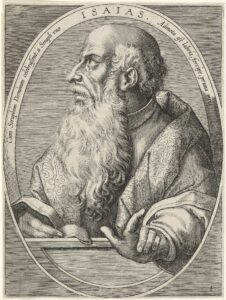
2. Second Isaiah (Deutero-Isaiah): Chapters 40–55
The Era: 6th Century BCE (c. 550–539 BCE)
The Context: The Babylonian Exile. Jerusalem has been destroyed, the Davidic monarchy is dead, and the elites are captive in Babylon.
Suddenly, at chapter 40, the tone, vocabulary, and historical setting of the book completely change. The Assyrian threat is gone, replaced by the Babylonian captivity. The author of these chapters is an anonymous prophet living among the exiles.
Second Isaiah pivots from judgment to comfort and cosmic restoration. This author witnesses the rise of the Persian Emperor Cyrus the Great and makes a staggering theological leap. He declares that Yahweh is not just the local god of Jerusalem, but the undisputed, singular Creator of the universe. In a radical move, Second Isaiah designates the pagan king Cyrus as God’s “Messiah” (anointed one), tasked with defeating Babylon and setting the Jewish exiles free. This section contains some of the most soaring, beautiful poetry in the ancient world, cementing the transition from Israelite henotheism to absolute monotheism.
3. Third Isaiah (Trito-Isaiah): Chapters 56–66
The Era: Late 6th to 5th Century BCE (c. 538–500 BCE)
The Context: The Return to Zion. The exiles have returned to a ruined Jerusalem, but the reality does not match the glorious vision promised by Second Isaiah.
The final chapters of the book were likely written by a post-exilic prophetic school—the spiritual disciples of the earlier Isaiahs. The returning exiles are struggling with poverty, ruined infrastructure, and fierce internal conflicts about who is allowed to participate in the rebuilt Temple.
Third Isaiah addresses this deeply fractured community. The message focuses heavily on social justice, proper worship, and radical inclusion. The authors aggressively push back against xenophobia, arguing that foreigners and eunuchs who keep the Sabbath must be welcomed into God’s house, declaring the Temple a “house of prayer for all nations.” The book concludes with a sweeping apocalyptic vision of a “new heavens and a new earth,” pushing the hope of restoration into a cosmic, eternal future.
Core Themes and Motifs
Despite being written by different authors across three centuries, the editors (redactors) who compiled the final scroll brilliantly wove specific literary and theological motifs throughout the entire text to give it profound unity.
The Holy One of Israel
This specific, majestic title for Yahweh appears 12 times in First Isaiah, 14 times in Second Isaiah, and twice in Third Isaiah (while appearing almost nowhere else in the Hebrew Bible). It serves as the theological superglue of the book. It emphasizes that God is wholly “other”—transcendent, pure, and terrifyingly brilliant. Because God is the “Holy One,” the people of Israel are expected to reflect that holiness through both ritual purity and socio-economic justice.
Zion Theology
Jerusalem (Mount Zion) is the geographical heart of the book, but its role evolves:
- First Isaiah: Zion is a corrupt city that must be purged by fire, but it is ultimately invulnerable to the Assyrians because it is God’s dwelling place.
- Second Isaiah: Zion is a grieving, abandoned mother who is comforted by the promise that her exiled children are returning home across a miraculously blooming desert.
- Third Isaiah: Zion becomes a cosmic, radiant capital. It is no longer just a Judean fortress, but the spiritual center of the world where all nations will stream to learn the law of God.
The Evolution of the Savior
The Book of Isaiah provides the foundational texts for how later Judaism and Christianity understood the concept of a deliverer.
- In First Isaiah, the hope is political and royal. The prophet looks for an ideal Davidic King—a shoot from the stump of Jesse (Isaiah 11) who will rule with perfect wisdom and establish global peace (where the wolf lives with the lamb).
- In Second Isaiah, the monarchy is dead. The hope shifts to the enigmatic Suffering Servant (famously detailed in Isaiah 53). This servant is not a conquering king, but a figure who absorbs the violence, sickness, and sins of the people, achieving redemption through suffering rather than military force.
The Message and Theology of Isaiah
When you read the Book of Isaiah as a finalized, redacted whole, it presents the ultimate macro-narrative of ancient Israelite theology.
The book argues that human history is not random; it is guided by the sovereign hand of the Holy One of Israel. It teaches that empires like Assyria and Babylon are merely tools in the hand of a God who demands justice for the poor and the oppressed.
The ultimate message of Isaiah is the trajectory of Purification, Comfort, and Universalism. It tells the story of a people who had to be brutally purged of their corruption through the fire of exile, only to discover that their God was big enough to orchestrate their rescue using a Persian emperor. It concludes with the radical theological assertion that Yahweh’s ultimate goal was never just to save the physical city of Jerusalem, but to use the suffering and restoration of Israel as a beacon of light to draw the entire world into a new, healed creation.
-
Beyond Abstinence: Defining the Architecture of Purity Culture
For many raised in late-20th-century evangelicalism, “abstinence” and “purity culture” are frequently treated as exact synonyms. However, while abstinence is a private historical ethical choice, purity culture is a modern, highly visible sociological construct. This article examines the architecture of the 1990s movement—from purity pledges to the courtship model—and explains why disentangling the ancient ethic from the modern subculture is the crucial first step in understanding its lasting psychological impact.
-
How Can Modern Churches Build Strong Communities Without Sacrificing Intellectual Honesty?
Can a church remain strong when its members question traditional interpretations of the Bible?Discover how shared values, meaningful relationships, and intellectual honesty can help modern Christian communities thrive without demanding agreement on every question.
-
A Voice from the Dust: How the Discovery of Ugarit Rewrote Biblical Scholarship
The accidental discovery of the ancient city of Ugarit in 1928 transformed biblical scholarship. Its texts provided crucial insights into Biblical Hebrew, uncovered the mythology of ancient Canaan, and revealed how Israelite religion developed within the wider cultural world of the ancient Near East.
-
Did Paul Believe Christians Go to Heaven? Paul’s Cosmos, Christology, and Hope of Resurrection
What did Paul think heaven was, who did he believe Jesus was, and what did he expect to happen after death? Explore Paul’s first-century Jewish apocalyptic worldview, his complex understanding of Jesus, and his expectation of bodily resurrection and the liberation of creation.
-
The Whistleblower in the Dirt: Unearthing the Socio-Economic Reality of the Talents
What’s the Parable of the Talents really about? Squadering your abilities or is there more? Let’s dig a little deeper.