
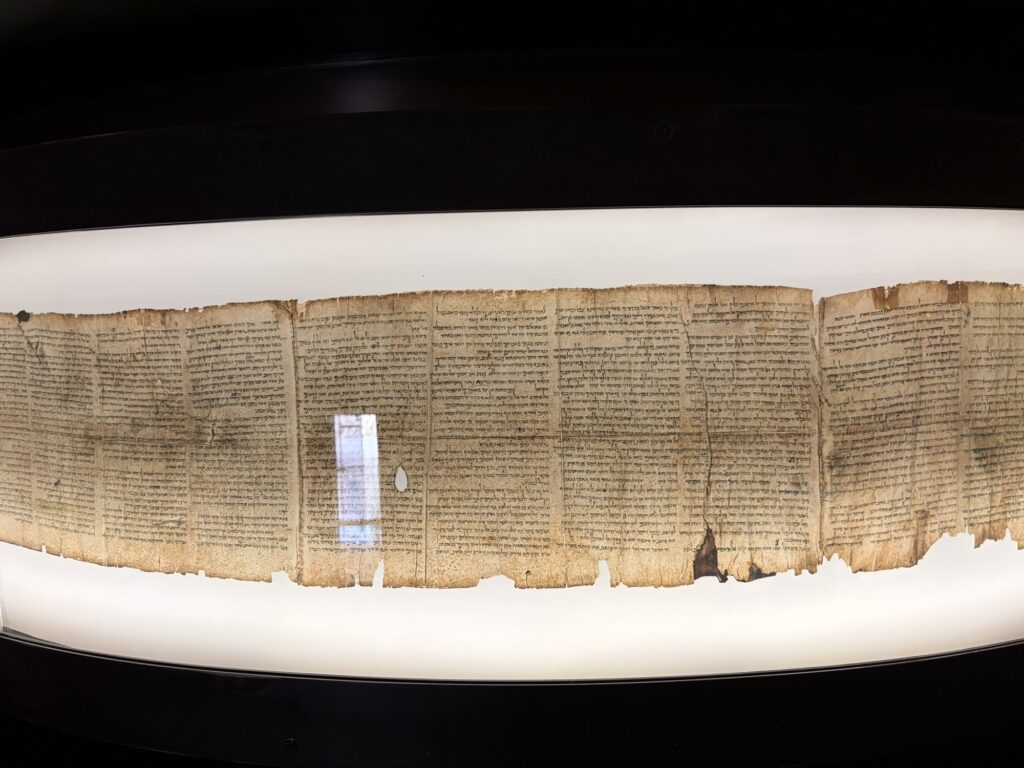
The Great Isaiah Scroll (1QIsaᵃ), currently housed at the Shrine of the Book in the Israel Museum, is undeniably a monumental artifact. Dating to roughly 125 BCE, it stands as the only completely preserved biblical scroll recovered from the Qumran caves. Its discovery demonstrated that a textual tradition closely resembling the medieval Masoretic Text existed over a millennium earlier than previously established by physical evidence.
However, a popular apologetic argument frequently utilizes this scroll to claim that the biblical text was preserved “perfectly” or “flawlessly” through the centuries. From a historical-critical perspective, a close analysis of the physical manuscript reveals a very different reality. When confronted with the actual manuscript data, the claim of perfect preservation is both historically and scientifically inaccurate.
Thousands of Textual Variants
While the overarching message and structure of the Great Isaiah Scroll align with the later Masoretic Text, the two documents are by no means identical. Textual critics and scholars have documented over 2,600 textual differences between 1QIsaᵃ and the standard medieval Hebrew text.
These variations generally fall into three categories:
- Orthography (Spelling): The vast majority of these differences are orthographic. The scribes of 1QIsaᵃ utilized a fuller spelling system—often referred to as the “Qumran practice”—extensively adding vowel letters (matres lectionis) to the text to aid in pronunciation.
- Grammar and Morphology: The scroll frequently employs different pronoun suffixes, verb forms, and conjunctions. These differences reflect the living Hebrew dialect of the Second Temple period, rather than the stricter, more standardized grammar of the later Masoretic tradition.
- Word Choices and Synonyms: There are numerous instances throughout the manuscript where the scroll substitutes a common word for a rarer one found in the Masoretic Text, or vice versa. This demonstrates that scribes occasionally updated the vocabulary for their contemporary audience.
Scribes at Work: Visible Errors and Corrections
A claim of perfect transmission implicitly requires an infallible copying process. Yet, the Great Isaiah Scroll is a remarkably human document, littered with physical evidence of scribal fallibility.
The manuscript bears the marks of human error and subsequent editorial intervention:
- Omissions and Insertions: The original scribe frequently skipped words, phrases, or entire lines. This was often the result of a common copying error known as parablepsis, where a scribe’s eye accidentally skips from one word to an identical word on the following line.
- Later Corrections: The scroll provides visible evidence of several different correctors who reviewed the text after the initial scribe had completed their work. These later editors crossed out mistakes, erased words, and squeezed missing text between the lines or into the margins.
- Alternative Readings: In certain passages, correctors inserted alternative readings directly above the original text. This clearly indicates that even within the Qumran community, there was an active awareness of variant textual traditions.
Conflating Manuscripts: The Difference Between 1QIsaᵃ and 1QIsaᵇ
The apologetic argument for perfect preservation often relies on a methodological error: conflating the Great Isaiah Scroll (1QIsaᵃ) with a second, highly fragmentary Isaiah scroll discovered in the same cave, known as 1QIsaᵇ.
The fragmentary 1QIsaᵇ is textually much closer to the eventual Masoretic Text, exhibiting very few variations. Apologists sometimes take the statistical uniformity of the highly fragmented 1QIsaᵇ and incorrectly apply those characteristics to the visually impressive, complete 1QIsaᵃ on display in the museum, using the resulting conflation to argue for absolute, overarching textual uniformity.
The Scientific Consensus: Substantial Continuity, Not Perfect Preservation
Utilizing the Great Isaiah Scroll to argue that “the biblical text” as a whole was perfectly preserved ignores the broader scientific consensus established by the rest of the Qumran library.
As demonstrated by other Qumran manuscripts, such as the Book of Jeremiah or Samuel, the Second Temple period was defined by textual plurality, where different literary editions of biblical books circulated simultaneously. While the proto-Masoretic tradition of Isaiah was remarkably stable compared to other texts, it was still subject to the normal historical realities of scribal transmission, linguistic updating, and human error.
The Great Isaiah Scroll is a magnificent historical witness that proves substantial continuity of a specific textual tradition. It does not, however, prove perfect preservation.
When you visit the museum the scroll you get to see in the shrine is a copy. The actual scroll is preserved in a specially designed bunker.
-
Beyond Abstinence: Defining the Architecture of Purity Culture
For many raised in late-20th-century evangelicalism, “abstinence” and “purity culture” are frequently treated as exact synonyms. However, while abstinence is a private historical ethical choice, purity culture is a modern, highly visible sociological construct. This article examines the architecture of the 1990s movement—from purity pledges to the courtship model—and explains why disentangling the ancient ethic from the modern subculture is the crucial first step in understanding its lasting psychological impact.
-
How Can Modern Churches Build Strong Communities Without Sacrificing Intellectual Honesty?
Can a church remain strong when its members question traditional interpretations of the Bible?Discover how shared values, meaningful relationships, and intellectual honesty can help modern Christian communities thrive without demanding agreement on every question.
-
A Voice from the Dust: How the Discovery of Ugarit Rewrote Biblical Scholarship
The accidental discovery of the ancient city of Ugarit in 1928 transformed biblical scholarship. Its texts provided crucial insights into Biblical Hebrew, uncovered the mythology of ancient Canaan, and revealed how Israelite religion developed within the wider cultural world of the ancient Near East.
-
Did Paul Believe Christians Go to Heaven? Paul’s Cosmos, Christology, and Hope of Resurrection
What did Paul think heaven was, who did he believe Jesus was, and what did he expect to happen after death? Explore Paul’s first-century Jewish apocalyptic worldview, his complex understanding of Jesus, and his expectation of bodily resurrection and the liberation of creation.
-
The Whistleblower in the Dirt: Unearthing the Socio-Economic Reality of the Talents
What’s the Parable of the Talents really about? Squadering your abilities or is there more? Let’s dig a little deeper.