
In April 2010, Noah’s Ark Ministries International (NAMI), an evangelical organization based in Hong Kong, made an announcement that captured international headlines: their expedition had discovered ancient wooden structures high on Mount Ararat. The team reported a 99.9% probability that the structure was Noah’s Ark.
For many observers, that specific percentage stood out. It functioned as an expression of extreme confidence, though it was not accompanied by a defined sample space, a validated statistical model, or an independently verifiable calculation. Following the announcement, allegations surfaced—some from individuals associated with earlier expeditions—suggesting the wooden structures might have been staged. While the available public record does not justify treating every detail of these allegations as proven fact, the historical outcome of the 2010 expedition is clear. More than a decade and a half later, there is still no generally accepted archaeological confirmation of the claimed vessel.
The NAMI expedition is not merely a story of failed verification; it is a prime example of the financial scale of these projects. The parent organization behind the announcement, The Media Evangelism Limited, is a massive media entity that operates a Noah’s Ark theme park in Hong Kong and produces documentaries. By examining what happens to these announcements after the initial publicity fades, a complex picture emerges—one that raises important questions about geology, methodology, and the lucrative commercial value of an archaeological discovery that is perpetually “imminent.”
Two Sites, One Narrative
It is crucial to distinguish between the two primary geographic targets of these claims. The 2010 NAMI expedition focused on alleged wooden structures buried in the ice high on Mount Ararat. Conversely, much of the ongoing search focuses on the Durupınar site—a massive, boat-shaped geological formation located further south near Doğubayazıt.
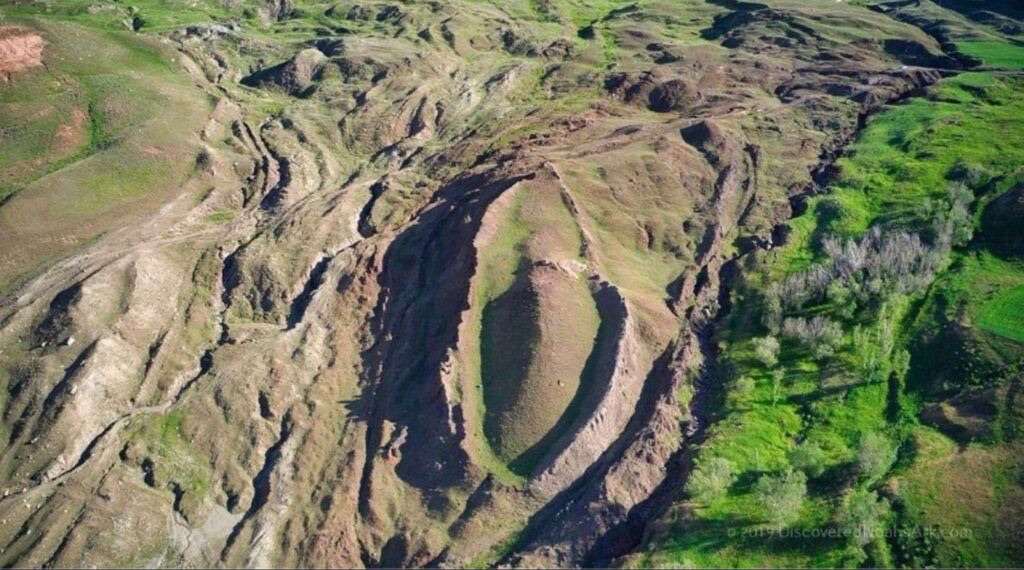
While geological findings at Durupınar do not directly refute NAMI’s claims about wooden structures elsewhere on the mountain, both sites attract expeditions that share a similar conceptual framework—a framework that often conflicts with historical-critical scholarship.
The Biblical and Historical Framework
To understand the search for the Ark, it is necessary to examine what biblical scholarship tells us about the flood narrative itself. The biblical account found in Genesis 6–9 is not an isolated ancient text. It belongs to a broader ancient Near Eastern literary tradition involving transmission, adaptation, and shared motifs. This includes the earlier, though fragmentary, Mesopotamian Atrahasis Epic, as well as the later Epic of Gilgamesh. Tablet XI of Gilgamesh, for instance, details a catastrophic deluge, a divinely instructed boatbuilder, the release of birds, and a vessel coming to rest on a mountain.
These literary relationships do not definitively rule out a historical flood event, but they seriously complicate attempts to treat the Genesis account as an independent, journalistic record of a specific wooden vessel waiting to be found.
Furthermore, there is a geographical misconception that drives many modern expeditions. Genesis 8:4 does not state that the Ark rested on the modern summit of Mount Ararat. It notes that the vessel came to rest on the “mountains of Ararat,” referencing the broader geographical region associated with ancient Urartu. The identification of the biblical location with the specific Turkish peak is a later interpretive tradition, yet many expeditions proceed as though the biblical text provides precise geographical coordinates.
A History of Imminent Discoveries
The Durupınar site did not enter the public consciousness through a recent archaeological breakthrough; it was noticed in 1959 during an aerial survey. Its unusual, hull-like shape immediately attracted international interest.
For over six decades, the Durupınar formation has been repeatedly presented as a promising Ark location. A pivotal figure in popularizing this site was Ron Wyatt, an American amateur explorer who claimed numerous biblical discoveries throughout his career, including the Ark of the Covenant and chariot wheels from the Exodus. Wyatt’s approach helped popularize a model of biblical archaeology in which extraordinary claims were presented directly to a religious audience via videos and newsletters, largely bypassing established archaeological channels.
Notably, skepticism toward Wyatt’s methodology is not limited to secular academics. Major young-earth creationist organizations, such as Answers in Genesis, have published extensive critiques rejecting Wyatt’s evidence. When organizations committed to the historical reality of a global flood find the presented evidence inadequate, it becomes clear that the skepticism surrounding these discoveries is a matter of archaeological standards, not merely anti-religious bias.
The Geological Reality and the Radar Problem
When evaluating the Durupınar site specifically, the most vital scientific context comes from published geological investigations. While a single study does not constitute universal consensus on every aspect of the region’s topography, independent geologists have consistently identified natural explanations for the formation, and no independently authenticated archaeological evidence establishes it as a vessel.
In 1996, geologist Lorence G. Collins and David Fasold published a critical analysis in the Journal of Geoscience Education titled, “Bogus ‘Noah’s Ark’ from Turkey Exposed as a Common Geologic Structure”. Their investigation explained the formation’s characteristics through natural geological processes, identifying the underlying structure as a doubly plunging syncline.
Perhaps the most compelling aspect of this study was Fasold’s involvement. Fasold had previously been a prominent champion of the Durupınar-Ark interpretation before changing his position in response to the physical evidence. A researcher changing his conclusion in response to geological evidence illustrates the critical difference between investigating a hypothesis and defending a predetermined answer.
Despite this, recent expeditions have attempted to bypass the surface geology by focusing on subsurface anomalies. Modern searches frequently utilize ground-penetrating radar (GPR) and electrical resistivity tomography. These are highly valuable scientific instruments, but their results require careful interpretation. A radar anomaly does not independently establish the presence of timber, rooms, or a ship’s hull.
The 2026 Expedition: The Economics of Perpetual Discovery
This ongoing cycle is perfectly illustrated by recent efforts at the Durupınar site. In September 2026, the organization Noah’s Ark Scans conducted a highly publicized core-drilling initiative. Following the fieldwork, the project founder told media outlets that a drill bit had broken at a depth of four to five meters on a hard layer, suggesting the obstruction could be rock or possibly petrified wood.
While stating that definitive laboratory results will be evaluated over the winter, the organization simultaneously utilizes the suspense to drive funding. The project’s official website directs supporters to a GiveSendGo crowdfunding campaign, advertises regional tours to the site, and sells official merchandise—including $30 “The Ark Is Real” t-shirts—explicitly noting that every purchase funds their ongoing fieldwork in eastern Turkey.
This represents a clear case study in the modern economics of the Ark search: an inconclusive event (a broken drill bit) is framed as a potential breakthrough, generating media momentum that directly translates into immediate merchandising and donation opportunities.
The Methodology of an Unfalsifiable Hypothesis
An investigator could reasonably respond that an inconclusive radar survey or a broken drill bit does not falsify the presence of a buried archaeological structure. That is true. However, the real methodological flaw arises when investigators fail to specify what evidence would cause them to abandon the Ark interpretation entirely.
Inconclusive evidence can justify further research. It cannot, by itself, justify increasing confidence in a particular explanation. If the only acceptable outcome is discovering Noah’s Ark, every inconclusive result becomes an argument for another expedition.
An organization announcing that Noah’s Ark has definitively been found would immediately face demands for physical, verifiable evidence. Conversely, a claim that the Ark might be confirmed next year is much harder to conclusively evaluate, yet it successfully generates media attention, curiosity, and a sense of urgency for supporters. The repeated failure to produce conclusive evidence has not ended the search; rather, it continually fuels it.
There is a fundamental difference between funding research to determine whether a hypothesis is correct and funding research that continually assumes the hypothesis must eventually be confirmed.
After more than sixty years of investigating the same boat-shaped formation, how many more inconclusive discoveries must be announced before the original hypothesis is seriously reconsidered?
It makes us wonder who’s profiting from this.
-
Beyond Abstinence: Defining the Architecture of Purity Culture
For many raised in late-20th-century evangelicalism, “abstinence” and “purity culture” are frequently treated as exact synonyms. However, while abstinence is a private historical ethical choice, purity culture is a modern, highly visible sociological construct. This article examines the architecture of the 1990s movement—from purity pledges to the courtship model—and explains why disentangling the ancient ethic from the modern subculture is the crucial first step in understanding its lasting psychological impact.
-
How Can Modern Churches Build Strong Communities Without Sacrificing Intellectual Honesty?
Can a church remain strong when its members question traditional interpretations of the Bible?Discover how shared values, meaningful relationships, and intellectual honesty can help modern Christian communities thrive without demanding agreement on every question.
-
A Voice from the Dust: How the Discovery of Ugarit Rewrote Biblical Scholarship
The accidental discovery of the ancient city of Ugarit in 1928 transformed biblical scholarship. Its texts provided crucial insights into Biblical Hebrew, uncovered the mythology of ancient Canaan, and revealed how Israelite religion developed within the wider cultural world of the ancient Near East.
-
Did Paul Believe Christians Go to Heaven? Paul’s Cosmos, Christology, and Hope of Resurrection
What did Paul think heaven was, who did he believe Jesus was, and what did he expect to happen after death? Explore Paul’s first-century Jewish apocalyptic worldview, his complex understanding of Jesus, and his expectation of bodily resurrection and the liberation of creation.
-
The Whistleblower in the Dirt: Unearthing the Socio-Economic Reality of the Talents
What’s the Parable of the Talents really about? Squadering your abilities or is there more? Let’s dig a little deeper.