
If you scroll through modern pop culture, feminist literature, or fantasy lore, Lilith is an absolute superstar. She is widely known by a captivating, scandalous backstory: she was Adam’s first wife, created from the same earth as him before Eve was ever in the picture. Because she was made his equal, she refused to submit to him, spoke the secret name of God, flew away from the Garden of Eden, and became the mother of demons.
It is a brilliant, empowering, and terrifying narrative. There is just one catch from a historical-critical perspective: none of that story is in the Bible.
Much like Satan and Mammon, the character of Lilith is the result of a massive, centuries-long game of mythological telephone. She evolved from a terrifying ancient Mesopotamian disease-bringer into a minor biblical bird, morphed into a medieval rebel, and finally resurrected as a modern icon of independence.
Here is the evolutionary biography of Lilith, tracing how a nightmare became a legend.
Phase 1: The Mesopotamian Wind Demon (Lilitu)
Long before the Hebrew Bible was written, the ancient Near East was haunted by a class of terrifying supernatural creatures. In ancient Sumerian and Akkadian mythology (dating back to the 3rd millennium BCE), there was a category of female demons known as the Lilitu or Ardat-Lili.
These were not fallen angels or rebellious wives; they were the personification of ancient trauma. In a world with staggering infant mortality rates and sudden, unexplained deaths, the Lilitu were believed to be wind and storm demons who brought disease and death to pregnant women and newborns. They were often depicted as predatory, phantom-like figures who roamed the night, stealing into houses to snatch babies or seduce sleeping men.
When the ancient Israelites lived alongside the Babylonians and Canaanites, this regional folklore naturally bled into their cultural vocabulary. In Hebrew folk etymology, the name Lilith became closely associated with the Hebrew word לַיְלָה (lailah), meaning “night.” She became the ultimate “terror of the night.”
Phase 2: The Screech Owl of Isaiah (The Biblical Cameo)
Despite her massive modern reputation, Lilith only appears in the canonical Hebrew Bible exactly one time. And she isn’t in the Garden of Eden.
In Isaiah 34:14, the prophet is describing the total, apocalyptic destruction of the kingdom of Edom. He paints a picture of a ruined, desolate wasteland that has been completely abandoned by humans and overtaken by wild scavengers.
“Desert creatures will meet with hyenas, and wild goats will bleat to each other; there the lilith will also rest and find for herself a place of repose.”
In this context, Lilith is not a grand cosmic villain or a rival to Eve. She is simply listed alongside hyenas, wild goats, and vultures as a creature of the desolate ruins. Because the exact translation of lilith here is ambiguous, English Bibles have historically translated the word as “screech owl,” “night monster,” or “night hag.” In the biblical text itself, she is nothing more than an eerie, nocturnal scavenger haunting the desert.
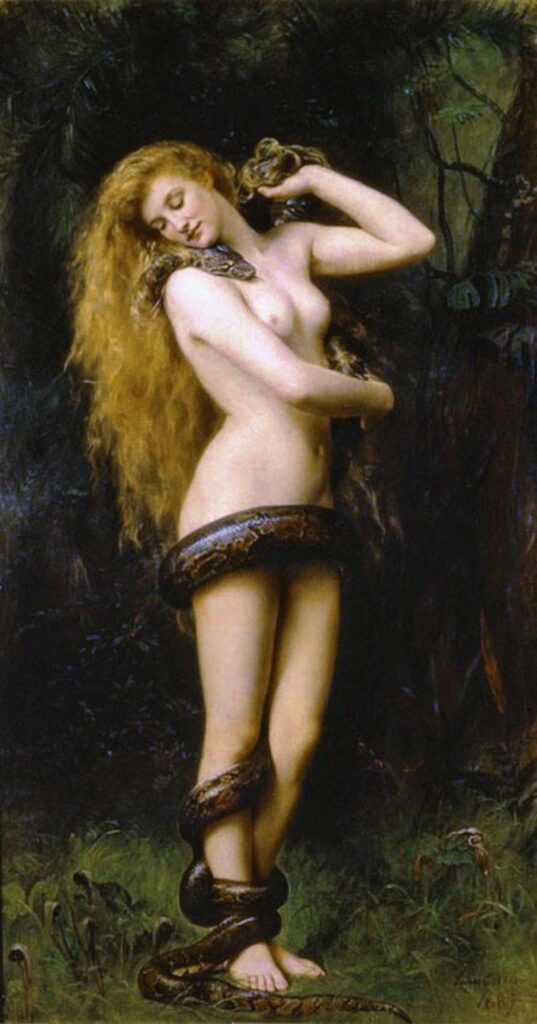
Phase 3: The Talmudic Terror (Late Antiquity)
During the Rabbinic period (roughly the 3rd to 6th centuries CE), Jewish scholars compiling the Talmud began to flesh out the folklore surrounding Lilith, returning her to her terrifying Mesopotamian roots.
In the Talmud, Lilith is transformed into a highly dangerous, winged succubus. The rabbis described her as a demon with long flowing hair who hunted in the dark. She had two primary, horrifying functions in Jewish folklore:
- The Child-Thief: She was blamed for the sudden deaths of infants (what we might now call SIDS).
- The Seed-Stealer: She was believed to seduce men in their sleep to steal their seed, using it to birth an army of demonic offspring.
For centuries, Lilith was viewed with absolute, paralyzing fear. Archaeological excavations across the Middle East have uncovered hundreds of ancient Jewish “incantation bowls” and amulets buried under the floors of houses. These bowls were inscribed with magical spells specifically designed to bind Lilith and physically block her from entering the bedrooms of pregnant women.
Phase 4: Adam’s First Wife (The Alphabet of Ben Sira)
If Lilith was just an owl or a child-stealing monster, where did the famous story about her being Adam’s first wife come from?
The answer lies in a strange, anonymous, and highly satirical text written around the 8th to 10th centuries CE, called The Alphabet of Ben Sira.
The author of this medieval text noticed a famous textual glitch in the Book of Genesis. In Genesis chapter 1, God creates man and woman simultaneously: “male and female he created them.” But in Genesis chapter 2, God creates Adam first, and later creates Eve out of Adam’s rib.
To resolve this contradiction, the Alphabet of Ben Sira invented a brilliant, retrospective piece of fan-fiction. The author claimed that the woman in Genesis 1 was Lilith, and the woman in Genesis 2 was Eve.
According to this medieval text, God created Lilith from the exact same earth as Adam. When Adam demanded that Lilith lie beneath him during sex (a metaphor for female subservience), Lilith flatly refused, stating: “We are equal to each other inasmuch as we were both created from the earth.” When Adam refused to compromise, Lilith uttered the secret, ineffable name of God, grew wings, and flew away from the Garden of Eden to the shores of the Red Sea. God sent three angels (Senoy, Sansenoy, and Semangelof) to bring her back, but she refused, embracing her role as the mother of demons.
This is the crucial historical takeaway: the story of Lilith as the rebellious first wife was written nearly a thousand years after the New Testament, and almost two thousand years after Genesis. It is medieval folklore, not ancient scripture.
Phase 5: The Feminist Resurrection
For the next millennium, Lilith remained a terrifying bogeyman in Jewish mysticism and Kabbalah. But in the 20th century, the mythological script was completely flipped.
During the feminist movements of the 1960s and 70s, writers and activists looked back at the medieval Alphabet of Ben Sira and realized something profound: by modern standards, Lilith was not the villain of the story. She was the hero.
She was a woman who was created equal to man, demanded to be treated as an equal, and willingly chose to be demonized and exiled into the wilderness rather than submit to an oppressive patriarchal structure. Lilith was reclaimed as the ultimate symbol of female autonomy and power. This reclamation birthed Jewish feminist magazines named Lilith, the famous Lilith Fair music festival of the 1990s, and countless modern fantasy adaptations where she reigns as a dark, powerful, independent anti-hero.
Summary: A Myth for Every Era
When we look at the historical evolution of Lilith, we see the ultimate mirror of human psychology. To the ancient Mesopotamians, she was the explanation for the tragic deaths of their children. To the biblical prophets, she was the eerie sound of a bird in a ruined city. To medieval rabbis, she was a cautionary tale about the dangers of female rebellion. And to the modern world, she is an icon of liberation. Lilith is the perfect example of how mythology never really dies—it just adapts to what society needs it to be.
-
Beyond Abstinence: Defining the Architecture of Purity Culture
For many raised in late-20th-century evangelicalism, “abstinence” and “purity culture” are frequently treated as exact synonyms. However, while abstinence is a private historical ethical choice, purity culture is a modern, highly visible sociological construct. This article examines the architecture of the 1990s movement—from purity pledges to the courtship model—and explains why disentangling the ancient ethic from the modern subculture is the crucial first step in understanding its lasting psychological impact.
-
How Can Modern Churches Build Strong Communities Without Sacrificing Intellectual Honesty?
Can a church remain strong when its members question traditional interpretations of the Bible?Discover how shared values, meaningful relationships, and intellectual honesty can help modern Christian communities thrive without demanding agreement on every question.
-
A Voice from the Dust: How the Discovery of Ugarit Rewrote Biblical Scholarship
The accidental discovery of the ancient city of Ugarit in 1928 transformed biblical scholarship. Its texts provided crucial insights into Biblical Hebrew, uncovered the mythology of ancient Canaan, and revealed how Israelite religion developed within the wider cultural world of the ancient Near East.
-
Did Paul Believe Christians Go to Heaven? Paul’s Cosmos, Christology, and Hope of Resurrection
What did Paul think heaven was, who did he believe Jesus was, and what did he expect to happen after death? Explore Paul’s first-century Jewish apocalyptic worldview, his complex understanding of Jesus, and his expectation of bodily resurrection and the liberation of creation.
-
The Whistleblower in the Dirt: Unearthing the Socio-Economic Reality of the Talents
What’s the Parable of the Talents really about? Squadering your abilities or is there more? Let’s dig a little deeper.