
For decades, early biblical archaeologists searched the sands of the Middle East for a “smoking gun”—a monument or text that would definitively prove the stories of the Book of Exodus and the Israelite conquest of Canaan. They were looking for Egyptian records of Moses, the parting of the sea, or the plagues.
They never found them. But in 1896, the legendary British archaeologist Sir Flinders Petrie made a discovery in the ruins of a temple in Thebes (modern Luxor) that sent shockwaves through the historical community. He unearthed a massive, ten-foot-tall slab of black granite carved with Egyptian hieroglyphs.
Petrie reportedly turned to his colleague and said, “This stele will be better known in the world than anything else I have found.” He was right. Known today as the Merneptah Stele (or the Israel Stele), this monument contains the absolute earliest extra-biblical mention of “Israel” in human history. By reading the stone critically, we can uncover exactly how the ancient Egyptians viewed the Israelites, and catch a Pharaoh in a monumental lie.
An Afterthought at the End of a War
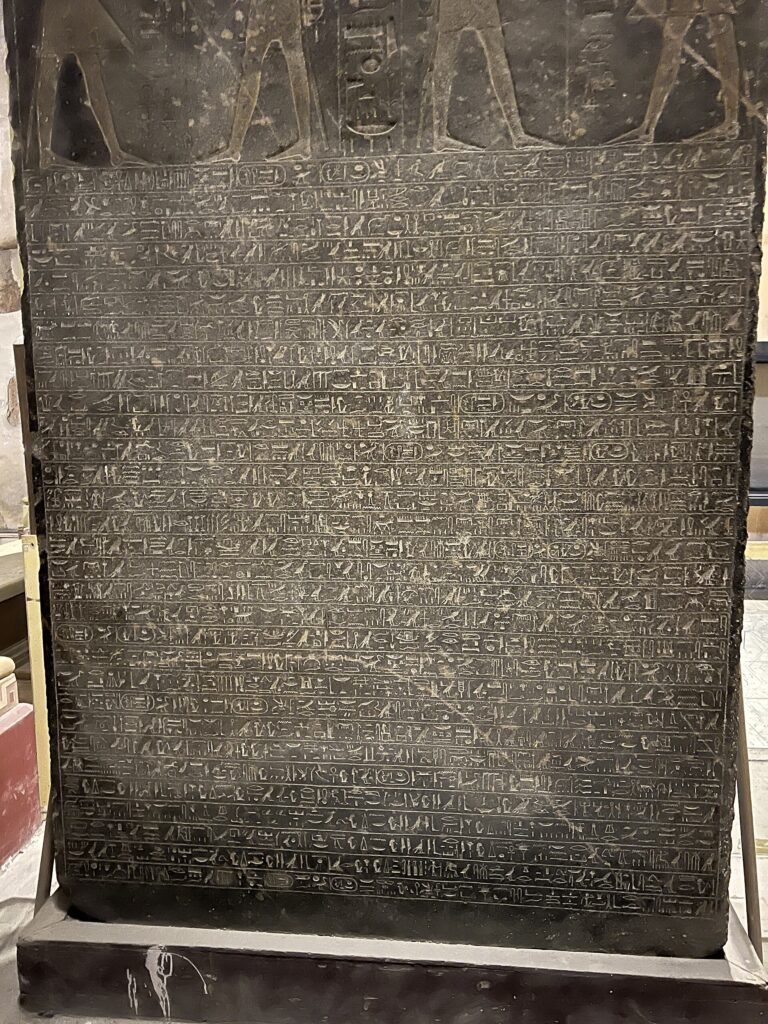
The stele was commissioned around 1208 BCE by Pharaoh Merneptah, the son of the famous Ramesses II (Ramesses the Great).
If you were to read the entire monument, you might actually find it quite tedious. The vast majority of the inscription is a boastful, highly poetic account of Merneptah’s military victory over the Libyans to the west of Egypt.
But at the very end of the stele, almost as an afterthought, the scribes tacked on a short poem summarizing a separate military campaign into the land of Canaan (the region that would become modern Israel). The poem lists the city-states the Pharaoh conquered to pacify the region:
“Canaan is plundered with every hardship.
Ashkelon is taken, Gezer captured,
Yenoam reduced to nothing.
Israel is laid waste, its seed is not.”
The Magic of the Determinative: A People, Not a Kingdom
The appearance of the word “Israel” is historically explosive, but the true genius of the monument lies in a tiny, easily missed detail in the hieroglyphics.
Ancient Egyptian is a complex writing system. Because many words could sound the same or have multiple meanings, scribes used silent symbols at the end of a word called determinatives to tell the reader exactly what category the word belonged to.
When the scribe carved the names of the Canaanite enemies—Ashkelon, Gezer, and Yenoam—he used a specific determinative: a throw-stick and three mountains. To an Egyptian reader, this symbol meant: This is a settled, foreign city-state with borders.
But when the scribe carved the name “Israel,” he changed the symbol. He used the determinative of a man and a woman over three vertical plural strokes. To an Egyptian reader, this meant: This is a foreign, nomadic, or tribal people with no established borders or central city.
This tiny linguistic shift is an archaeological goldmine. It proves that in the late 13th century BCE, Israel definitively existed in the land of Canaan. However, they were not yet the wealthy, heavily fortified kingdom with a massive capital city that we see centuries later under King Omri or King David. The Merneptah Stele perfectly aligns with the historical reality of the biblical Book of Judges: early Israel was a loose, rural tribal confederation wandering the highlands.
The Seed is Not: Spotting the Royal Lie
Just like King Mesha of Moab would do four centuries later on his own stele, Pharaoh Merneptah could not resist the urge to exaggerate.
Merneptah proudly declares to the world: “Israel is laid waste, its seed is not.”
In ancient Egyptian political poetry, claiming an enemy’s “seed is not” was a powerful agricultural and genealogical metaphor. Merneptah was boasting that he had completely eradicated the Israelites—destroying their grain so they would starve, and wiping out their bloodline so they would have no future descendants. He was claiming a total, permanent genocide.
History, of course, proves this was a spectacular piece of royal fiction. The tribal people that Merneptah claimed to have wiped off the face of the earth had not perished. Instead, they would survive the collapse of the Bronze Age, settle the highlands, unite into a monarchy, and outlast the Egyptian empire that carved this very stone.
Tearing Down the Monolith
The Merneptah Stele forces us to read history with a critical, nuanced eye. It does not prove the story of the Exodus, nor does it confirm the parting of the Red Sea. If anything, it complicates the biblical narrative by showing that the Egyptians viewed early Israel as just another minor, nomadic nuisance in their empire.
But the stone remains the ultimate historical anchor. It strips away the mythology and grounds the origins of the biblical people in hard, granite reality. It proves that by 1208 BCE, a distinct group of people calling themselves Israel was wandering the Canaanite highlands, making enough noise to draw the wrath—and the lies—of the most powerful empire on earth.
-
Beyond Abstinence: Defining the Architecture of Purity Culture
For many raised in late-20th-century evangelicalism, “abstinence” and “purity culture” are frequently treated as exact synonyms. However, while abstinence is a private historical ethical choice, purity culture is a modern, highly visible sociological construct. This article examines the architecture of the 1990s movement—from purity pledges to the courtship model—and explains why disentangling the ancient ethic from the modern subculture is the crucial first step in understanding its lasting psychological impact.
-
How Can Modern Churches Build Strong Communities Without Sacrificing Intellectual Honesty?
Can a church remain strong when its members question traditional interpretations of the Bible?Discover how shared values, meaningful relationships, and intellectual honesty can help modern Christian communities thrive without demanding agreement on every question.
-
A Voice from the Dust: How the Discovery of Ugarit Rewrote Biblical Scholarship
The accidental discovery of the ancient city of Ugarit in 1928 transformed biblical scholarship. Its texts provided crucial insights into Biblical Hebrew, uncovered the mythology of ancient Canaan, and revealed how Israelite religion developed within the wider cultural world of the ancient Near East.
-
Did Paul Believe Christians Go to Heaven? Paul’s Cosmos, Christology, and Hope of Resurrection
What did Paul think heaven was, who did he believe Jesus was, and what did he expect to happen after death? Explore Paul’s first-century Jewish apocalyptic worldview, his complex understanding of Jesus, and his expectation of bodily resurrection and the liberation of creation.
-
The Whistleblower in the Dirt: Unearthing the Socio-Economic Reality of the Talents
What’s the Parable of the Talents really about? Squadering your abilities or is there more? Let’s dig a little deeper.