
When reading the Gospels, one inevitably encounters passages that are difficult to align. Consider the cleansing of the Temple. John places the episode near the beginning of Jesus’ ministry, while Matthew, Mark, and Luke place it during his final visit to Jerusalem. Does one account have to be wrong?
Historically, interpreters have answered this question differently. Modern historical criticism, and specifically redaction criticism, approaches this by asking what each evangelist is doing with the traditions and sources available to him. By the mid-twentieth century, redaction criticism increasingly emphasized how each evangelist shaped inherited traditions and sources into distinctive theological narratives. Mark presents Jesus as the suffering and misunderstood Messiah, with the passion occupying a particularly prominent place. Matthew repeatedly presents Jesus in relation to Moses, Israel’s Scriptures, and the fulfillment of Torah. Luke repeatedly emphasizes the poor, outsiders, women, sinners, and others who occupy socially marginal positions. John presents Jesus through distinctive theological language, most famously as the Logos—the Word who becomes flesh.
The Quest for Historical Harmony
Ancient Christians were already well aware of these variations, but they responded through different hermeneutical lenses.
Augustine of Hippo approached Gospel discrepancies from a strong conviction that the canonical texts were truthful and divinely authoritative. In The Harmony of the Gospels, he sought explanations for apparent tensions, sometimes appealing to differences in wording, selection, chronology, or the possibility that similar accounts described separate events.
The Temple cleansing provides a clear illustration of his method. Augustine responded to the chronological difference between John and the Synoptics by proposing that Jesus cleansed the Temple twice—with John recording the first event, and the other three recording the later one. Augustine placed considerable emphasis on demonstrating that these apparent discrepancies could be reconciled at the level of historical chronology.
Origen and the Hermeneutics of Difficulty
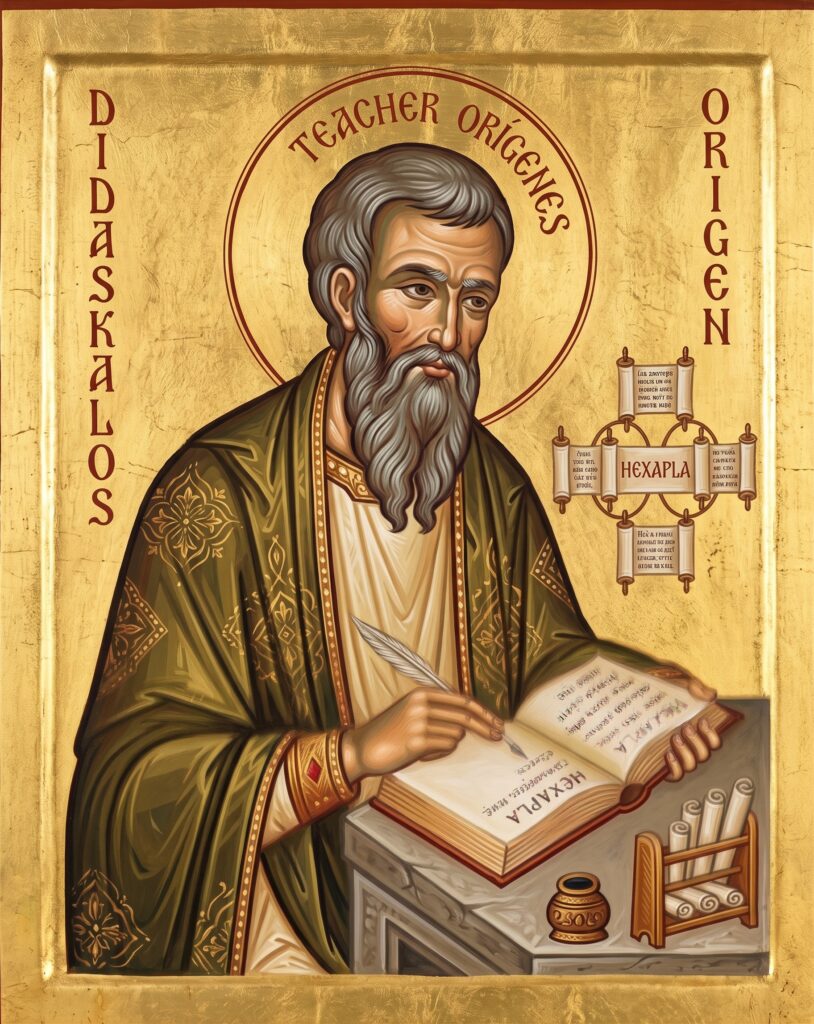
Origen of Alexandria encountered many of the same difficulties, but his solution could take a different form. Unlike interpreters who insist that every apparent discrepancy must be resolved at the level of historical chronology, Origen was willing to acknowledge that some Gospel narratives cannot be adequately reconciled if they are read solely as straightforward history. Rather than abandoning the texts, he turned to their deeper spiritual meaning.
Crucially, Origen did not reject the concept of harmony; rather, he distinguished historical or literal harmony from a deeper spiritual harmony. When examining the Temple cleansing, Origen argued that the accounts could not be adequately harmonized if treated solely as a straightforward historical chronology. He therefore sought a different kind of harmony, asking what the difficulty itself might be communicating.
Origen described some of Scripture’s difficulties as “stumbling blocks”: obstacles within the literal narrative that could force the reader to search for a deeper spiritual meaning. For Origen, this did not mean that Scripture had failed; the difficulty itself could be part of the Holy Spirit’s pedagogical design. Indeed, Origen could go further: he argued that where a historical reading could not convey the spiritual meaning, the Holy Spirit might allow Scripture to contain events that did not literally occur or could not have occurred. The purpose was not deception, but to prevent readers from stopping at the surface and to lead them toward a deeper understanding of divine truth.
Reading with Intellectual Honesty
The existence of Gospel differences does not require the reader either to harmonize them away or to abandon faith. It asks a more difficult question: what should we do when the texts themselves resist easy harmonization?
Augustine responded to such difficulties by searching for historical reconciliation. Origen sometimes took another path. When a Gospel narrative could not be reconciled with another at the level of straightforward chronology, he did not simply discard it. He asked what the difficulty itself might be doing within the text. For Origen, a stumbling block could become an invitation to move beyond the surface and search for a deeper meaning.
Modern historical criticism asks different questions about sources, composition, chronology, and the theological purposes of the evangelists. We do not have to become Origenists to learn something from his approach. We can acknowledge difficult passages without embarrassment, distinguish evidence from harmonizing speculation, and recognize that a text’s surface meaning may not exhaust its meaning.
Intellectual honesty therefore does not require Christians to choose between faith and critical reading. It requires them to take the texts seriously enough to encounter them as they have actually come to us: four canonical narratives with overlapping traditions, distinctive emphases, theological purposes, and tensions that have challenged Christian readers from the beginning. Sometimes the most faithful response to a difficult text is not to make the difficulty disappear, but to allow it to make us read more carefully.
-
Ancient Israel and Judah: History Behind the Hebrew Bible
Why did Israel disappear while Judah survived? Why did Egypt support its former Assyrian conquerors? And why does the Bible portray some of Judah’s neighbours as enemies and traitors? Archaeology and ancient inscriptions reveal a fascinating history of political alliances, imperial ambitions, and national catastrophe—and help explain how that history shaped the Hebrew Bible.
-
Reconsidering ‘Adam’ in Hosea 6:7: A Historical-Critical Analysis
The translation of kəʾādām in Hosea 6:7 represents a classic textual knot where a single ambiguous term can reorient a passage’s entire historical setting. By evaluating the locative anchor šām (“there”), historical-critical scholars find compelling reasons to read the phrase as a reference to a local Jordan Valley town rather than the primeval first man.
-
Part 5: The Modern Era and the Individualized Psalm
Analyze the profound shift in 20th-century worship music from objective, communal liturgy to highly personalized expressions of psychological faith. Understand how contemporary arrangements utilize the introspective poetry of texts like Psalm 139.
-
Part 4: The Anglo-American Diaspora and “Lining Out”
Follow the migration of metrical psalmody across the Atlantic into rugged frontier communities lacking organs and printed text. Investigate the resilient, highly communal vocal practices of Common Meter, “lining out,” and American Shape-Note singing.
-
Part 3: The Calvinist Reformation and Metrical Psalmody
Examine the 16th-century musical revolution that dismantled complex Latin polyphony to democratize congregational singing. Learn how the Genevan Psalter fundamentally reshaped ancient Hebrew poetry into metered European melodies.
Leave a Reply
You must be logged in to post a comment.