
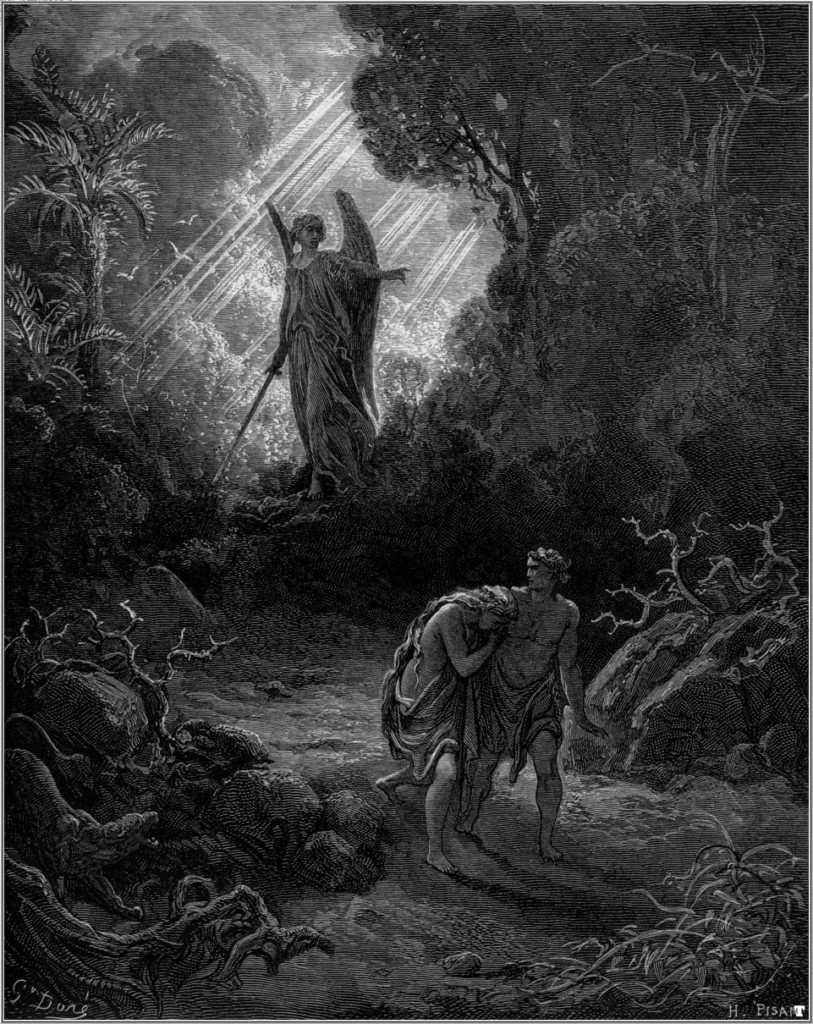
For millions of Western Christians, the doctrine of Original Sin is the absolute starting point of human history. It is the theological premise that because Adam and Eve ate the forbidden fruit in the Garden of Eden, every subsequent human being is born inherently corrupt, legally guilty, and condemned by God from the very moment of conception.
Because it is so deeply embedded in Western culture, most people assume this doctrine is explicitly stamped on page one of the Bible. But when we look at the historical development of the theology and read the biblical texts in their original languages, a fascinating, highly complex picture emerges.
The doctrine of Original Sin as we know it today was not handed down on Mount Sinai, nor was it preached by Jesus. It was constructed centuries later by a brilliant, troubled African bishop who was working with a faulty Latin translation.
The Architect: Augustine of Hippo
To find the father of the doctrine of Original Sin, historians do not look to the Book of Genesis; they look to the 4th and 5th centuries CE, to the writings of St. Augustine of Hippo.
Before Augustine, early Christian thinkers generally believed that humans inherited a fallen, mortal world and perhaps a tendency to sin, but they fiercely defended human free will and personal responsibility. But Augustine, locked in a bitter theological debate with a British monk named Pelagius, codified a much darker view of human nature.
Augustine argued that Adam’s rebellion fundamentally shattered human nature. He posited that humanity was a massa damnata (a mass of perdition). We didn’t just inherit Adam’s bad example; we inherited his actual legal guilt, transmitted biologically through the act of procreation. Therefore, even a newborn infant is guilty of Adam’s sin and requires baptism to avoid the fires of hell.
The Great Translation Error
How did Augustine anchor this massive theological claim to the Bible? He relied heavily on the writings of the Apostle Paul, specifically Romans 5:12.
But there was a catastrophic linguistic problem. Augustine was a master of Latin, but he famously struggled with Greek. He was reading Romans in a Latin translation that contained a severe grammatical error.
In the original Greek, Paul writes that death spread to all men eph’ ho (because) all sinned. Paul was saying that Adam introduced death, but individuals die because they commit their own sins.
However, Augustine’s Latin Bible translated that Greek phrase as in quo (in whom).
Reading the faulty Latin, Augustine concluded that Paul was saying: “Death spread to all men, in whom [meaning in Adam] all sinned.” Augustine built an entire theological edifice on a mistranslation, arguing that every human being was literally, biologically present in Adam when he ate the fruit, and therefore, we are all legally culpable for his crime.
What Does the Old Testament Say?
If we put Augustine aside and read the Hebrew Bible (the Old Testament) in its original context, the Western concept of Original Sin completely vanishes.
First, look at Genesis 3. When read historically, the story of the Garden of Eden is an etiology—a retroactive origin story to explain the hardships of the ancient agricultural world. It explains why childbirth is dangerous, why snakes have no legs, and why farming is backbreaking labor. The text says humans became mortal and were exiled, but it never mentions inherited, biological guilt. In fact, the word “sin” does not even appear in the Garden of Eden narrative; it first appears in Genesis 4 with the story of Cain and Abel.
Furthermore, ancient Judaism rigorously rejects the idea of inherited guilt. The prophet Ezekiel explicitly combats the idea of generational punishment. In Ezekiel 18:20, the text declares: “The one who sins is the one who will die. The child will not share the guilt of the parent, nor will the parent share the guilt of the child.” To this day, Judaism does not teach Original Sin. Jewish theology teaches that humans are born with a yetzer hara (an evil or selfish inclination) and a yetzer hatov (a good inclination), and that humans possess the free will to choose between them.
The Eastern Alternative: Ancestral Sin
If Augustine invented the Western doctrine, what happened to the Christians in the East who were actually reading Paul in the original Greek?
The Eastern Orthodox Church never adopted Augustine’s doctrine of Original Sin. Because they were reading the correct Greek text of Romans 5, they developed a doctrine known as Ancestral Sin.
Eastern theologians argue that humans do not inherit Adam’s guilt; we inherit his consequences. To use a modern metaphor: if a pregnant mother becomes addicted to dangerous substances, her child might be born with severe health complications. The child suffers the tragic consequences of the mother’s actions, but a judge would never declare the infant legally guilty of a crime.
In the Eastern view, Adam introduced a terminal disease into the human bloodstream: mortality. Because we inherit a mortal, fearful, dying nature, we inevitably end up sinning. But we are only judged for the sins we personally commit, not for the theft of a fruit thousands of years before we were born.
Reading History Backwards
When we read the Bible through a historical-critical lens, we have to separate the ancient text from the centuries of theology layered on top of it.
The doctrine of Original Sin is a profound, highly influential philosophical framework created by Augustine to explain the pervasive reality of human evil. But it is not a biblical baseline. By recognizing it as a later theological invention built on a Latin mistranslation, we can read the original biblical texts as the ancient writers intended—not as a legal document condemning infants, but as a complex, ongoing exploration of human mortality, moral choice, and our messy relationship with the divine.
-
Beyond Abstinence: Defining the Architecture of Purity Culture
For many raised in late-20th-century evangelicalism, “abstinence” and “purity culture” are frequently treated as exact synonyms. However, while abstinence is a private historical ethical choice, purity culture is a modern, highly visible sociological construct. This article examines the architecture of the 1990s movement—from purity pledges to the courtship model—and explains why disentangling the ancient ethic from the modern subculture is the crucial first step in understanding its lasting psychological impact.
-
How Can Modern Churches Build Strong Communities Without Sacrificing Intellectual Honesty?
Can a church remain strong when its members question traditional interpretations of the Bible?Discover how shared values, meaningful relationships, and intellectual honesty can help modern Christian communities thrive without demanding agreement on every question.
-
A Voice from the Dust: How the Discovery of Ugarit Rewrote Biblical Scholarship
The accidental discovery of the ancient city of Ugarit in 1928 transformed biblical scholarship. Its texts provided crucial insights into Biblical Hebrew, uncovered the mythology of ancient Canaan, and revealed how Israelite religion developed within the wider cultural world of the ancient Near East.
-
Did Paul Believe Christians Go to Heaven? Paul’s Cosmos, Christology, and Hope of Resurrection
What did Paul think heaven was, who did he believe Jesus was, and what did he expect to happen after death? Explore Paul’s first-century Jewish apocalyptic worldview, his complex understanding of Jesus, and his expectation of bodily resurrection and the liberation of creation.
-
The Whistleblower in the Dirt: Unearthing the Socio-Economic Reality of the Talents
What’s the Parable of the Talents really about? Squadering your abilities or is there more? Let’s dig a little deeper.