
Because Jesus of Nazareth is so famous for using parables—stories like the Good Samaritan or the Prodigal Son—we often assume he invented the genre. But when Jesus stood on a Galilean hillside and told a story about a farmer sowing seed, he was not creating a new literary form. He was tapping into a profound, centuries-old Jewish tradition.
In the Hebrew Bible (the Old Testament), the word for a parable is mashal.
However, a mashal is much broader than the Greek parabole found in the New Testament. A mashal can be a proverb, a riddle, a taunt, or an allegory. But among these are brilliant, fully formed narrative parables. While the Gospel parables are often used to explain the mysterious nature of the “Kingdom of God,” the parables of the Hebrew Bible were typically used as weapons: they were political satire, diplomatic insults, and psychological traps.
Here are four of the most prominent parables found in the Bible outside the Gospels.
1. The Psychological Trap: Nathan’s Ewe Lamb (2 Samuel 12)
This is arguably the most famous and devastating parable in the entire Bible.
King David has just committed a horrific abuse of power. He slept with Bathsheba, the wife of one of his elite soldiers, Uriah. When she became pregnant, David tried to cover it up and eventually ordered Uriah to be abandoned on the front lines to be slaughtered. David then married Bathsheba and thought he had gotten away with it. The prophet Nathan is sent by God to confront the king, but confronting an absolute monarch directly is a good way to get executed. So, Nathan uses a mashal.
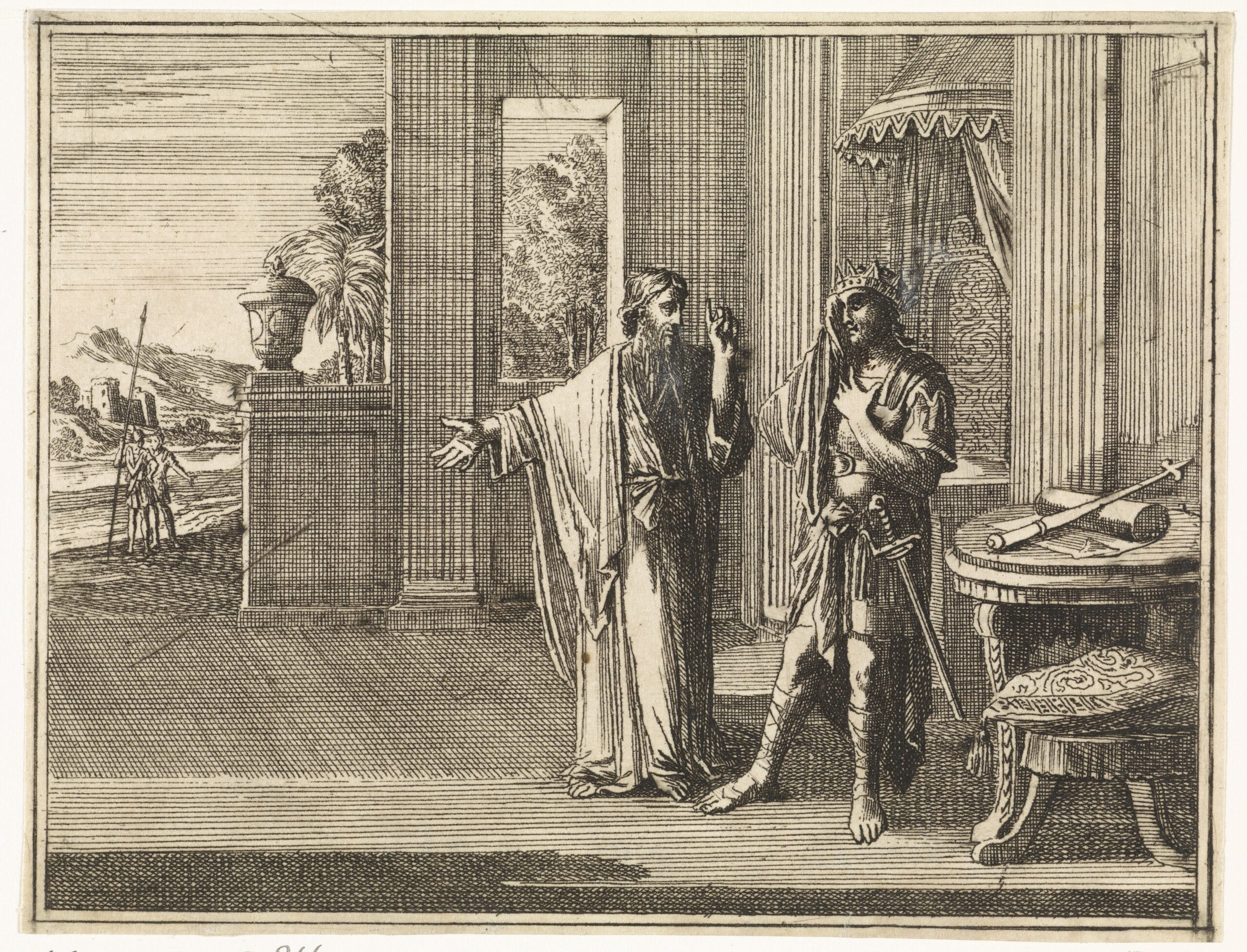
He tells David a story about two men: one rich, one incredibly poor. The rich man had massive flocks of sheep, while the poor man had only one little ewe lamb that he raised like a daughter; it even drank from his cup and slept in his arms. When a traveler visited the rich man, the rich man refused to butcher any of his own sheep. Instead, he stole the poor man’s beloved lamb and slaughtered it for his guest.
David, missing the metaphor entirely, flies into a royal rage. He declares that the rich man deserves to die and must pay restitution fourfold.
Nathan looks at the furious king and delivers the knockout blow: “You are the man!” The parable functioned as a psychological trap. By hiding David’s monumental crimes of adultery and murder inside a mundane story about sheep theft, Nathan bypassed the king’s defensive ego and forced David to accidentally pronounce his own judgment.
2. Ancient Political Satire: Jotham’s Trees (Judges 9)
While we usually think of parables as strictly human stories, the Hebrew mashal also encompasses what we would call fables (stories featuring talking plants or animals).
In the Book of Judges, a ruthless man named Abimelech murders seventy of his own half-brothers to seize power and declare himself king over the city of Shechem. The only brother to escape is the youngest, Jotham.
Standing on Mount Gerizim, Jotham shouts a parable down to the citizens of Shechem. He tells a story about the trees of the forest trying to elect a king. They go to the olive tree, the fig tree, and the grapevine, asking each to rule over them. But every useful, productive plant refuses, saying they are too busy producing good fruit to waste their time waving over the trees.
Finally, the trees ask the thornbush (the bramble). The useless, invasive weed eagerly accepts, saying, “Come and take refuge in my shade; but if not, let fire come out of the thornbush and consume the cedars of Lebanon!”
This is a brilliant piece of ancient political satire. Jotham is telling the citizens of Shechem that good, productive people do not crave tyrannical power. The only people who eagerly seek absolute rule are useless, dangerous “brambles” like Abimelech, who will ultimately burn the city to the ground.
3. The Broken Vineyard: Isaiah’s Song (Isaiah 5)
The prophet Isaiah uses a parable disguised as a love song to deliver a devastating oracle of divine judgment.
Isaiah begins by singing a song about a friend who planted a vineyard on a fertile hill. The friend did everything right: he cleared the stones, planted the choicest vines, built a watchtower, and carved out a winepress. He fully expected a crop of sweet, valuable grapes. Instead, the vineyard yielded wild, bitter, inedible fruit.
Isaiah then breaks the fourth wall, directly asking the people of Jerusalem to judge between the vinedresser and the vineyard. What else could the farmer have possibly done? The only logical conclusion is to tear down the walls and let the vineyard be overgrown.
Then, Isaiah drops the metaphor: “The vineyard of the Lord Almighty is the nation of Israel, and the people of Judah are the vines he delighted in. And he looked for justice, but saw bloodshed; for righteousness, but heard cries of distress.” This agricultural parable became so culturally foundational that Jesus directly borrowed its imagery centuries later in his own Parable of the Wicked Tenants (Matthew 21).
4. Diplomatic Trash Talk: The Thistle and the Cedar (2 Kings 14)
Sometimes, a mashal was used purely for diplomatic mockery.
In the 8th century BCE, King Amaziah of Judah experienced a massive military victory against the Edomites. Arrogant and flushed with success, Amaziah sends a message to Jehoash, the King of Israel in the north, challenging him to a battle.
King Jehoash does not respond with a formal declaration of war. He responds with a deeply insulting, one-sentence parable:
“A thistle in Lebanon sent a message to a cedar in Lebanon, ‘Give your daughter to my son in marriage.’ Then a wild beast in Lebanon came along and trampled the thistle underfoot.”
The meaning was crystal clear without needing an explanation. Jehoash was the towering, ancient cedar. Amaziah was a tiny, annoying weed who had severely overestimated his own importance. Jehoash was telling the King of Judah to stay home and enjoy his recent victory, lest he get stepped on. (Amaziah ignored the parable, went to war, and was decisively crushed).
-
Beyond Abstinence: Defining the Architecture of Purity Culture
For many raised in late-20th-century evangelicalism, “abstinence” and “purity culture” are frequently treated as exact synonyms. However, while abstinence is a private historical ethical choice, purity culture is a modern, highly visible sociological construct. This article examines the architecture of the 1990s movement—from purity pledges to the courtship model—and explains why disentangling the ancient ethic from the modern subculture is the crucial first step in understanding its lasting psychological impact.
-
How Can Modern Churches Build Strong Communities Without Sacrificing Intellectual Honesty?
Can a church remain strong when its members question traditional interpretations of the Bible?Discover how shared values, meaningful relationships, and intellectual honesty can help modern Christian communities thrive without demanding agreement on every question.
-
A Voice from the Dust: How the Discovery of Ugarit Rewrote Biblical Scholarship
The accidental discovery of the ancient city of Ugarit in 1928 transformed biblical scholarship. Its texts provided crucial insights into Biblical Hebrew, uncovered the mythology of ancient Canaan, and revealed how Israelite religion developed within the wider cultural world of the ancient Near East.
-
Did Paul Believe Christians Go to Heaven? Paul’s Cosmos, Christology, and Hope of Resurrection
What did Paul think heaven was, who did he believe Jesus was, and what did he expect to happen after death? Explore Paul’s first-century Jewish apocalyptic worldview, his complex understanding of Jesus, and his expectation of bodily resurrection and the liberation of creation.
-
The Whistleblower in the Dirt: Unearthing the Socio-Economic Reality of the Talents
What’s the Parable of the Talents really about? Squadering your abilities or is there more? Let’s dig a little deeper.