
When modern readers encounter the Parable of the Ten Virgins in the Gospel of Matthew (Chapter 25), it often feels like a story about incredibly rude bridesmaids. Ten young women are waiting for a groom; he is late, they all fall asleep, and when he finally arrives, five of the women run out of oil. The “smart” ones refuse to share, the “foolish” ones get locked out, and the groom coldly turns them away.
To a modern Western sensibility, the wise virgins seem selfish, and the punishment seems wildly disproportionate to the crime of being late.
But this confusion stems entirely from reading a first-century, Middle Eastern agrarian story through the lens of modern wedding planners. When we strip away our contemporary assumptions and place the story back into its original socio-historical context, it transforms from a petty squabble over supplies into a tense, high-stakes drama about honor, preparation, and the catastrophic social cost of complacency.
The Logistics of an Ancient Wedding
To understand the parable, we first have to discard the modern idea of a wedding. In first-century Judea and Galilee, there were no rented venues, no precise schedules, and no printed invitations with a strict 5:00 PM start time.
A wedding was a community-wide, multi-day festival, and the absolute centerpiece of the event was the procession.
After a long period of betrothal, the groom would leave his father’s house, accompanied by his friends, and travel through the village to the bride’s family home to claim his wife. Once the bride was secured, the entire party would parade back to the groom’s house for the feast. Because the days were fiercely hot and agricultural work consumed the daylight hours, this grand procession almost always happened at night.
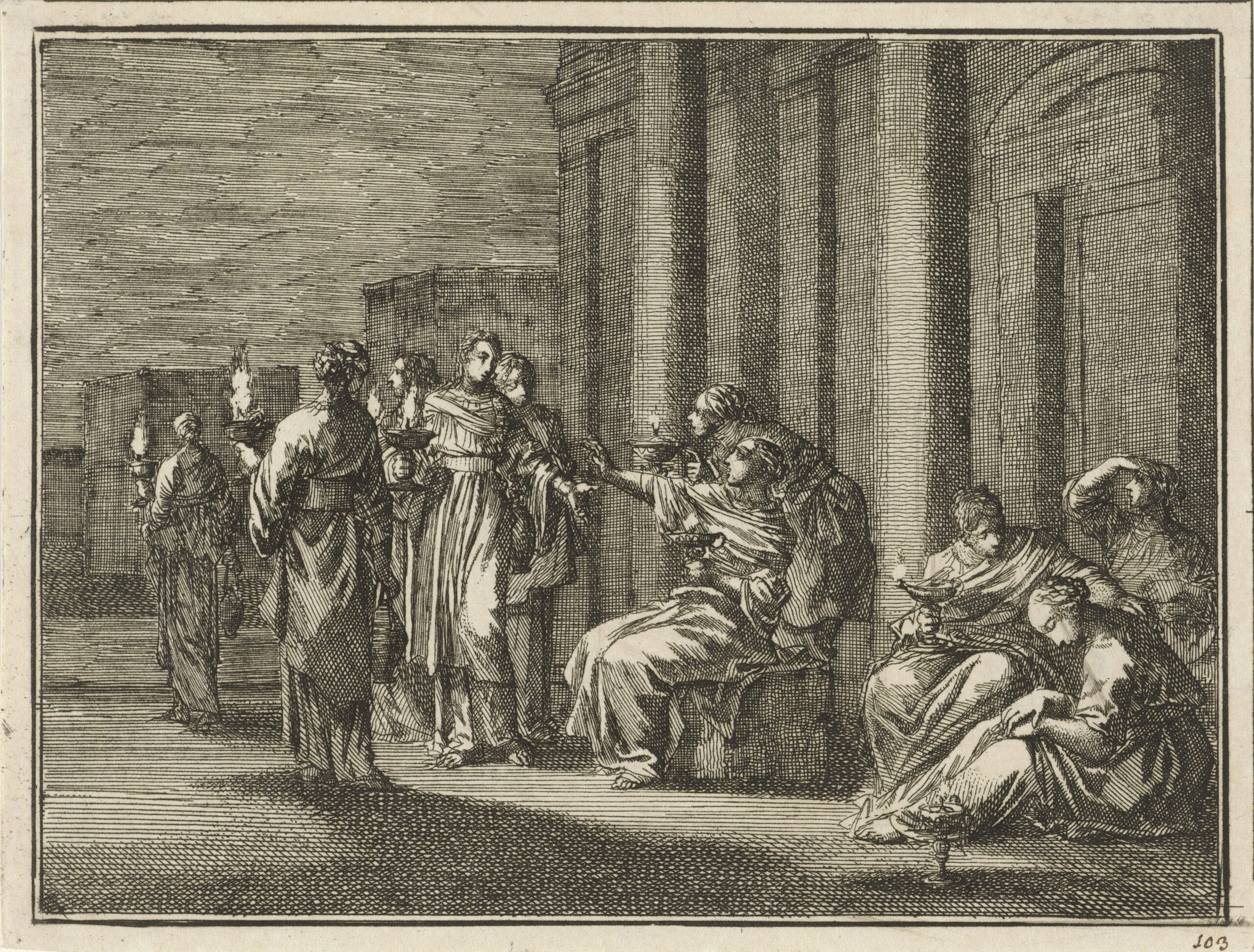
The ten “virgins” (unmarried young women, likely friends or relatives of the bride) had one specific, vital job: they were the honor guard. They were tasked with waiting at the bride’s house or along the route, ready to intercept the groom’s party and light the dark, unpaved village streets for the joyful parade back to the feast.
The Technology of the Lampades
The single biggest misunderstanding of this parable involves the lighting equipment. Sunday school illustrations almost universally show the girls holding small, terracotta oil lamps (the kind shaped like Aladdin’s lamp).
However, biblical historians and archaeologists note that the Greek text uses the word lampades. In an outdoor, processional context, lampades does not mean tiny, indoor clay lamps; it means torches.
A first-century processional torch was essentially a long stick with a bundle of oil-soaked rags bound to the top. When lit, these torches flared brightly and burned fiercely, cutting through the night and signaling the joy of the festival. But because they burned so aggressively, they consumed oil at a massive rate. An indoor clay lamp might burn all night; an outdoor processional torch would burn out in fifteen or twenty minutes if it wasn’t constantly drenched with fresh olive oil.
This technological reality completely changes our understanding of the “foolish” girls. If they were holding clay lamps, forgetting oil is a minor oversight. But because they were holding torches, bringing a secondary flask of oil wasn’t just a good idea—it was the fundamental requirement of the job. To bring a torch to a wedding without an extra flask of oil was to fundamentally misunderstand the assignment.
The Economics of Honor
This brings us to the delay. In the ancient Near East, the groom’s arrival time was highly variable. He might be delayed by last-minute dowry negotiations with the bride’s father, or simply by the sheer logistics of gathering his entourage. When the midnight cry rings out, the torches are lit. The foolish girls, realizing their rags will burn out before the procession even starts, beg the wise girls to share.
To a modern reader, the refusal of the wise girls seems remarkably un-Christian. But in the context of the first century, the wise girls are acting to preserve the honor of the groom.
If you have ten torches and only enough oil to sustain five of them, dividing the oil doesn’t mean everyone gets a little bit of light. It means all ten torches will burn out halfway down the street. In an honor-and-shame culture, plunging a wedding procession into total darkness in the middle of the village would have been a massive public humiliation for the bride and groom. The wise girls refuse to share not out of spite, but out of necessity: it is better to have five brilliantly burning torches than ten smoking, extinguished ones.
The Closed Door: A Social Severing
The foolish girls scramble to find merchants in the middle of the night (a desperate and unlikely endeavor), and while they are gone, the procession moves into the groom’s house, and the heavy wooden doors are bolted shut.
When the foolish girls finally arrive and knock, the groom speaks through the door: “Truly I tell you, I do not know you.”
In the ancient world, “I do not know you” is not a statement of cognitive ignorance (he obviously knew who the bride’s friends were). It is a formal, devastating legal and social formula. It means, “I no longer recognize a relationship with you.” By failing in their sole duty and threatening the honor of the wedding, the girls haven’t just missed the appetizers; they have ruptured the social contract of the community.
The First-Century Takeaway
For the original audience listening to Jesus, the parable was a stark, eschatological warning. As the early Christian community anticipated the coming of the Kingdom of God (the arrival of the groom), they were grappling with the reality of the “delay.” The end of the age had not come as quickly as some expected, and spiritual fatigue was setting in.
The parable delivered a clear, lightly terrifying message to the first-century listener: You must have the endurance for the long haul, because preparedness cannot be borrowed. Just as a torchbearer cannot borrow oil at midnight, a person cannot borrow spiritual vigilance, moral integrity, or a relationship with the divine from their neighbor at the moment of crisis. You either have it when the midnight cry rings out, or you find yourself on the wrong side of the door.
-
Beyond Abstinence: Defining the Architecture of Purity Culture
For many raised in late-20th-century evangelicalism, “abstinence” and “purity culture” are frequently treated as exact synonyms. However, while abstinence is a private historical ethical choice, purity culture is a modern, highly visible sociological construct. This article examines the architecture of the 1990s movement—from purity pledges to the courtship model—and explains why disentangling the ancient ethic from the modern subculture is the crucial first step in understanding its lasting psychological impact.
-
How Can Modern Churches Build Strong Communities Without Sacrificing Intellectual Honesty?
Can a church remain strong when its members question traditional interpretations of the Bible?Discover how shared values, meaningful relationships, and intellectual honesty can help modern Christian communities thrive without demanding agreement on every question.
-
A Voice from the Dust: How the Discovery of Ugarit Rewrote Biblical Scholarship
The accidental discovery of the ancient city of Ugarit in 1928 transformed biblical scholarship. Its texts provided crucial insights into Biblical Hebrew, uncovered the mythology of ancient Canaan, and revealed how Israelite religion developed within the wider cultural world of the ancient Near East.
-
Did Paul Believe Christians Go to Heaven? Paul’s Cosmos, Christology, and Hope of Resurrection
What did Paul think heaven was, who did he believe Jesus was, and what did he expect to happen after death? Explore Paul’s first-century Jewish apocalyptic worldview, his complex understanding of Jesus, and his expectation of bodily resurrection and the liberation of creation.
-
The Whistleblower in the Dirt: Unearthing the Socio-Economic Reality of the Talents
What’s the Parable of the Talents really about? Squadering your abilities or is there more? Let’s dig a little deeper.