
The Anatomy of a Descent: Satire, Scale, and Sheol in the Book of Jonah
Perhaps no text in the Hebrew Bible is as thoroughly misunderstood as the Book of Jonah. Due to centuries of Sunday school adaptations and literalist debates over marine biology, the book has been domesticated into a simplistic children’s fable about obedience.
However, when we read the text in its original Hebrew context, a vastly different piece of literature emerges. The Book of Jonah is not historical reportage; it is a brilliant, highly sophisticated theological satire. It uses recurring linguistic motifs, cosmic irony, and spatial geography to ruthlessly critique the rigid, exclusionary boundaries of post-exilic religious nationalism.
To understand the genius of the author, we have to trace Jonah’s literal and spiritual trajectory.
The Geography of Disobedience: The Motif of Yarad
From the moment Jonah receives his divine commission to go east to the great city of Nineveh, he attempts to flee west to Tarshish. But the author is not just describing a change in direction; he is describing a profound, systemic collapse.
This collapse is anchored by the relentless repetition of the Hebrew verb yarad, meaning “to go down” or “to descend.”
- Jonah goes down (yarad) to the seaport of Joppa.
- He goes down (yarad) into the ship.
- As the storm rages, he goes down (yarad) into the innermost hold of the vessel, falling into a deep, death-like sleep.
Jonah’s flight from the presence of Yahweh is portrayed as a continuous, anti-ascension. In ancient Near Eastern cosmology, to move away from the presence of God (often associated with the heights of Mount Zion or the heavens) is to move inevitably toward the realm of the dead.
When the pagan sailors finally throw Jonah overboard to appease the storm, his descent reaches its terrifying climax. In chapter 2, Jonah describes sinking past the waves, down to the very roots of the mountains, to a place where the bars of the earth close behind him forever. He has descended to Sheol—the dark, watery underworld of the dead.
The Great Fish: A Vehicle of Salvation, Not Punishment
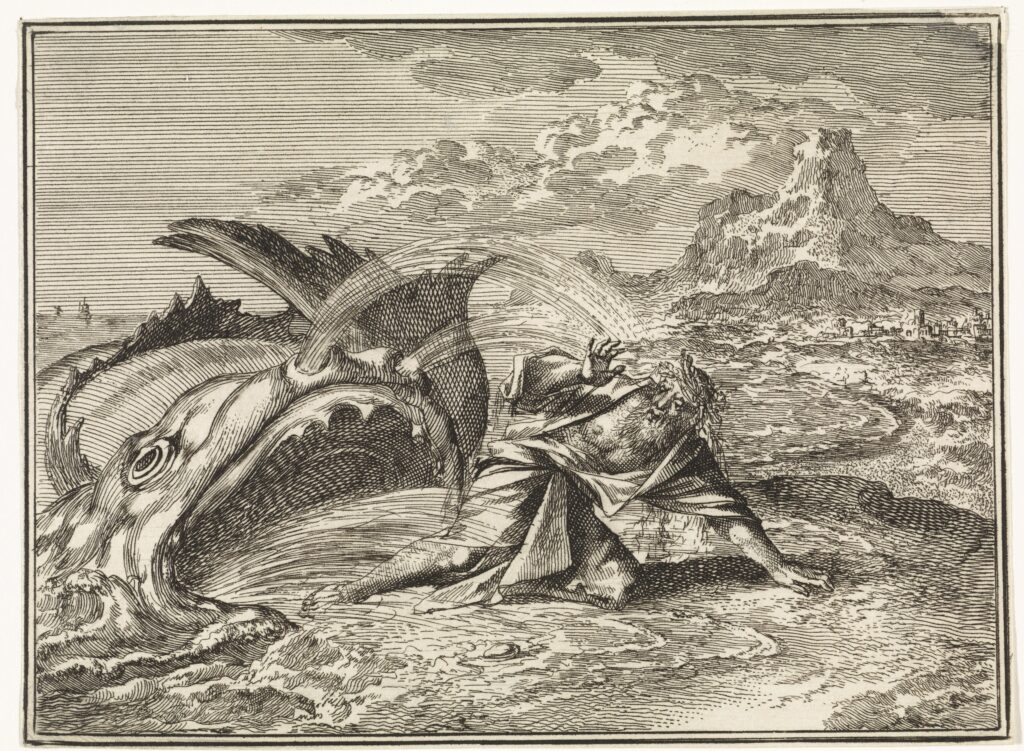
This brings us to the most famous, and most misunderstood, element of the story: the fish.
In popular imagination, the fish is the instrument of God’s punishment—a terrifying monster sent to torment the disobedient prophet. The Hebrew text, however, presents the exact opposite reality. The ocean is the punishment; the fish is the rescue.
The text explicitly states that Yahweh “appointed” or “ordained” (manah) a great fish to swallow Jonah. In the ancient world, the chaotic sea was the ultimate symbol of death and anti-creation. By sending the fish, God provides a fleshy, biological ark to save the drowning prophet from the abyss of Sheol.
This is why, while sitting in the belly of the fish, Jonah does not pray a lament or a prayer of repentance. Instead, he recites a classic psalm of thanksgiving (Jonah 2:2-9). He thanks God because he has already been saved from drowning. In Hebrew, the word used for the belly of the fish is me’eh, which can also mean “womb.” Jonah’s descent into the dark, watery depths of the fish is not his grave, but a period of gestation before he is “vomited” back onto dry land—a chaotic, messy, and entirely unearned rebirth.
The Satire of Scale: The Motif of Gadol
The literary brilliance of Jonah also relies heavily on the Hebrew root g-d-l, meaning “great,” “large,” or “big” (gadol). In a text of only four short chapters, variations of this word appear fourteen times, creating a relentless, overwhelming sense of scale.
The author describes:
- A great city (Nineveh)
- A great wind
- A great storm
- The great fear of the sailors
- A great fish
- The great joy (and later, great displeasure) of Jonah
This repetition is highly intentional. The author builds a cosmic world where everything is massive, expansive, and overwhelming. The storm is huge, the fish is huge, the pagan city is huge, and, ultimately, the mercy of God is huge.
There is only one thing in the entire narrative that is incredibly small: the worldview of the prophet.
This is the central satirical bite of the book. Jonah is a caricature of religious exclusivity. He operates with a tiny, rigid theology where God’s mercy is strictly reserved for the Israelite in-group, and divine wrath is meant for foreign outsiders like the Assyrians of Nineveh.
The author systematically dismantles this “Paper Calf” of religious tribalism. Every pagan in the story acts more righteously than the prophet. The foreign sailors pray to Yahweh and try to save Jonah’s life. The king of Nineveh immediately repents. Even the cows of Nineveh are put in sackcloth and ashes. Meanwhile, the prophet of Yahweh is petty, suicidal, and furious that his God is too compassionate.
When we read Jonah not as a literal historical logbook, but as a masterful, subversive novella, its true power is unlocked. It is a text that uses a man going “down, down, down” into the belly of the earth to hold a mirror up to its readers, forcing them to ask: Is your God as vast as the great wind and the great fish, or have you shrunk the divine down to the size of your own prejudices?
Leave a Reply
You must be logged in to post a comment.