When we hear the phrase “Golden Calf,” we instantly picture the ultimate biblical betrayal: the Israelites, fresh from the miraculous Exodus, dancing in a hedonistic frenzy around a pagan idol while Moses is delayed on Mount Sinai. For millennia, this story has functioned as the definitive religious warning against idolatry.
But if we look past the theological overlay and examine the archaeological and textual evidence, a very different picture emerges. The Golden Calf was likely not a pagan idol at all. Instead, the story in Exodus 32 is less about the sins of the ancient Israelites and much more about a fierce, brilliantly crafted smear campaign between rival priesthoods.
The Bull in the Ancient Near East
To understand the “calf” (which in ancient Hebrew usually denotes a young, virile bull), we have to understand ancient Near Eastern iconography. In the Canaanite and wider Levantine world, the bull was the ultimate symbol of strength, fertility, and divine power.
The chief god of the Canaanite pantheon, El, was frequently titled “Bull El.” The storm god, Baal, was often depicted standing or riding on the back of a bull. Crucially, the bull was rarely meant to be the god itself. Instead, it served as the deity’s pedestal or mount.
Early Israelite religion shared this cultural matrix. When ancient northern Israelites used bull imagery, they were not abandoning Yahweh for a foreign god; they were utilizing the standard regional iconography to depict Yahweh’s invisible presence resting upon a throne of immense power. This was functionally identical to the theology of the Jerusalem Temple in the south, where Yahweh was believed to sit invisibly enthroned above the golden Cherubim (winged sphinxes) topping the Ark of the Covenant. The North preferred the Bull; the South preferred the Cherubim.
The Biblical Schism and the Historical Reality
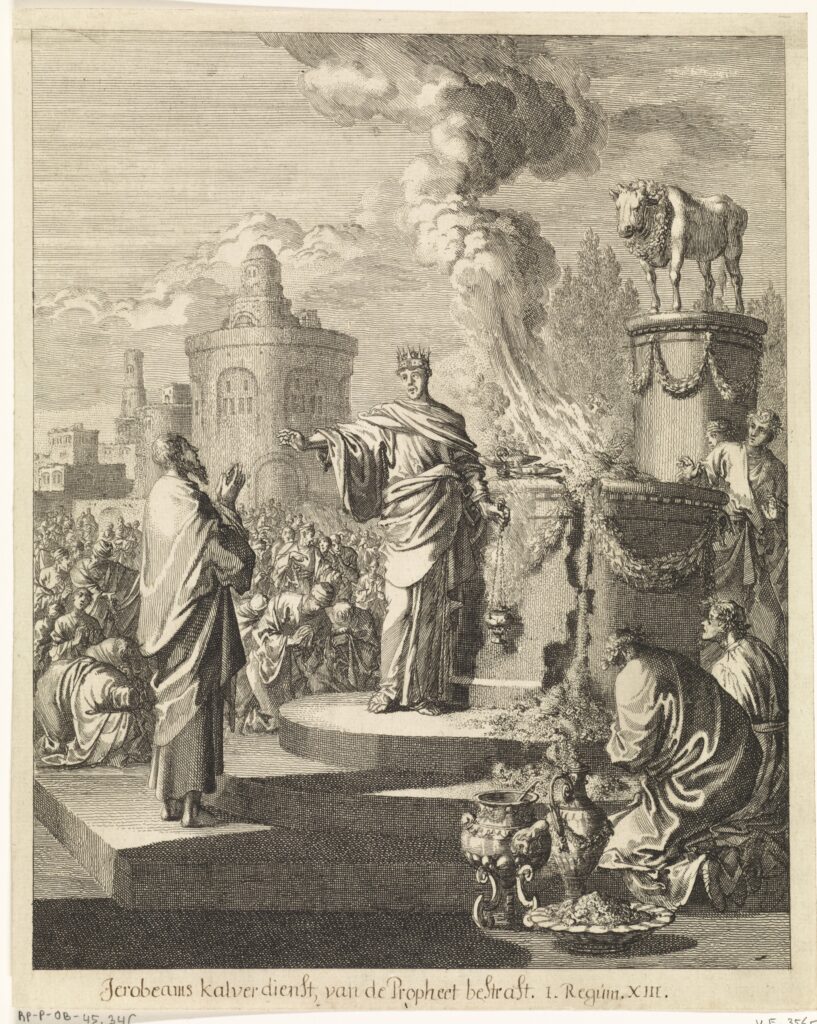
According to the biblical narrative, the political trouble with the calf began after the death of King Solomon (c. 930 BCE). The text claims that a massive, unified Israelite empire suddenly fractured into two rival states: Israel in the north, and Judah in the south. The northern king, Jeroboam I, allegedly panicked that his citizens would continue traveling south to Jerusalem to worship. To stop them, he invented a new, rebellious religion, building two rogue shrines at Dan and Bethel and declaring, “Here are your gods, O Israel, who brought you up out of Egypt!”
However, when we step outside the biblical text and look at the archaeological record, a different reality emerges.
Historically, Israel and Judah were likely always distinct regional entities. The northern highlands (Israel) were wealthier, more populated, and centralized into a state much earlier than the southern highlands (Judah). The monumental shrines at Dan and Bethel were not desperate, politically motivated inventions designed to mimic Jerusalem; they were ancient, deeply established, and entirely legitimate northern sanctuaries.
When northern kings patronized these shrines and utilized the traditional imagery of Yahweh invisibly enthroned upon a bull, they were not committing apostasy. The idea that these shrines were a “rebellion” against Jerusalem is a later theological polemic—written by Judean scribes who wanted to project Jerusalem’s absolute authority backward in time, framing the older, wealthier northern kingdom as a breakaway state of illegitimate idolaters.
Exodus 32: The Anti-Aaronite Polemic
This brings us back to Sinai and the story of Aaron making the Golden Calf in Exodus 32.
Critical biblical scholarship has pointed out striking and undeniable parallels between Jeroboam’s actions in 1 Kings and Aaron’s actions in Exodus:
- The Declaration: When Aaron finishes the calf, the people shout the exact same phrase Jeroboam uses centuries later: “These are your gods, O Israel, who brought you up out of the land of Egypt!”
- The Names of the Sons: Jeroboam’s two sons are named Nadab and Abijah. Aaron’s two eldest sons are named Nadab and Abihu.
- The Geography: The priesthood that claimed descent from Aaron officiated at the northern shrine of Bethel (and later dominated Jerusalem).
The story in Exodus 32 paints Aaron in an incredibly humiliating light. He caves to the mob immediately. He builds the idol. And when confronted by a furious Moses, Aaron offers a comical, cowardly excuse: “I threw the gold into the fire, and out came this calf!” Why would the Torah include a story that so viciously mocks the founding father of the Israelite priesthood?
The answer lies in authorial intent. Scholars identify this text as originating from a group of priests claiming descent directly from Moses (the Mushite priesthood, historically associated with the ancient shrine of Shiloh). These Moses-descended priests had been sidelined and disenfranchised by the Aaronite priests and the royal establishment. By writing the story of the Golden Calf, they hit two political targets with one brilliant piece of literature. First, they condemned the northern royal shrines. Second, they utterly assassinated the character of Aaron, depicting the figurehead of their priestly rivals as a weak-willed enabler of national apostasy.
Tearing Down the Paper Calf
When we strip away the theological domestication of the text, we see the Golden Calf story for what it originally was: a weaponized narrative designed to tear down a rival’s idol.
Ironically, in the modern era, a new kind of idol has taken its place. When readers elevate the Bible to the status of flawless, divine dictation—ignoring the messy, human, and deeply political history of rival priesthoods and regional conflicts—they create an idol out of the text itself. They replace the Golden Calf with a Paper Calf.
Here at Paper Calf, we aren’t into worshipping idols either.
We share that ancient, critical impulse to look behind the curtain. By refusing to bow down to biblical inerrancy, we can actually appreciate the text for what it is: a profound, complex, and deeply human artifact. We don’t worship the pages; we read them critically, uncovering the fascinating history beneath the dogma.
-
Beyond Abstinence: Defining the Architecture of Purity Culture
For many raised in late-20th-century evangelicalism, “abstinence” and “purity culture” are frequently treated as exact synonyms. However, while abstinence is a private historical ethical choice, purity culture is a modern, highly visible sociological construct. This article examines the architecture of the 1990s movement—from purity pledges to the courtship model—and explains why disentangling the ancient ethic from the modern subculture is the crucial first step in understanding its lasting psychological impact.
-
How Can Modern Churches Build Strong Communities Without Sacrificing Intellectual Honesty?
Can a church remain strong when its members question traditional interpretations of the Bible?Discover how shared values, meaningful relationships, and intellectual honesty can help modern Christian communities thrive without demanding agreement on every question.
-
A Voice from the Dust: How the Discovery of Ugarit Rewrote Biblical Scholarship
The accidental discovery of the ancient city of Ugarit in 1928 transformed biblical scholarship. Its texts provided crucial insights into Biblical Hebrew, uncovered the mythology of ancient Canaan, and revealed how Israelite religion developed within the wider cultural world of the ancient Near East.
-
Did Paul Believe Christians Go to Heaven? Paul’s Cosmos, Christology, and Hope of Resurrection
What did Paul think heaven was, who did he believe Jesus was, and what did he expect to happen after death? Explore Paul’s first-century Jewish apocalyptic worldview, his complex understanding of Jesus, and his expectation of bodily resurrection and the liberation of creation.
-
The Whistleblower in the Dirt: Unearthing the Socio-Economic Reality of the Talents
What’s the Parable of the Talents really about? Squadering your abilities or is there more? Let’s dig a little deeper.