
When modern readers hear the word “prophet,” they often imagine a mystical fortune-teller predicting distant, apocalyptic futures. However, historical-critical scholarship paints a vastly different picture of the biblical prophets. They were not primarily foretellers; they were fiercely political, socio-economic critics who analyzed the geopolitical realities of their day and held the ruling classes accountable to the covenant of Yahweh.
No figure exemplifies this better than Amos. As the earliest of the “classical” or writing prophets, the Book of Amos marks a massive shift in ancient Near Eastern literature. His text is a masterclass in socio-economic critique, aimed directly at the political and religious establishment of his era. To understand his message, one must examine the specific historical and economic crisis that forced a rural farmer to march into a royal sanctuary and declare the end of a kingdom.
The Outsider from Tekoa: Who and Where
Amos was not a professional cleric. Unlike many prophets of the ancient world who belonged to prophetic guilds or were employed by the royal court, Amos was a fiercely independent outsider. In the text, he explicitly distances himself from the religious establishment, declaring, “I am no prophet, nor a prophet’s son, but I am a herdsman and a dresser of sycamore figs” (Amos 7:14).
He lived in the mid-eighth century BCE (roughly 760–750 BCE). Crucially, he was a citizen of Tekoa, a rugged, rural agrarian village in the Southern Kingdom of Judah. Yet, his prophetic mission did not take place in his homeland. Driven by theological conviction, Amos crossed the highly militarized border into the rival Northern Kingdom of Israel, marching directly into Bethel, the site of the wealthy, royal sanctuary heavily subsidized by the northern king.
The Gilded Age of Jeroboam II: The Historical Context
To understand why Amos was so enraged, one must look at the geopolitical and economic reality of the Northern Kingdom during the reign of King Jeroboam II.
The mid-eighth century BCE was a “Gilded Age” for Israel. The dominant superpower of the era, the Assyrian Empire, was experiencing a temporary period of internal weakness. Without Assyrian pressure, Jeroboam II rapidly expanded Israel’s borders, seizing control of highly lucrative international trade routes. Wealth flooded into the capital city of Samaria. Archaeological excavations from this period confirm the biblical descriptions: the elite built massive estates, constructed both “summer and winter houses,” and decorated their furniture with expensive, imported ivory.
However, this unprecedented economic boom was built on a foundation of severe agrarian exploitation. The wealth was highly concentrated in the hands of the urban elite, while the rural peasantry was being systematically crushed. The elite weaponized the legal system to expand their massive estates, trapping peasant farmers in insurmountable debt, seizing their ancestral lands, and selling them into debt slavery.
The Socio-Economic Indictment: The Message
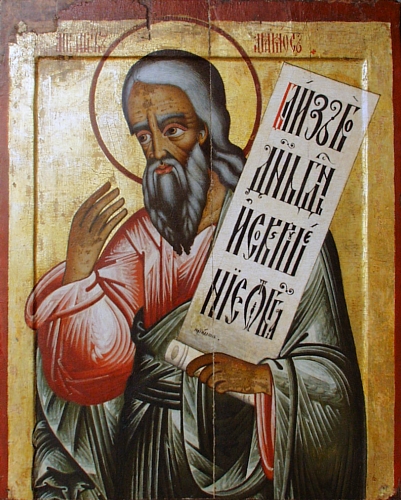
Amos arrived in Bethel to deliver a scathing indictment of this economic disparity. His message was revolutionary for the ancient world: he argued that the ultimate measure of a society’s devotion to God was not the lavishness of its temple rituals, but the socio-economic treatment of its most vulnerable citizens.
Amos attacked the corruption of the ancient justice system, which took place at the city gate. He condemned the judges who took bribes and pushed aside the destitute. He vividly described the cruelty of the merchant class, accusing them of tampering with their scales to cheat the poor and selling the needy into slavery for the price of a pair of sandals.
Furthermore, Amos delivered a brutal critique of the religious establishment. The wealthy elite of Israel believed that because they were funding massive, elaborate sacrifices at the sanctuary of Bethel, God was pleased with them and would continue to bless their economic expansion. Amos shattered this theology, delivering one of the most famous declarations in the Hebrew Bible in the voice of Yahweh:
“I hate, I despise your feasts, and I take no delight in your solemn assemblies… Take away from me the noise of your songs; to the melody of your harps I will not listen. But let justice roll down like waters, and righteousness like an ever-flowing stream.” (Amos 5:21-24)
For Amos, religious ritual divorced from ethical, socio-economic justice was not just empty; it was actively offensive to the divine.
The Clash with the Establishment
Because Amos was threatening the theological justification for the state’s economic system, he immediately clashed with the authorities. In chapter 7, Amaziah, the high priest of the royal sanctuary at Bethel, reports Amos to King Jeroboam II for treason. Amaziah commands Amos to flee back to the South, telling him to earn his living by prophesying in Judah, but to never again prophesy at Bethel, “for it is the king’s sanctuary, and it is a temple of the kingdom.”
Amaziah represents the ultimate domestication of theology—a state-sponsored religion designed to protect the status quo. Amos responds by reiterating the impending doom of the nation. He warned that because the elite had fractured the covenant through their economic violence, God would use the Assyrian Empire as an instrument of judgment to crush the Northern Kingdom, tear down the ivory houses, and send the elite into exile.
Less than four decades later, in 722 BCE, the Assyrian war machine marched into Samaria, fulfilling Amos’s geopolitical analysis and wiping the Northern Kingdom of Israel off the map permanently. Ultimately, the Book of Amos endures as a foundational text of historical criticism, demonstrating that true prophetic literature is inherently concerned with the dangerous intersection of wealth, power, and justice.
-
Beyond Abstinence: Defining the Architecture of Purity Culture
For many raised in late-20th-century evangelicalism, “abstinence” and “purity culture” are frequently treated as exact synonyms. However, while abstinence is a private historical ethical choice, purity culture is a modern, highly visible sociological construct. This article examines the architecture of the 1990s movement—from purity pledges to the courtship model—and explains why disentangling the ancient ethic from the modern subculture is the crucial first step in understanding its lasting psychological impact.
-
How Can Modern Churches Build Strong Communities Without Sacrificing Intellectual Honesty?
Can a church remain strong when its members question traditional interpretations of the Bible?Discover how shared values, meaningful relationships, and intellectual honesty can help modern Christian communities thrive without demanding agreement on every question.
-
A Voice from the Dust: How the Discovery of Ugarit Rewrote Biblical Scholarship
The accidental discovery of the ancient city of Ugarit in 1928 transformed biblical scholarship. Its texts provided crucial insights into Biblical Hebrew, uncovered the mythology of ancient Canaan, and revealed how Israelite religion developed within the wider cultural world of the ancient Near East.
-
Did Paul Believe Christians Go to Heaven? Paul’s Cosmos, Christology, and Hope of Resurrection
What did Paul think heaven was, who did he believe Jesus was, and what did he expect to happen after death? Explore Paul’s first-century Jewish apocalyptic worldview, his complex understanding of Jesus, and his expectation of bodily resurrection and the liberation of creation.
-
The Whistleblower in the Dirt: Unearthing the Socio-Economic Reality of the Talents
What’s the Parable of the Talents really about? Squadering your abilities or is there more? Let’s dig a little deeper.