
In the sprawling, meticulously documented genealogical records of the Hebrew Bible, almost everyone has a backstory. You generally know who their father was, what tribe they belonged to, and where they died. But there is one glaring, fascinating exception: a man named Melchizedek.
He steps onto the biblical stage for exactly three verses in the Book of Genesis, vanishes without a trace, and yet ultimately becomes one of the most important theological figures in both ancient Judaism and early Christianity.
When we look at Melchizedek through the lens of modern historical-critical scholarship, we do not just find a mysterious priest. We find a masterclass in how ancient texts evolved, how political propaganda shaped the Bible, and—according to one provocative hypothesis—evidence of an ancient scribal cover-up.
The Genesis Cameo: A Strange Encounter
Melchizedek makes his singular historical appearance in Genesis 14. The patriarch Abraham has just won a regional war to rescue his nephew, Lot. As Abraham returns with the spoils of war, he is met by a mysterious figure: Melchizedek, the “King of Salem” and “Priest of God Most High” (El Elyon in Hebrew).
Melchizedek brings out a feast of bread and wine and pronounces a blessing over Abraham. In a shocking reversal of expected hierarchy, Abraham—the revered father of the Hebrew people—defers to this foreign king and gives him a tenth of all his spoils (a tithe).
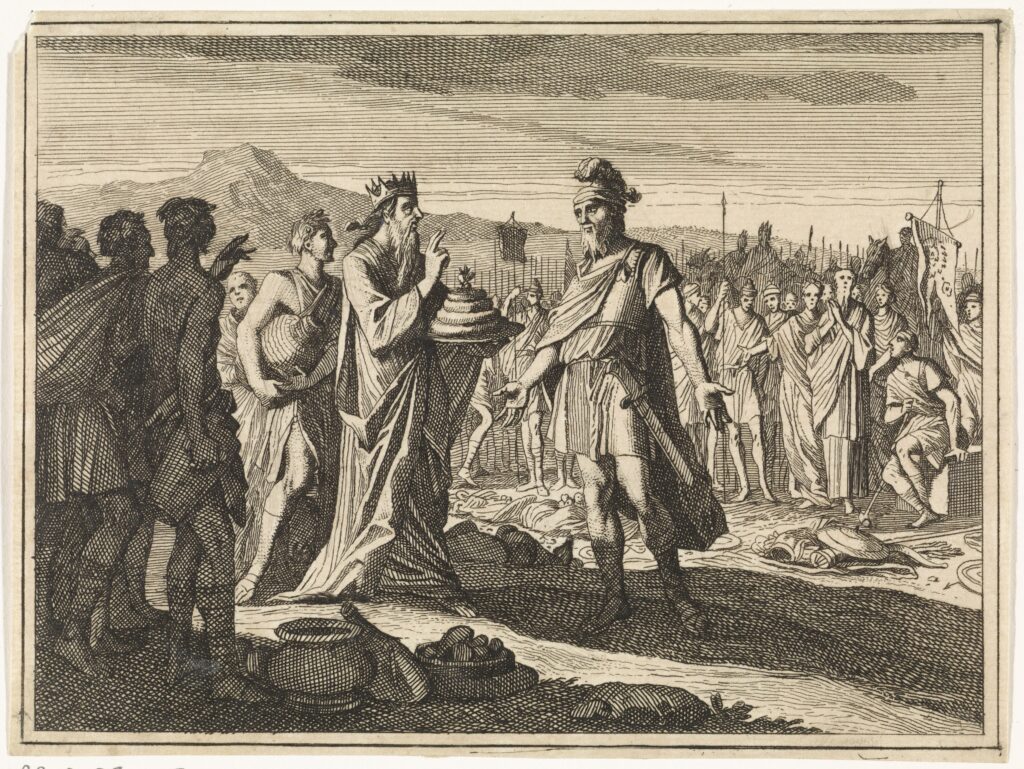
For traditional historians and linguists, this encounter is a fascinating window into pre-Israelite Canaan. In ancient Semitic languages, Malki-tzedek translates to “My King is Zedek” (Zedek being an ancient Canaanite deity of justice). “Salem” is almost universally recognized as the ancient Jebusite city that would later become Jerusalem, and El Elyon was the supreme creator deity in the Canaanite pantheon. Historically, this passage suggests that when the early Hebrew nomads arrived in the land, they recognized the spiritual authority of this established, settled Canaanite priest-king.
But a closer look at the text reveals a strange narrative glitch that has led modern scholars to ask a startling question: Was Melchizedek actually the King of Salem, or did an ancient scribe alter the text?
The Scribal Cover-Up: Was Melchizedek the King of Sodom?
If you read Genesis 14 closely, the narrative flow experiences a violent, clumsy hiccup.
In verse 17, Abraham returns from battle and goes out to meet the King of Sodom. But before the King of Sodom can open his mouth, Melchizedek suddenly materializes out of nowhere in verse 18, blesses Abraham, receives the tithe, and vanishes. Then, in verse 21, the narrative completely ignores the interruption: “The king of Sodom said to Abram, ‘Give me the people and keep the goods for yourself.'”
Historically, this reads like two characters awkwardly fighting for the exact same space on the page. In recent years, scholars like Dr. Robert R. Cargill have proposed a brilliant and radical hypothesis: originally, there were not two kings meeting Abraham. There was only one: Melchizedek, the King of Sodom.
According to this hypothesis, a later scribe deliberately altered the text to cover up a deeply embarrassing historical memory. As biblical traditions evolved over the centuries, the city of Sodom became the ultimate symbol of depravity and divine wrath (famously destroyed by fire and brimstone in Genesis 19). For a later scribe, the idea that Abraham received a holy blessing from the King of Sodom, ate a sacred meal with him, and paid him a massive tithe was absolutely scandalous.
To fix this theological nightmare, the scribe only had to change a single letter. The Hebrew word for Sodom is סדם (Sodom). The Hebrew word for Salem is שלם (Shalem). By simply swapping the first consonant, the scribe instantly erased Melchizedek’s connection to the infamous city.
Furthermore, by changing the text to “Salem,” the scribes solved two problems at once. They scrubbed the embarrassing Sodom connection, and they retroactively gave the city of Jerusalem an ancient, towering spiritual pedigree.
Political Legitimacy and the Cosmic Priest
Whether Melchizedek was originally the King of Sodom or Salem, the edited text of Genesis 14 became a powerful political tool centuries later.
When King David conquered Jerusalem and made it his capital, he faced a religious crisis. According to the Torah, the Israelite priesthood belonged strictly to the tribe of Levi, but David was from the tribe of Judah. How could the King of Jerusalem also lead religious worship? The royal scribes found their loophole in Genesis 14. Psalm 110 was composed as a royal coronation hymn, declaring to the Davidic king: “You are a priest forever, in the order of Melchizedek.” By conquering Jerusalem, David inherited a much older, geographically superior priesthood—the ancient royal priesthood of Melchizedek.
By the first century CE, Melchizedek had evolved even further, transforming from a historical Canaanite king into a massive, esoteric, apocalyptic figure. In the Dead Sea Scrolls, the Essene community at Qumran elevated him to a divine, angelic judge who would defeat the forces of darkness at the end of time.
This first-century fascination directly influenced the New Testament. The author of the Book of Hebrews faced the exact same theological puzzle King David did: How can Jesus be the ultimate High Priest if he is from the tribe of Judah? The author devotes nearly three chapters to answering this, using Melchizedek as the ultimate proof. Because Melchizedek has no recorded genealogy, birth, or death in the Genesis text, the author of Hebrews argues that he represents a superior, eternal priesthood that predates the Levitical law.
When we step back and trace the textual history of Melchizedek, we witness the beautiful, layered evolution of biblical literature. He begins as a local chieftain offering bread and wine, survives a likely scribal assassination of his hometown, is resurrected as a political precedent for the kings of Jerusalem, and is finally elevated into the heavens as an eternal, cosmic blueprint for the divine.
-
Beyond Abstinence: Defining the Architecture of Purity Culture
For many raised in late-20th-century evangelicalism, “abstinence” and “purity culture” are frequently treated as exact synonyms. However, while abstinence is a private historical ethical choice, purity culture is a modern, highly visible sociological construct. This article examines the architecture of the 1990s movement—from purity pledges to the courtship model—and explains why disentangling the ancient ethic from the modern subculture is the crucial first step in understanding its lasting psychological impact.
-
How Can Modern Churches Build Strong Communities Without Sacrificing Intellectual Honesty?
Can a church remain strong when its members question traditional interpretations of the Bible?Discover how shared values, meaningful relationships, and intellectual honesty can help modern Christian communities thrive without demanding agreement on every question.
-
A Voice from the Dust: How the Discovery of Ugarit Rewrote Biblical Scholarship
The accidental discovery of the ancient city of Ugarit in 1928 transformed biblical scholarship. Its texts provided crucial insights into Biblical Hebrew, uncovered the mythology of ancient Canaan, and revealed how Israelite religion developed within the wider cultural world of the ancient Near East.
-
Did Paul Believe Christians Go to Heaven? Paul’s Cosmos, Christology, and Hope of Resurrection
What did Paul think heaven was, who did he believe Jesus was, and what did he expect to happen after death? Explore Paul’s first-century Jewish apocalyptic worldview, his complex understanding of Jesus, and his expectation of bodily resurrection and the liberation of creation.
-
The Whistleblower in the Dirt: Unearthing the Socio-Economic Reality of the Talents
What’s the Parable of the Talents really about? Squadering your abilities or is there more? Let’s dig a little deeper.