
If you were to open the Book of Psalms, you would mostly find highly structured, liturgical poetry designed for formal worship in the Jerusalem Temple. But tucked near the end of the collection is a poem that completely breaks the mold.
Psalm 137 does not feel like a polished hymn. It feels like an open wound.
Written in the immediate aftermath of the Babylonian destruction of Jerusalem in 586 BCE, Psalm 137 is the most famous song of exile in human history. It captures the profound psychological devastation of a displaced people. Yet, because of its shocking, violent conclusion, it is also a text that modern readers desperately try to sanitize. By looking at both the historical reality of the poem and its massive footprint in later art, we can uncover the true, unfiltered power of this ancient text.
The Setting: Taunts by the Water
The historical context of the psalm is the Babylonian Exile. The Neo-Babylonian Empire, under King Nebuchadnezzar, had laid siege to Jerusalem, starved its inhabitants, burned the Temple of Yahweh to the ground, and marched the Judean elite hundreds of miles east into Mesopotamia.
The poem opens with a hauntingly beautiful scene: “By the rivers of Babylon we sat and wept when we remembered Zion. There on the poplars we hung our harps.”
The “rivers” were likely the massive irrigation canals branching off the Euphrates. The Judean exiles are sitting in the lush, alien landscape of their conquerors. Then, the psychological torment begins. The Babylonian captors demand entertainment: “Sing us one of the songs of Zion!”
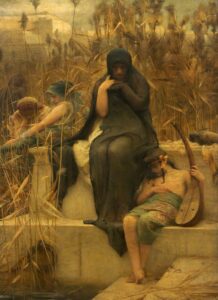
This is not an innocent request for a cultural exchange. In the ancient Near East, the defeat of a nation was viewed as the defeat of that nation’s god. By demanding a song of Zion—hymns that celebrated Yahweh’s invincible protection of Jerusalem—the Babylonians are mocking the Judeans. They are forcing the victims to sing the very songs that history has just seemingly proven false.
The Judean response is a defiant refusal: “How can we sing the songs of the Lord while in a foreign land?” To sing the song for the amusement of the captor would be the ultimate betrayal of their identity. Instead, they hang up their instruments and take a solemn vow never to forget their ruined home.
The Uncomfortable Climax
For the first six verses, Psalm 137 is a beautiful, melancholic masterpiece. But then, the poem takes a dark, terrifying turn. The final three verses contain some of the most brutal language in the entire Bible.
The author turns their attention to their enemies. First, they curse the Edomites (Judah’s neighbors who opportunistically cheered on the destruction of Jerusalem). Then, the poet unleashes a horrifying curse against Babylon itself: “Daughter Babylon, doomed to destruction… Happy is the one who seizes your infants and dashes them against the rocks.”
For centuries, the church and synagogue have struggled with these final lines. They are routinely cut out of lectionaries and omitted from Sunday school lessons. Theological commentators have desperately tried to domesticate the text by allegorizing the “infants” as “little sins” that we must smash against the “rock of faith.”
But when we read the text historically, we do not need to allegorize it. This is not a theology textbook; it is the raw, unfiltered trauma of a survivor. The Babylonians had breached the walls of Jerusalem and slaughtered Judean children in the streets. The poet, consumed by grief and powerlessness, is crying out for exact, brutal retribution. By leaving this horrific curse in the Bible, the ancient editors refused to sanitize the reality of war. They allowed the authentic, ugly rage of the oppressed to remain permanently recorded.
The Afterlife of the Exile
Because Psalm 137 captures the universal experience of exile, oppression, and the longing for home, it has heavily influenced modern art, politics, and music. Its imagery has been adopted by marginalized groups across the globe who see themselves sitting by their own “rivers of Babylon.”
1. Verdi’s Nabucco and the Italian Resistance In 1842, the Italian composer Giuseppe Verdi premiered his opera Nabucco (short for Nebuchadnezzar). The emotional centerpiece of the opera is the “Va, pensiero,” also known as the Chorus of the Hebrew Slaves. Verdi brilliantly adapted Psalm 137, having the enslaved Judeans sing of their lost homeland. At the time, northern Italy was under the oppressive control of the Austrian Empire. The Italian audience immediately identified with the captive Judeans, and “Va, pensiero” became the unofficial anthem of the Risorgimento—the movement for Italian unification and independence.
2. Frederick Douglass and the Abolitionist Movement In 1852, the great African American abolitionist Frederick Douglass delivered one of the most famous speeches in American history: “What to the Slave is the Fourth of July?” Addressing a white audience, Douglass explicitly used Psalm 137 to expose their hypocrisy. Just as the Babylonians demanded a joyful song from their captives, white America was asking enslaved Black people to celebrate a national holiday of “freedom.” Douglass quoted the psalm directly, declaring that for a slave to celebrate American independence would be as agonizing as a Judean singing the songs of Zion in Babylon.
3. The Rastafarians and the Disco Floor Perhaps the most famous adaptation of the psalm came from the Caribbean. In the mid-20th century, the Rastafari movement in Jamaica adopted the language of the Old Testament to describe their reality. To a Rastafarian, “Babylon” represents the oppressive, Western capitalist system, and “Zion” represents Africa and spiritual freedom.
In 1970, the Jamaican reggae group The Melodians recorded “Rivers of Babylon,” turning the ancient psalm into a powerful Rastafarian protest anthem. Eight years later, the vocal group Boney M covered the song. In one of the strangest twists of musical history, they took this 2,500-year-old lament of genocide and exile, laid it over a European dance beat, and turned it into one of the best-selling disco hits of all time.
A Monument to Memory
Psalm 137 is a difficult, magnificent text. It refuses to be a polite religious hymn. It is a monument to the stubbornness of human memory. Whether sung by a choir of opera singers in 19th-century Italy, quoted by an American abolitionist, or chanted to a reggae beat in Jamaica, the core message of the ancient Judean captives remains unchanged: even in the darkest exile, we will not forget who we are.
-
Beyond Abstinence: Defining the Architecture of Purity Culture
For many raised in late-20th-century evangelicalism, “abstinence” and “purity culture” are frequently treated as exact synonyms. However, while abstinence is a private historical ethical choice, purity culture is a modern, highly visible sociological construct. This article examines the architecture of the 1990s movement—from purity pledges to the courtship model—and explains why disentangling the ancient ethic from the modern subculture is the crucial first step in understanding its lasting psychological impact.
-
How Can Modern Churches Build Strong Communities Without Sacrificing Intellectual Honesty?
Can a church remain strong when its members question traditional interpretations of the Bible?Discover how shared values, meaningful relationships, and intellectual honesty can help modern Christian communities thrive without demanding agreement on every question.
-
A Voice from the Dust: How the Discovery of Ugarit Rewrote Biblical Scholarship
The accidental discovery of the ancient city of Ugarit in 1928 transformed biblical scholarship. Its texts provided crucial insights into Biblical Hebrew, uncovered the mythology of ancient Canaan, and revealed how Israelite religion developed within the wider cultural world of the ancient Near East.
-
Did Paul Believe Christians Go to Heaven? Paul’s Cosmos, Christology, and Hope of Resurrection
What did Paul think heaven was, who did he believe Jesus was, and what did he expect to happen after death? Explore Paul’s first-century Jewish apocalyptic worldview, his complex understanding of Jesus, and his expectation of bodily resurrection and the liberation of creation.
-
The Whistleblower in the Dirt: Unearthing the Socio-Economic Reality of the Talents
What’s the Parable of the Talents really about? Squadering your abilities or is there more? Let’s dig a little deeper.