
For centuries, readers of the Book of Genesis have grappled with the internal contradictions of the Noah narrative. The text presents conflicting timelines, differing numbers of animals, and shifting portraits of the divine. From a historical-critical perspective, these are not textual errors, but rather the visible seams of a composite document.
According to the Documentary Hypothesis—pioneered by scholars like Julius Wellhausen and refined by modern critics like Richard Elliott Friedman and David M. Carr—the biblical Flood myth was constructed by stitching together two distinct, earlier traditions: the Yahwist (J) source and the Priestly (P) source.
By separating these strands, we can observe two complete, coherent, and independent flood narratives that were later intertwined by a redactor (editor).
The Hallmarks of the Two Sources
Before reading the reconstructed text, it helps to understand the fundamental differences between the two traditions:
- Divine Names: The J-source consistently uses the personal name YHWH, while the P-source uses Elohim until the name YHWH is formally revealed to Moses later in Exodus.
- The Animals: J distinguishes between clean and unclean animals, commanding Noah to take seven pairs of clean animals for sacrifice (7:2). P, which maintains that sacrifice did not begin until the Sinai covenant, commands a strict two of every kind (6:19).
- Chronologies: The J narrative is swift and dramatic: a seven-day warning followed by forty days and nights of rain. The P narrative is highly structured, featuring exact calendar dates, a 150-day flood period, and cosmological imagery (the bursting of the fountains of the deep).
- Theology and Anthropomorphism: J portrays a highly anthropomorphic deity who “regrets,” feels grief in his “heart,” and personally shuts the door of the ark. P’s Elohim is transcendent, issuing structural commands and establishing eternal, cosmic covenants.
The Reconstructed Text
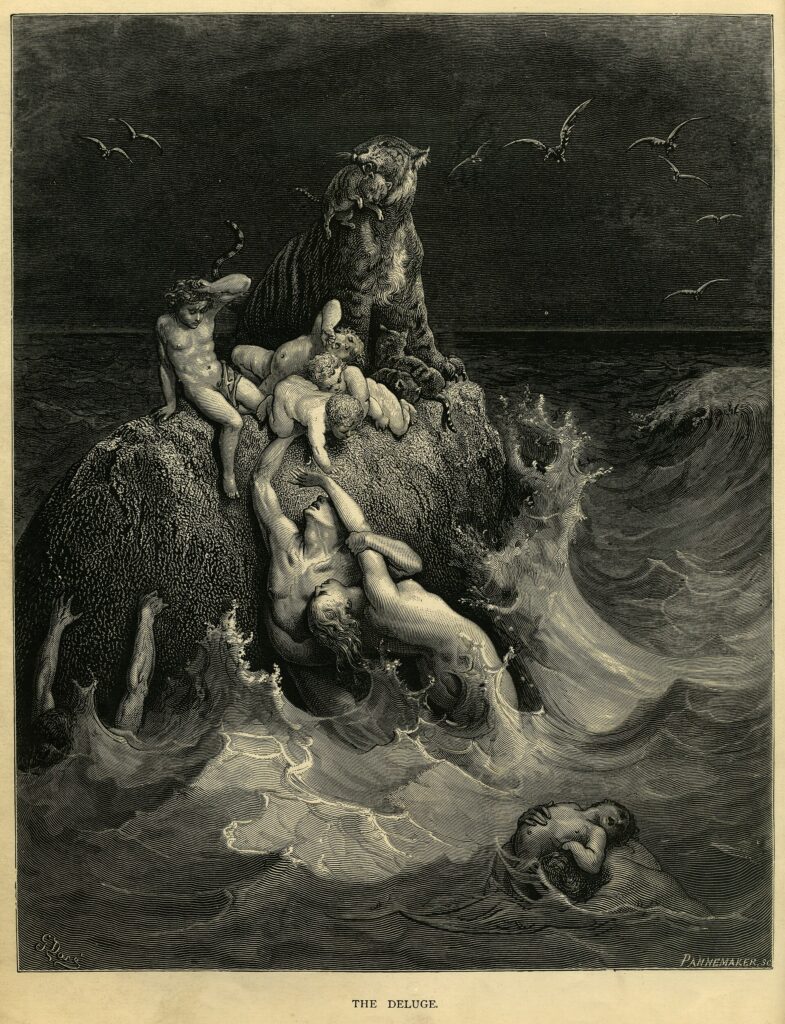
Below is a direct translation of the Hebrew Masoretic Text. It preserves the exact divine names (YHWH and Elohim) and maintains the raw, anthropomorphic language of the original Hebrew.
To reveal the underlying literary strata, the text is formatted as follows:
- The Yahwist (J) source is in italics.
- The Priestly (P) source is in bold.
- Redactional seams (plain text) are noted where the later editor stitched the accounts together.
Where modern scholarly consensus is divided or has evolved, notes have been provided for transparency.
Genesis 6
6:5 And YHWH saw that the wickedness of humankind was great in the earth, and that every inclination of the thoughts of their heart was only evil continually.
6:6 And YHWH regretted that he had made humankind on the earth, and it grieved him to his heart.
Scholarly Note on 6:6: The translation “regretted” faithfully captures the Hebrew verb niḥam, which can mean regret, relent, or change one’s mind. It highlights the deeply anthropomorphic nature of the J-source deity.
6:7 So YHWH said, “I will wipe out humankind whom I have created from the face of the ground, from human to domestic animal to creeping thing and to the birds of the heavens, for I regret that I have made them.”
6:8 But Noah found favor in the eyes of YHWH.
6:9 These are the generations of Noah. Noah was a righteous man, blameless in his generation. Noah walked with Elohim.
6:10 And Noah fathered three sons, Shem, Ham, and Japheth.
6:11 Now the earth was corrupt before Elohim, and the earth was filled with violence.
6:12 And Elohim saw the earth, and behold, it was corrupt, for all flesh had corrupted their way on the earth.
6:13 And Elohim said to Noah, “The end of all flesh has come before me, for the earth is filled with violence through them. Behold, I will destroy them with the earth.
Scholarly Note on 6:13: The Hebrew phrase mašḥīṯām ’eṯ-hā’āreṣ is notoriously difficult. While translated here as “with the earth,” it is not meant instrumentally (“using the earth”). Many scholars prefer “together with the earth,” indicating that both humanity and the environment are being ruined simultaneously.
6:14 Make yourself an ark of gopher wood. Make rooms in the ark, and cover it inside and out with pitch.
6:15 This is how you are to make it: the length of the ark three hundred cubits, its breadth fifty cubits, and its height thirty cubits.
6:16 Make a roof for the ark, and finish it to a cubit above, and set the door of the ark in its side; make it with lower, second, and third decks.
6:17 For behold, I will bring a flood of waters upon the earth to destroy all flesh in which is the breath of life under heaven. Everything that is on the earth shall die.
6:18 But I will establish my covenant with you, and you shall come into the ark, you, your sons, your wife, and your sons’ wives with you.
6:19 And of every living thing of all flesh, you shall bring two of every sort into the ark to keep them alive with you. They shall be male and female.
6:20 Of the birds according to their kinds, and of the animals according to their kinds, of every creeping thing of the ground, according to its kind, two of every sort shall come in to you to keep them alive.
6:21 Also take with you every sort of food that is eaten, and store it up. It shall serve as food for you and for them.”
6:22 And Noah did this; according to all that Elohim commanded him, so he did.
Genesis 7
7:1 Then YHWH said to Noah, “Go into the ark, you and all your household, for I have seen that you are righteous before me in this generation.
7:2 Take with you seven pairs of all clean animals, the male and his mate, and a pair of the animals that are not clean, the male and his mate,
7:3 and seven pairs of the birds of the heavens also, male and female, to keep their offspring alive on the face of all the earth.
7:4 For in seven days I will send rain on the earth forty days and forty nights, and every living thing that I have made I will blot out from the face of the ground.”
7:5 And Noah did according to all that YHWH commanded him.
7:6 Noah was six hundred years old when the flood of waters came upon the earth.
7:7 And Noah and his sons and his wife and his sons’ wives with him went into the ark to escape the waters of the flood.
7:8 Of clean animals, and of animals that are not clean, and of birds, and of everything that creeps on the ground,
7:9 two and two, male and female, went into the ark with Noah, as Elohim had commanded Noah.
7:10 And after seven days the waters of the flood came upon the earth.
Scholarly Note on 7:7–10: The assignment of these verses is one of the most debated aspects of the flood narrative. While placed primarily in J here, verses 7–9 are highly hybridized. They combine J’s “clean/unclean” distinction with P’s “male and female” language and P’s concern for pairs (“two and two”). Many source critics view this section not as pure J, but as heavy editorial stitching by the redactor attempting to harmonize the conflicting animal counts.
7:11 In the six hundredth year of Noah’s life, in the second month, on the seventeenth day of the month, on that day all the fountains of the great deep burst forth, and the windows of the heavens were opened.
7:12 And rain fell upon the earth forty days and forty nights.
7:13 On the very same day Noah and his sons, Shem and Ham and Japheth, and Noah’s wife and the three wives of his sons with them entered the ark,
7:14 they and every beast, according to its kind, and all the livestock according to their kinds, and every creeping thing that creeps on the earth, according to its kind, and every bird, according to its kind, every winged creature.
7:15 They went into the ark with Noah, two and two of all flesh in which there was the breath of life.
7:16 And those that entered, male and female of all flesh, went in as Elohim had commanded him. And YHWH shut him in.
7:17 The flood continued forty days upon the earth. And the waters increased and bore up the ark, and it rose high above the earth.
Scholarly Note on 7:17: This mixed division is defensible, but contested. Some scholars assign the entire verse to P. This verse represents another clear redactional seam where the editor intertwined J’s 40-day chronology with P’s broader narrative flow.
7:18 The waters prevailed and increased greatly on the earth, and the ark floated on the face of the waters.
7:19 And the waters prevailed so mightily on the earth that all the high mountains under the whole heaven were covered.
7:20 The waters prevailed above the mountains, covering them fifteen cubits deep.
7:21 And all flesh died that moved on the earth, birds, livestock, beasts, all swarming creatures that swarm on the earth, and all humankind.
7:22 Everything on the dry land in whose nostrils was the breath of life died.
7:23 He blotted out every living thing that was on the face of the ground, human and animals and creeping things and birds of the heavens. They were blotted out from the earth. Only Noah was left, and those who were with him in the ark.
7:24 And the waters prevailed on the earth one hundred and fifty days.
Genesis 8
8:1 But Elohim remembered Noah and all the beasts and all the livestock that were with him in the ark. And Elohim made a wind blow over the earth, and the waters subsided.
8:2 The fountains of the deep and the windows of the heavens were closed, the rain from the heavens was restrained,
8:3 and the waters receded from the earth continually. At the end of one hundred and fifty days the waters had abated,
8:4 and in the seventh month, on the seventeenth day of the month, the ark came to rest on the mountains of Ararat.
8:5 And the waters continued to abate until the tenth month; in the tenth month, on the first day of the month, the tops of the mountains were seen.
8:6 At the end of forty days Noah opened the window of the ark that he had made
8:7 and sent forth a raven. It went to and fro until the waters were dried up from the earth.
Scholarly Note on 8:7: Older critical reconstructions occasionally assigned the entire bird sequence (both raven and dove) to the Yahwist. However, modern consensus favors assigning the raven to P. The raven appears only once and fits perfectly within the Priestly chronology, whereas the dove narrative utilizes classic J styling and operates on J’s seven-day intervals.
8:8 Then he sent forth a dove from him, to see if the waters had subsided from the face of the ground.
8:9 But the dove found no place to set her foot, and she returned to him to the ark, for the waters were still on the face of the whole earth. So he put out his hand and took her and brought her into the ark with him.
8:10 He waited another seven days, and again he sent forth the dove out of the ark.
8:11 And the dove came back to him in the evening, and behold, in her mouth was a freshly plucked olive leaf. So Noah knew that the waters had subsided from the earth.
8:12 Then he waited another seven days and sent forth the dove, and she did not return to him anymore.
8:13 In the six hundred and first year, in the first month, the first day of the month, the waters were dried from off the earth. And Noah removed the covering of the ark and looked, and behold, the face of the ground was dry.
8:14 In the second month, on the twenty-seventh day of the month, the earth had dried out.
8:15 Then Elohim said to Noah,
8:16 “Go out from the ark, you and your wife, and your sons and your sons’ wives with you.
8:17 Bring out with you every living thing that is with you of all flesh—birds and animals and every creeping thing that creeps on the earth—that they may swarm on the earth, and be fruitful and multiply on the earth.”
8:18 So Noah went out, and his sons and his wife and his sons’ wives with him.
8:19 Every animal, every creeping thing, and every bird, everything that moves on the earth, went out by families from the ark.
8:20 Then Noah built an altar to YHWH, and took of every clean animal and of every clean bird, and offered burnt offerings on the altar.
8:21 And when YHWH smelled the pleasing odor, YHWH said in his heart, “I will never again curse the ground because of humankind, for the inclination of the human heart is evil from youth. Neither will I ever again strike down every living creature as I have done.
Scholarly Note on 8:21: The translation “pleasing odor” is the standard academic equivalent for the Hebrew sacrificial formula, which literally translates closer to an “odor of soothing” or “restfulness.”
8:22 While the earth remains, seedtime and harvest, cold and heat, summer and winter, day and night, shall not cease.”
Genesis 9
9:1 And Elohim blessed Noah and his sons and said to them, “Be fruitful and multiply and fill the earth.
9:2 The fear of you and the dread of you shall be upon every beast of the earth and upon every bird of the heavens, upon everything that creeps on the ground and all the fish of the sea. Into your hand they are delivered.
9:3 Every moving thing that lives shall be food for you. And as I gave you the green plants, I give you everything.
9:4 But you shall not eat flesh with its life, that is, its blood.
9:5 And for your lifeblood I will require a reckoning: from every beast I will require it and from human beings. From every man’s brother I will require the life of humankind.
9:6 Whoever sheds the blood of a human, by a human shall his blood be shed, for Elohim made humankind in his own image.
Scholarly Note on 9:6: The rendering “by a human shall his blood be shed” is faithful, though some scholars prefer “by humankind” as the Hebrew word ‘adam can function as a collective noun here.
9:7 And you, be fruitful and multiply, increase greatly on the earth and multiply in it.”
9:8 Then Elohim said to Noah and to his sons with him,
9:9 “Behold, I establish my covenant with you and your offspring after you,
9:10 and with every living creature that is with you, the birds, the livestock, and every beast of the earth with you, as many as came out of the ark; it is for every beast of the earth.
9:11 I establish my covenant with you, that never again shall all flesh be cut off by the waters of the flood, and never again shall there be a flood to destroy the earth.”
9:12 And Elohim said, “This is the sign of the covenant that I make between me and you and every living creature that is with you, for all future generations:
9:13 I have set my bow in the cloud, and it shall be a sign of the covenant between me and the earth.
9:14 When I bring clouds over the earth and the bow is seen in the clouds,
9:15 I will remember my covenant that is between me and you and every living creature of all flesh. And the waters shall never again become a flood to destroy all flesh.
9:16 When the bow is in the clouds, I will see it and remember the everlasting covenant between Elohim and every living creature of all flesh that is on the earth.”
9:17 Elohim said to Noah, “This is the sign of the covenant that I have established between me and all flesh that is on the earth.”
The Coherence of the Isolated Sources
When the Yahwist (J) and Priestly (P) strands are read independently, the jarring chronological and logistical contradictions of the canonical text vanish, revealing two standalone, internally consistent narratives. The isolated J-source reads as a fast-paced, emotionally resonant epic: a grieving YHWH sends a forty-day rainstorm, Noah brings seven pairs of clean animals to ensure both survival and ritual purity, and the deity is ultimately appeased by the scent of a post-flood sacrifice, vowing never to curse the earth again. Conversely, the isolated P-source unfolds as a majestic, highly structured cosmic liturgy. Elohim, acting as a transcendent architect, commands precise dimensions for the ark and systematically uncreates the world by breaking open the ancient cosmic waters for 150 days. Noah takes exactly two of every animal—as the P tradition maintains that animal sacrifice was not introduced until the time of Moses at Mount Sinai—and the narrative culminates not at an altar, but with an eternal, universal covenant sealed by a rainbow. By disentangling the text, it becomes clear that the later redactor did not seek to create a seamless historical log, but rather chose to preserve the profound theological distinctiveness of both ancient masterpieces side-by-side within a single scroll.
-
Beyond Abstinence: Defining the Architecture of Purity Culture
For many raised in late-20th-century evangelicalism, “abstinence” and “purity culture” are frequently treated as exact synonyms. However, while abstinence is a private historical ethical choice, purity culture is a modern, highly visible sociological construct. This article examines the architecture of the 1990s movement—from purity pledges to the courtship model—and explains why disentangling the ancient ethic from the modern subculture is the crucial first step in understanding its lasting psychological impact.
-
How Can Modern Churches Build Strong Communities Without Sacrificing Intellectual Honesty?
Can a church remain strong when its members question traditional interpretations of the Bible?Discover how shared values, meaningful relationships, and intellectual honesty can help modern Christian communities thrive without demanding agreement on every question.
-
A Voice from the Dust: How the Discovery of Ugarit Rewrote Biblical Scholarship
The accidental discovery of the ancient city of Ugarit in 1928 transformed biblical scholarship. Its texts provided crucial insights into Biblical Hebrew, uncovered the mythology of ancient Canaan, and revealed how Israelite religion developed within the wider cultural world of the ancient Near East.
-
Did Paul Believe Christians Go to Heaven? Paul’s Cosmos, Christology, and Hope of Resurrection
What did Paul think heaven was, who did he believe Jesus was, and what did he expect to happen after death? Explore Paul’s first-century Jewish apocalyptic worldview, his complex understanding of Jesus, and his expectation of bodily resurrection and the liberation of creation.
-
The Whistleblower in the Dirt: Unearthing the Socio-Economic Reality of the Talents
What’s the Parable of the Talents really about? Squadering your abilities or is there more? Let’s dig a little deeper.