
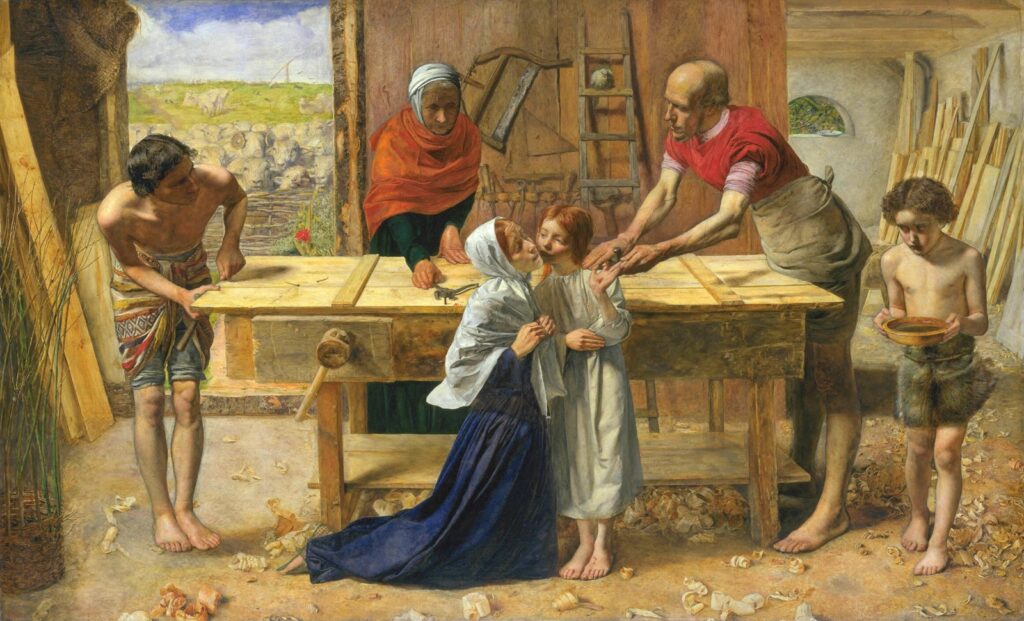
When John Everett Millais exhibited Christ in the House of His Parents in 1850, Victorian audiences were not presented with a vision of heavenly glory, but with a scene of mundane, physical labor. The painting depicts the Holy Family inside a cramped, active workshop. Wood shavings litter the floor, tools hang on the walls, and a half-finished door rests on a large carpentry table. At the center, a young Jesus holds up a bleeding hand, having cut himself on an exposed nail, while Mary kneels to comfort him and Joseph leans over to inspect the wound. By plunging the divine directly into the gritty reality of nineteenth-century labor, Millais produced an image that deeply unsettled his contemporaries.
A Christ Who Looks Like a Worker
The discomfort the painting caused was rooted in its uncompromising physicality. Millais deliberately refused the conventional separation between sacred history and ordinary labor. Joseph is presented as a muscular working man, with the physical presence of someone accustomed to manual labor. The figures do not wear the flowing, timeless drapery typical of high religious art, but rather garments that look worn and functional.
By rendering the scene through close observation of contemporary working life, Millais collapsed the distance between the biblical past and the material world of Victorian Britain. The workshop is a modest working-class environment, painted with an attention to detail that makes the physical realities of carpentry unusually palpable.
Why Millais Painted It This Way
This radical departure from convention was central to the mission of the Pre-Raphaelite Brotherhood. Founded in 1848, the Brotherhood opposed the established conventions of the Royal Academy. British academic painting generally favored idealized forms, elevated composition, and conventions derived from classical art. The Pre-Raphaelites, by contrast, demanded a return to what they regarded as the sincerity of early art, emphasizing intense color, meticulous detail, and an almost obsessive commitment to close observation.
To achieve this, Millais studied a working carpenter’s shop in Oxford Street, using contemporary labor as part of his visual research. Crucially, Millais was not attempting to produce a historically reconstructed first-century Jewish workspace. The setting utilizes Victorian tools, architecture, and working practices. Millais did not make first-century Nazareth historically accurate; he made it materially imaginable.
Why Victorians Objected
The reception to this reimagining was notoriously hostile, but the controversy was not merely aesthetic. Millais’s realism also raised uncomfortable questions about how sacred history should look when the Incarnation was taken seriously as physical and ordinary.
Critics were appalled. Charles Dickens was particularly hostile, describing the young Jesus as a “wry-necked, blubbering, red-headed boy” and objecting strongly to Millais’s portrayal of Mary. These objections highlight Victorian anxieties regarding class, propriety, and proper representation. The controversy wasn’t simply that Jesus shouldn’t look working-class; it was that sacred figures shouldn’t look physically unattractive or insufficiently dignified.
The painting appeared amid rapid industrialization and profound social change, when questions about class, labor, respectability, and religious representation were increasingly visible in Victorian culture. For viewers accustomed to more idealized representations of Jesus, encountering a Christ who belonged to the laboring classes felt uncomfortably vulgar.
Realism Without Abandoning Symbolism
Yet, to view the painting merely as a naturalistic treatment of a holy subject is to miss the tension at the heart of the painting. Millais’s work looks radically realistic, but it is not simply naturalistic. The canvas is densely packed with Christian symbolism.
The central action—Christ cutting his hand on a nail, with a drop of blood falling onto his foot—has traditionally been read as a typological foreshadowing of the Crucifixion. Joseph’s tools, particularly the pincers he uses to examine the nail, can be read as prefiguring the instruments of the Passion. A young John the Baptist approaches cautiously carrying a bowl of water, symbolizing his future role in Christ’s baptism. The sheep outside have likewise been interpreted symbolically, potentially evoking Christ’s future followers. Millais utilized realism not to discard reverence, but to embed theological truth within the physical world.
What Changed—and What Didn’t
Every age tends to emphasize particular aspects of Jesus, making some images of Christ more persuasive or meaningful than others. Much Renaissance religious art used idealized bodies, classical proportion, and controlled beauty to communicate sacred dignity. By the mid-nineteenth century, that visual language had begun to feel artificial to artists like Millais.
Millais did not invent the belief in Christ’s humanity; Christian theology had emphasized the Incarnation for centuries. However, his approach belongs to a nineteenth-century tendency to make Christ’s humanity more physically and socially imaginable. He changed how that humanity could be visually represented, placing the textures of human labor at the center of his representation.
Millais’s achievement was not to make Christ less sacred, but to make his humanity impossible to ignore. The divine does not appear in a golden, timeless world detached from ordinary existence. It appears in a carpenter’s workshop, among tools, wood shavings, blood, labor, and human bodies. That was precisely what made the painting so unsettling—and why it remains such a revealing example of how Victorian artists could imagine what it meant for God to become human.
-
Beyond Abstinence: Defining the Architecture of Purity Culture
For many raised in late-20th-century evangelicalism, “abstinence” and “purity culture” are frequently treated as exact synonyms. However, while abstinence is a private historical ethical choice, purity culture is a modern, highly visible sociological construct. This article examines the architecture of the 1990s movement—from purity pledges to the courtship model—and explains why disentangling the ancient ethic from the modern subculture is the crucial first step in understanding its lasting psychological impact.
-
How Can Modern Churches Build Strong Communities Without Sacrificing Intellectual Honesty?
Can a church remain strong when its members question traditional interpretations of the Bible?Discover how shared values, meaningful relationships, and intellectual honesty can help modern Christian communities thrive without demanding agreement on every question.
-
A Voice from the Dust: How the Discovery of Ugarit Rewrote Biblical Scholarship
The accidental discovery of the ancient city of Ugarit in 1928 transformed biblical scholarship. Its texts provided crucial insights into Biblical Hebrew, uncovered the mythology of ancient Canaan, and revealed how Israelite religion developed within the wider cultural world of the ancient Near East.
-
Did Paul Believe Christians Go to Heaven? Paul’s Cosmos, Christology, and Hope of Resurrection
What did Paul think heaven was, who did he believe Jesus was, and what did he expect to happen after death? Explore Paul’s first-century Jewish apocalyptic worldview, his complex understanding of Jesus, and his expectation of bodily resurrection and the liberation of creation.
-
The Whistleblower in the Dirt: Unearthing the Socio-Economic Reality of the Talents
What’s the Parable of the Talents really about? Squadering your abilities or is there more? Let’s dig a little deeper.