
In the complex narratives of the Hebrew Bible, the nomadic desert tribes of the southern Levant occupy a pivotal, yet fiercely debated, role in the history of early Israelite religion. While the broader Midianite groups are frequently depicted as enemies, the Kenites are almost universally treated with reverence. This textual anomaly has fueled over a century of academic discussion, centering largely on the Midianite-Kenite hypothesis.
First proposed in the 19th century by scholars such as Cornelis Tiele and Karl Budde, this model suggests that Yahweh worship originated among these southern groups before being adopted by emerging Israelite populations. Today, while a southern geographical origin for Yahweh commands broad scholarly support, the precise roles of the Midianites, the Kenites, and the nature of early Yahwism remain subjects of vibrant academic debate.
Geography and Identity: Evaluating the Evidence
Understanding the relationship between the Midianites and the Kenites requires navigating texts that offer associations rather than precise ethnographies, alongside an archaeological record that allows for multiple interpretations.
The Midianite Trade Networks
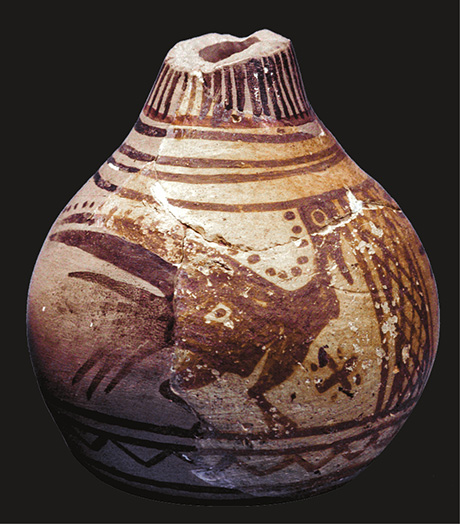
During the Late Bronze and Early Iron Ages (roughly 1300–1000 BCE), groups associated with Midian inhabited the region east of the Gulf of Aqaba in northwestern Arabia, with influence extending into the Sinai and the Negev. Archaeological discoveries, notably the widely distributed polychrome “Qurayya ware,” demonstrate that they participated in sophisticated, long-distance trade networks. While earlier scholarship sometimes characterized the Midianites as the definitive masters of camel domestication, current archaeology suggests camel use expanded gradually during this period, making it difficult to link the development specifically to one group.
The Kenites and the Etymology Debate
The exact relationship between the Kenites and the Midianites remains unclear. Biblical texts sometimes connect the two—such as associating Moses’ father-in-law with both Midian and the Kenites (Judges 1:16; 4:11). The evidence allows for several possibilities: the Kenites may have been a subgroup of the Midianites, a closely allied faction, or simply associated by biblical authors because they occupied similar southern territories.
Furthermore, the very definition of a “Kenite” is debated. It has long been proposed that the Hebrew name Qeni derives from a Semitic root for “smith” or “metalworker.” If true, this would characterize the Kenites as a specialized occupational guild. However, linguists and historians remain divided; many specialists today treat the “Kenite as smith” etymology as a possibility rather than an established fact.
The Biblical Anomaly: Israel’s Enduring Allies
The Hebrew Bible preserves a stark contrast in its treatment of these southern groups. In texts like Judges 6–8 and Numbers 25–31, Midianites are portrayed as dangerous seducers or hostile raiders. Conversely, the Kenites consistently appear as loyal, protected allies of Israel:
- The Jethro Tradition: Moses’ father-in-law (Jethro or Hobab) is portrayed positively, offering wise counsel and, crucially, participating in a sacrifice honoring Yahweh in Exodus 18.
- The Heroism of Jael: In Judges 4–5, Jael the Kenite is celebrated as a heroic figure who assassinates the Canaanite general Sisera.
- Royal Protection: King Saul explicitly spares the Kenites during a military campaign, citing their historic kindness to the Israelites (1 Samuel 15:6).
- The Rechabite Purists: The Rechabites, a conservative ascetic group traced genealogically to the Kenites (1 Chronicles 2:55), are praised by the prophet Jeremiah for their faithful adherence to an ancient, nomadic lifestyle.
This remarkably consistent positive portrayal strongly suggests that later biblical authors retained an ancient cultural memory of close, formative ties between the early Israelites and these desert groups.
The Southern Origins Consensus
While identifying the Kenites specifically as the original Yahwists is not a universal consensus, there is broad scholarly agreement regarding the geographic origins of Yahweh.
Many historians, including prominent scholars like Thomas Römer, point to the oldest strata of biblical texts—often referred to as archaic biblical poetry—which consistently associate Yahweh with regions far to the south of Judah. Texts such as Deuteronomy 33:2, Judges 5:4–5, and Habakkuk 3:3 place Yahweh’s appearance in areas like Seir, Edom, Paran, and Teman. Römer and others argue that these texts preserve an undeniable memory that Yahweh originated in the southern deserts before becoming the national deity of the central highland Israelites.
This is further supported by the Exodus 18 narrative, where Jethro, a non-Israelite priest, blesses Yahweh and leads a sacrificial meal. Many scholars view this as significant evidence that early traditions remembered a profound connection between Yahweh worship and southern groups outside Israel.
The Metallurgy Debate
The most controversial extension of the Midianite-Kenite hypothesis involves tying early Yahwism specifically to metallurgy.
Scholars like Nissim Amzallag have advanced the intriguing theory that Yahweh was originally a patron deity of copper smelting. This model draws on the potential “smith” etymology of the Kenites, the extensive copper production in the Arabah, Midianite presence at the Timna Valley mines, and the symbolic connections between Yahweh, fire, volcanism, and the biblical bronze serpent (Nehushtan).
However, this reconstruction faces substantial scholarly pushback. The theory that Yahweh was originally a smelting deity has generated significant discussion but has not achieved broad consensus. While excavations led by Beno Rothenberg at Timna revealed a desert tent-shrine containing a copper snake, demonstrating the presence of snake imagery in a southern cultic setting, identifying that specific cult directly with Yahwism remains an inference. For many specialists, the metallurgy model represents an interesting possibility rather than a demonstrated historical reconstruction.
Conclusion
The favorable treatment of the Kenites in the biblical text may preserve an ancient memory of close ties between early Israelites and southern desert groups associated with Yahweh worship. Many scholars argue that Yahweh originated in regions such as Midian, Edom, Seir, or Paran before becoming Israel’s national deity. While the precise role of the Kenites remains debated, their consistently positive portrayal, their association with Moses’ family, and the southern geographic traditions surrounding Yahweh suggest that they occupied a significant place in the religious memory of ancient Israel.
-
Beyond Abstinence: Defining the Architecture of Purity Culture
For many raised in late-20th-century evangelicalism, “abstinence” and “purity culture” are frequently treated as exact synonyms. However, while abstinence is a private historical ethical choice, purity culture is a modern, highly visible sociological construct. This article examines the architecture of the 1990s movement—from purity pledges to the courtship model—and explains why disentangling the ancient ethic from the modern subculture is the crucial first step in understanding its lasting psychological impact.
-
How Can Modern Churches Build Strong Communities Without Sacrificing Intellectual Honesty?
Can a church remain strong when its members question traditional interpretations of the Bible?Discover how shared values, meaningful relationships, and intellectual honesty can help modern Christian communities thrive without demanding agreement on every question.
-
A Voice from the Dust: How the Discovery of Ugarit Rewrote Biblical Scholarship
The accidental discovery of the ancient city of Ugarit in 1928 transformed biblical scholarship. Its texts provided crucial insights into Biblical Hebrew, uncovered the mythology of ancient Canaan, and revealed how Israelite religion developed within the wider cultural world of the ancient Near East.
-
Did Paul Believe Christians Go to Heaven? Paul’s Cosmos, Christology, and Hope of Resurrection
What did Paul think heaven was, who did he believe Jesus was, and what did he expect to happen after death? Explore Paul’s first-century Jewish apocalyptic worldview, his complex understanding of Jesus, and his expectation of bodily resurrection and the liberation of creation.
-
The Whistleblower in the Dirt: Unearthing the Socio-Economic Reality of the Talents
What’s the Parable of the Talents really about? Squadering your abilities or is there more? Let’s dig a little deeper.