
To understand the figure of Leviathan, scholars look beyond the pages of the Hebrew Bible and into the broader mythology of the ancient Near East. Just as we have seen before that the Flood myth was composed from two separate sources, the biblical presentation of Leviathan is not a single, static narrative. Instead, it is the most famous biblical expression of the Chaoskampf (German for “chaos struggle”)—a widespread mythological motif in which a heroic storm god battles a monstrous sea serpent to establish cosmic order.
Ancient Israelite authors inherited this symbolic vocabulary and applied it to Yahweh. Over the centuries, Leviathan evolved from a Canaanite mythological entity into an Israelite poetic metaphor for creation, a domesticated plaything, an eschatological enemy, and finally, a symbol of oppressive earthly empires.
1. Canaanite Origins and Fragmentary Allusions
The direct literary ancestor of Leviathan is Lôtān, a primeval sea monster preserved in texts from Late Bronze Age Ugarit (c. 1300–1200 BCE). In this ancient Canaanite epic, Lôtān appears as an ally or agent of Yamm (the sea god) and is described precisely as a “fleeing serpent,” a “twisting serpent,” and a “mighty one with seven heads.” The storm god, Baal Hadad, must defeat Yamm and Lôtān to establish his supreme kingship over the pantheon.
The Hebrew name Livyatan is closely related linguistically to the Ugaritic name Lôtān and is generally understood as its Israelite counterpart. However, unlike the Baal Cycle, the Hebrew Bible never presents a full narrative of Yahweh’s battle with Leviathan. Instead, it preserves fragmentary poetic allusions that assume the ancient audience already knew the mythic imagery. Ancient Israel did not possess a single, rigid systematic mythology; rather, Israelite poets drew on a fluid family of chaos-monster imagery. Alongside Leviathan, biblical texts frequently invoke the Sea (Yam), the sea dragons (tanninim), and Rahab (a related chaos monster).
2. Primordial Chaoskampf: Subduing the Waters
When the early Israelites adopted this mythological language, they applied it to Yahweh’s acts of creation and historical salvation. In the oldest poetic layers of the Hebrew Bible, Yahweh assumes the role of the ultimate storm god who defeated the chaos waters.
Psalm 74:13–14 praises God, saying, “You divided the sea by your might; you broke the heads of the sea monsters in the waters. You crushed the heads of Leviathan.” Here, Leviathan and the dragons are poetic personifications of the chaotic, unformed oceans that Yahweh subdued to create a habitable, ordered earth.
Biblical authors freely reused this imagery to describe historical events. Isaiah 51:9–10 brilliantly blends the creation myth, the Chaoskampf tradition, and the Exodus narrative: “Was it not you who cut Rahab in pieces, who pierced the dragon? Was it not you who dried up the sea, the waters of the great deep…?”
3. Demythologization: The Domestication of the Monster
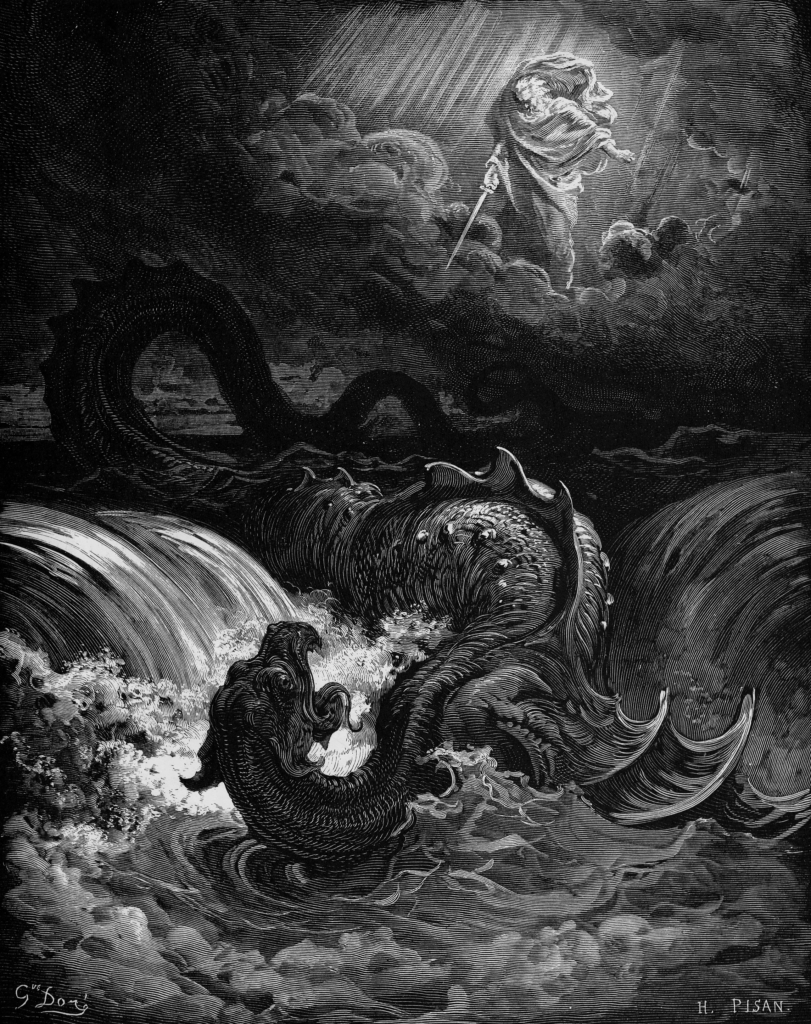
As Israelite theology developed a stronger emphasis on Yahweh’s absolute sovereignty, the idea of Leviathan as a genuine cosmic rival began to fade. The monster was demythologized into a magnificent, but ultimately subordinate, creature.
This shift culminates in two key texts:
- Job 41: Rather than an evil cosmic rival, Leviathan is presented as the ultimate apex predator. God uses Leviathan to demonstrate His own majesty: If you cannot even put a hook in the jaw of this beast, how can you question the Creator who fashioned it?
- Psalm 104: This psalm represents the most radical reinterpretation of the old myth. The terrifying chaos dragon has been transformed from a cosmic enemy into a creature that exists entirely within God’s creation and under God’s control. Psalm 104:26 declares that God formed Leviathan simply “to play with.”
4. The Eschatological Turn: Isaiah 27:1
The transition of Leviathan from a defeated primordial foe to a future enemy does not begin in the Second Temple period; it is already present in the Hebrew Bible. The single most important transitional text is Isaiah 27:1:
“On that day YHWH with his hard and great and strong sword will punish Leviathan the fleeing serpent, Leviathan the twisting serpent, and he will slay the dragon that is in the sea.”
This verse is a remarkable literary artifact. It preserves the ancient Ugaritic epithets (“fleeing serpent,” “twisting serpent”) almost verbatim, yet it radically transforms the Chaoskampf. The battle against chaos is no longer just a story about the past; it is an eschatological prophecy. The ultimate defeat of Leviathan is projected into the future, anticipating a day when Yahweh will finally and permanently destroy all cosmic and earthly chaos.
5. Apocalyptic Literature and Imperial Symbolism
During the Second Temple period, Jewish apocalyptic literature expanded on Isaiah’s eschatological vision. Texts like 1 Enoch and later Talmudic traditions taught that at the end of days, God would slay Leviathan (the sea monster) and Behemoth (the land monster), and their flesh would be served as a feast for the righteous at the messianic banquet.
By the time John of Patmos wrote the Book of Revelation in the late 1st century CE, the imagery had evolved again. John’s visions draw heavily on a synthesis of Daniel 7, Greco-Roman dragon imagery, and Jewish apocalyptic symbolism.
In Revelation 12, a “great red dragon, with seven heads and ten horns” appears—a clear callback to the broader Leviathan/Lôtān tradition. In chapter 13, a “beast rising out of the sea” emerges, representing the oppressive Roman Empire. John weaponizes the ancient sea-monster motif to make a theological point: the oppressive, chaotic empires of the first century are earthly manifestations of ancient cosmic chaos, and they, too, will be crushed by divine victory.
Conclusion: Cultural Continuity and Reinterpretation
Leviathan’s evolution illustrates not merely reinterpretation, but demythologization without complete elimination. Ancient Israel did not simply reject older Canaanite mythology. Instead, biblical authors repeatedly reused and redefined inherited mythic symbols: first as creation imagery, then as poetic metaphor, then as eschatological expectation, and finally as political symbolism. It stands as one of the clearest examples of cultural continuity between ancient Near Eastern religion and later Judeo-Christian literature.
-
Beyond Abstinence: Defining the Architecture of Purity Culture
For many raised in late-20th-century evangelicalism, “abstinence” and “purity culture” are frequently treated as exact synonyms. However, while abstinence is a private historical ethical choice, purity culture is a modern, highly visible sociological construct. This article examines the architecture of the 1990s movement—from purity pledges to the courtship model—and explains why disentangling the ancient ethic from the modern subculture is the crucial first step in understanding its lasting psychological impact.
-
How Can Modern Churches Build Strong Communities Without Sacrificing Intellectual Honesty?
Can a church remain strong when its members question traditional interpretations of the Bible?Discover how shared values, meaningful relationships, and intellectual honesty can help modern Christian communities thrive without demanding agreement on every question.
-
A Voice from the Dust: How the Discovery of Ugarit Rewrote Biblical Scholarship
The accidental discovery of the ancient city of Ugarit in 1928 transformed biblical scholarship. Its texts provided crucial insights into Biblical Hebrew, uncovered the mythology of ancient Canaan, and revealed how Israelite religion developed within the wider cultural world of the ancient Near East.
-
Did Paul Believe Christians Go to Heaven? Paul’s Cosmos, Christology, and Hope of Resurrection
What did Paul think heaven was, who did he believe Jesus was, and what did he expect to happen after death? Explore Paul’s first-century Jewish apocalyptic worldview, his complex understanding of Jesus, and his expectation of bodily resurrection and the liberation of creation.
-
The Whistleblower in the Dirt: Unearthing the Socio-Economic Reality of the Talents
What’s the Parable of the Talents really about? Squadering your abilities or is there more? Let’s dig a little deeper.