
When modern readers encounter the word “Gospel,” the term has often undergone a thorough theological domestication. Today, it is almost universally understood as a purely religious concept—referring to a book in the New Testament or a message about individual spiritual salvation. However, biblical historians argue that this modern reading strips the text of its original, radical context.
In the first-century Greco-Roman world, the word had absolutely no religious or Jewish connotations. Its original socio-economic and political impact was profound: it was a heavily loaded piece of Roman imperial propaganda.
The Greek word for “gospel” or “good news” is euangelion. A fascinating linguistic detail emerges when we compare how the Roman Empire used this word with how the anonymous author of the Gospel of Mark utilized it. The Romans generally proclaimed euangelia (the plural form), while Mark famously opens his text by declaring the euangelion (the singular form).
Understanding this subtle grammatical shift, and the scholars who brought it to light, is essential for recovering one of the most subversive statements in ancient literature.
The Roman Plural: The Imperial “Good Tidings”
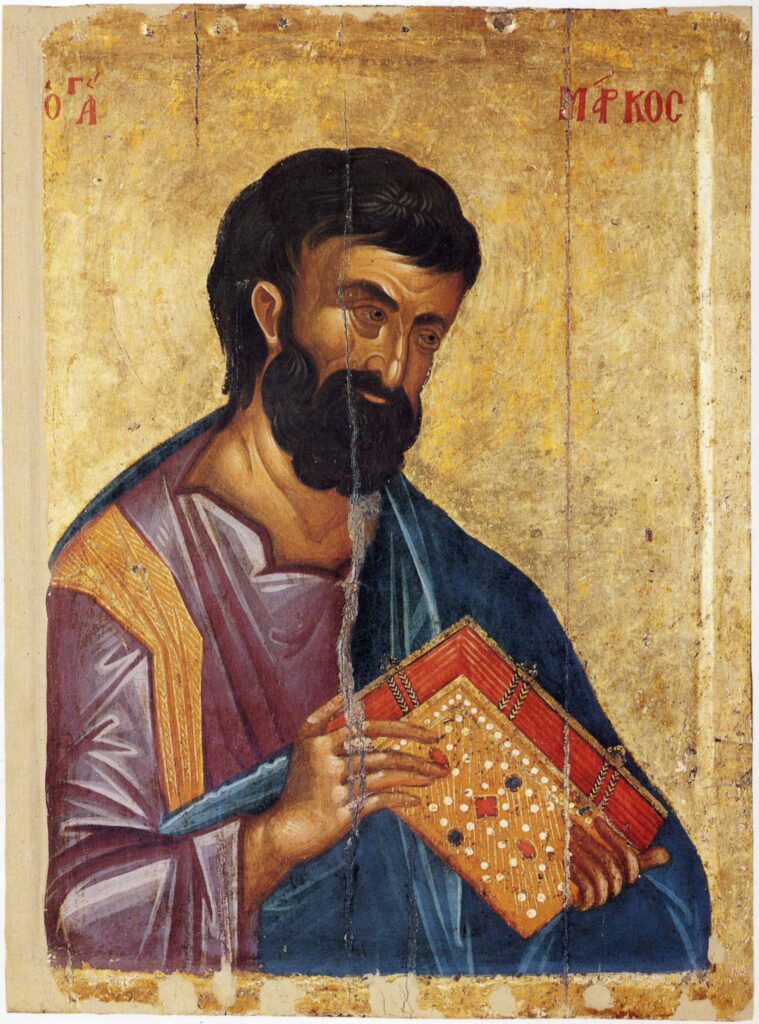
To grasp the weight of Mark‘s linguistic choice, we must look at the socio-political hierarchy of the Roman Empire.
Following decades of brutal civil war, Caesar Augustus emerged victorious and established a new world order. To solidify his absolute power, a massive propaganda campaign was launched across the Mediterranean, known as the Imperial Cult. Augustus was declared the “Savior” of the world who had ushered in the Pax Romana (the Peace of Rome). Because his adoptive father, Julius Caesar, had been deified, Augustus officially took the title Divi Filius—the “Son of God.”
As New Testament scholar Craig A. Evans has extensively documented, whenever the emperor achieved something significant that maintained this socio-economic order, imperial heralds would announce the euangelia—the “good tidings.” These announcements were typically plural because the empire generated many pieces of good news to justify its dominance: a military conquest, the suppression of a rebellion, or the ascension of a new heir.
Evans points to the most famous historical evidence of this: the Priene Inscription (dated to 9 BCE). Found in modern-day Turkey, this stone monument adjusts the local calendar to begin on the birthday of Caesar Augustus, explicitly reading:
“Since the Providence… has brought our life to the climax of perfection in giving to us Augustus… who being sent to us and our descendants as Savior… and since the birthday of the god has been for the whole world the beginning of the good tidings [euangelia] concerning him…”
For a first-century citizen, euangelia meant the plural announcements of Caesar’s power and the inescapable reality of Roman supremacy.
Mark’s Singular: Subverting the Empire
Decades later, likely shortly after the devastating destruction of Jerusalem by Roman forces in 70 CE, the author of Mark’s Gospel sat down to write the story of Jesus of Nazareth. Mark opens his narrative not with a safe, spiritual platitude, but with a highly charged political sentence:
“The beginning of the good news [euangelion] of Jesus Christ, the Son of God.” (Mark 1:1)
Scholars like John Dominic Crossan (in works such as God and Empire) highlight the radical rhetorical moves Mark makes in this single line. Mark co-opts the exclusive Roman title Divi Filius (“Son of God”) and applies it to a Jewish peasant executed by the Roman state. Furthermore, Mark takes the word euangelion (the imperial victory announcement) and applies it to the life and death of a crucified rabbi, completely upending the Roman definition of victory and power.
Crucially, Crossan notes that Mark deliberately shifts from the Roman euangelia (many glad tidings) to the singular euangelion (the one, definitive Good News).
Peeling Back the Theological Domestication
Why did Mark insist on the singular? Scholars such as Richard A. Horsley (Hearing the Whole Story) and Warren Carter (Matthew and Empire) emphasize that the Gospels must be read as socio-economic critiques from the margins of the empire.
Caesar provided many “glad tidings” (euangelia) because Roman peace was inherently fragile. It required constant military conquests, heavy taxation of the lower classes, and the continuous subjugation of foreign peoples to sustain its economy. The Roman “good news” was always temporary; the empire always needed another victory to maintain control.
By using the singular euangelion, Mark makes a profound claim that strikes at the heart of the imperial system. The true Son of God does not bring a series of temporary, violent political victories. Instead, Jesus brings the definitive Good News.
When analyzing this text, historical-critical scholars are careful to point out that this anti-imperial rhetoric should not be read as a calculated conspiracy technique, as if early Christians consciously sat down to manipulate theology purely to seize political power. Rather, these are natural, evolutionary ideas. For a traumatized, marginalized community living under the crushing weight of Rome, the theological concepts that best held the group together and provided a sense of ultimate meaning were the ones that survived, resonated, and were eventually canonized.
Over the centuries, texts like Mark’s Gospel have been heavily domesticated into abstract, spiritual lessons. But by reading Mark 1:1 alongside the work of historians and linguists, the text reclaims its edge. Mark was declaring to his first-century readers that true peace, salvation, and authority do not originate from the throne in Rome, but from the margins of the empire.
-
Beyond Abstinence: Defining the Architecture of Purity Culture
For many raised in late-20th-century evangelicalism, “abstinence” and “purity culture” are frequently treated as exact synonyms. However, while abstinence is a private historical ethical choice, purity culture is a modern, highly visible sociological construct. This article examines the architecture of the 1990s movement—from purity pledges to the courtship model—and explains why disentangling the ancient ethic from the modern subculture is the crucial first step in understanding its lasting psychological impact.
-
How Can Modern Churches Build Strong Communities Without Sacrificing Intellectual Honesty?
Can a church remain strong when its members question traditional interpretations of the Bible?Discover how shared values, meaningful relationships, and intellectual honesty can help modern Christian communities thrive without demanding agreement on every question.
-
A Voice from the Dust: How the Discovery of Ugarit Rewrote Biblical Scholarship
The accidental discovery of the ancient city of Ugarit in 1928 transformed biblical scholarship. Its texts provided crucial insights into Biblical Hebrew, uncovered the mythology of ancient Canaan, and revealed how Israelite religion developed within the wider cultural world of the ancient Near East.
-
Did Paul Believe Christians Go to Heaven? Paul’s Cosmos, Christology, and Hope of Resurrection
What did Paul think heaven was, who did he believe Jesus was, and what did he expect to happen after death? Explore Paul’s first-century Jewish apocalyptic worldview, his complex understanding of Jesus, and his expectation of bodily resurrection and the liberation of creation.
-
The Whistleblower in the Dirt: Unearthing the Socio-Economic Reality of the Talents
What’s the Parable of the Talents really about? Squadering your abilities or is there more? Let’s dig a little deeper.