
When modern readers debate whether the Bible permits or forbids tattoos, they are often asking an ancient text to comment on a strictly modern aesthetic practice. Today, tattoos are primarily matters of personal expression, artistic appreciation, or individual identity. In the ancient Near East, however, permanently marking the skin carried profound cultic, religious, and social weight.
To answer whether tattoos existed in the Levant millennia ago—and what the biblical authors actually had to say about them—we must step away from modern debates and turn to a historical-critical textual analysis, grounded in the archaeological realities of the ancient Mediterranean world.
The Archaeological Reality of Ancient Tattoos
Tattoos absolutely existed in the ancient Mediterranean and the Near East long before the biblical texts were finalized. The practice was widespread and culturally significant.
In ancient Egypt, archaeology has uncovered numerous mummies from the Middle Kingdom (c. 2000 BCE) and the New Kingdom (c. 1550–1070 BCE) bearing distinct, intricate tattoos. These markings were overwhelmingly found on women, often priestesses of the goddess Hathor. They featured geometric patterns or images of protective deities, such as the god Bes, tattooed on abdomens and thighs to offer magical protection during childbirth.
While the humid climate of the Levant does not preserve mummified flesh as effectively as the Egyptian sands, textual and iconographic evidence from surrounding cultures—such as the Canaanites, Syrians, and later nomadic Bedouin groups—strongly suggests that scarification and tattooing were common practices. In this agrarian and tribal world, marking the flesh was not a fashion statement. Tattoos served as tribal identifiers, permanent marks of slave ownership, or cultic dedications to specific local deities.
The Prohibition in Leviticus
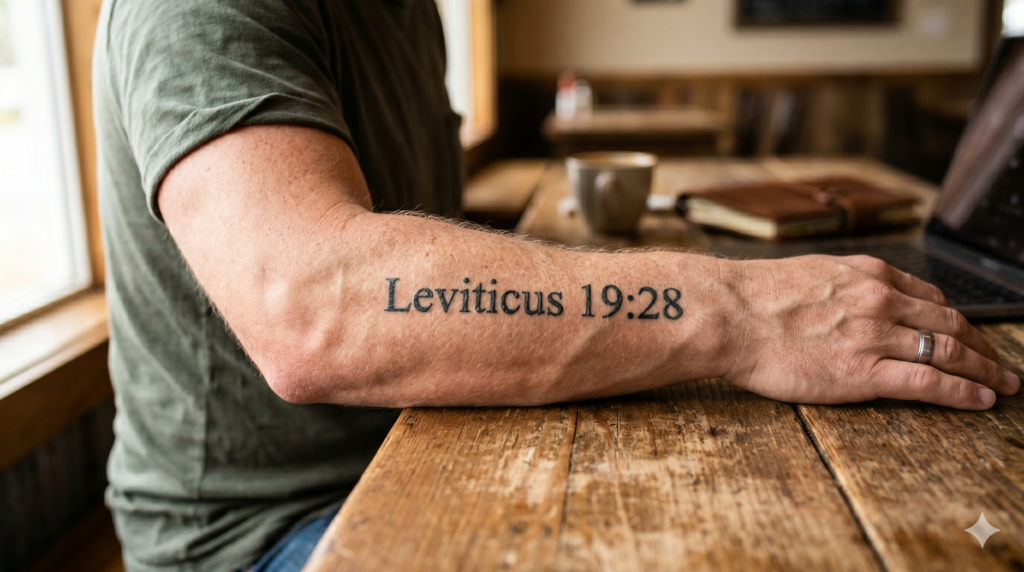
The primary text that addresses tattooing in the Hebrew Bible is found in the Holiness Code of Leviticus. The passage famously commands: “Do not cut your bodies for the dead or put tattoo marks on yourselves. I am the Lord” (Leviticus 19:28).
To understand this verse, historical-critical scholars look closely at the original Hebrew vocabulary and the immediate literary context. The phrase translated as “tattoo marks” hinges on the Hebrew word קַעֲקַע (qa’aqa), a highly obscure term that appears only this one time in the entire Hebrew Bible. Etymologically, it likely refers to a deep incision, a gouge, or a physical imprint. Paired with the word for “writing” (kethobeth), it describes a permanent, written mark on the skin.
Crucially, the context of the verse is defined by its qualifying phrase: “for the dead.” In ancient Canaanite religion, extreme mourning rituals often involved self-mutilation, slashing the skin, and marking the body to appease underworld deities or to honor deceased ancestors. The Levitical law, therefore, is not a generalized critique of body art. It is a strict, targeted prohibition against participating in the pagan mourning cults of the surrounding Canaanite culture.
Boundary Maintenance and the Body
Why was the biblical author so fiercely concerned with what an Israelite did with their skin? From an anthropological perspective, the Holiness Code in Leviticus is fundamentally concerned with the concept of boundary maintenance.
In the priestly worldview of ancient Israel, the physical body acted as a microcosm of the broader nation. Just as the nation of Israel was expected to remain wholly separate and distinct from the Canaanite populations, the physical body had to remain bounded, pure, and unmixed. This underlying theology explains why the exact same chapter in Leviticus forbids planting two different kinds of seed in a single field, weaving two different materials into one garment, or cutting the hair at the sides of the head—another known pagan cultic practice.
The ban on tattoos was a practical mechanism for maintaining a strict, visible ethnic and theological boundary. It ensured that the Israelites physically separated themselves from the polytheistic practices of their neighbors.
The Prophetic Subversion in Isaiah
Interestingly, while the Book of Leviticus strictly forbids marking the flesh, later prophetic literature utilizes the imagery of skin-marking in a highly positive, metaphorical light.
In the Book of Isaiah, written during the trauma of the Babylonian Exile in the 6th century BCE, the prophet envisions a future where outsiders eagerly align themselves with the God of Israel. The text declares: “Some will say, ‘I belong to the Lord’; others will call themselves by the name of Jacob; still others will write on their hand, ‘The Lord’s,’ and will take the name of Israel” (Isaiah 44:5).
The phrase “write on their hand” clearly suggests a permanent mark of ownership and loyalty. Because slaves and cultic devotees in the ancient world were often branded or tattooed with the name of their master or their god, the author of Second Isaiah boldly takes a well-known cultural practice and subverts it. Rather than viewing the mark as a pagan abomination, writing Yahweh’s name on the flesh becomes a powerful, poetic symbol of ultimate devotion and unbreakable covenant loyalty.
The Historical Verdict
When analyzing the Bible’s stance on tattoos, avoiding anachronism is essential. The ancient Israelites did not possess the concept of decorative tattoos as personal art. When the biblical text addresses marking the skin, it is addressing a world where a permanent mark was a definitive theological declaration. Leviticus outlawed the practice because it was intimately tied to Canaanite rituals for the dead and threatened the distinct boundaries of the Israelite community. Yet, as Israelite theology evolved, the prophets successfully reclaimed the imagery of the marked body to communicate a fierce, enduring loyalty to their God.
-
Beyond Abstinence: Defining the Architecture of Purity Culture
For many raised in late-20th-century evangelicalism, “abstinence” and “purity culture” are frequently treated as exact synonyms. However, while abstinence is a private historical ethical choice, purity culture is a modern, highly visible sociological construct. This article examines the architecture of the 1990s movement—from purity pledges to the courtship model—and explains why disentangling the ancient ethic from the modern subculture is the crucial first step in understanding its lasting psychological impact.
-
How Can Modern Churches Build Strong Communities Without Sacrificing Intellectual Honesty?
Can a church remain strong when its members question traditional interpretations of the Bible?Discover how shared values, meaningful relationships, and intellectual honesty can help modern Christian communities thrive without demanding agreement on every question.
-
A Voice from the Dust: How the Discovery of Ugarit Rewrote Biblical Scholarship
The accidental discovery of the ancient city of Ugarit in 1928 transformed biblical scholarship. Its texts provided crucial insights into Biblical Hebrew, uncovered the mythology of ancient Canaan, and revealed how Israelite religion developed within the wider cultural world of the ancient Near East.
-
Did Paul Believe Christians Go to Heaven? Paul’s Cosmos, Christology, and Hope of Resurrection
What did Paul think heaven was, who did he believe Jesus was, and what did he expect to happen after death? Explore Paul’s first-century Jewish apocalyptic worldview, his complex understanding of Jesus, and his expectation of bodily resurrection and the liberation of creation.
-
The Whistleblower in the Dirt: Unearthing the Socio-Economic Reality of the Talents
What’s the Parable of the Talents really about? Squadering your abilities or is there more? Let’s dig a little deeper.